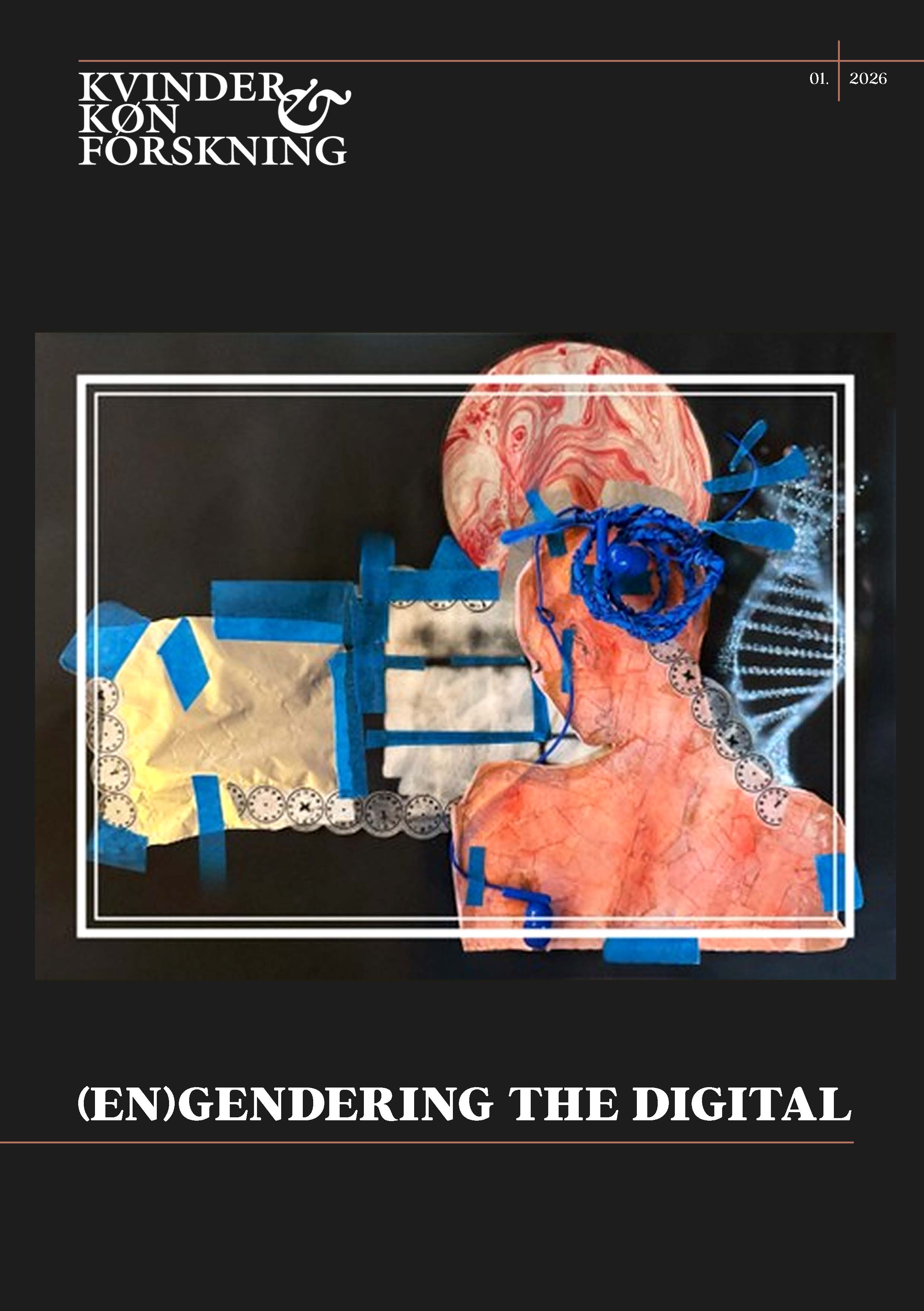
(En)Gendering the Digital
DOI:
https://doi.org/10.7146/kkf.v39i1.170543Referencer
Arnesson, J. (2023). Influencers as ideological intermediaries: Promotional politics and authenticity labour in influencer collaborations. Media, Culture and Society, 45(3), 528–544. https://doi.org/10.1177/01634437221117505
Askanius, T., Brock, M., Kaun, A., & Larsson, A. O. (2024). “Time to Abandon Swedish Women”: Discursive Connections Between Misogyny and White Supremacy in Sweden. International Journal of Communication; 18(19). https://ijoc.org/index.php/ijoc/article/view/16808/4840
Baker, C., Ging, D., & Andreasen, M. B. (2024). Recommending Toxicity: The role of algorithmic recommender functions on YouTube Shorts and TikTok in promoting male supremacist influencers. DCU Anti-Bullying Centre Dublin City University. https://antibullyingcentre.ie/wp-content/uploads/2024/04/DCU-Toxicity-Full-Report.pdf
Banet-Weiser, S. (2018). Empowered: Popular Feminism and Popular Misogyny. Duke University Press. https://doi.org/10.1215/9781478002772
Banet-Weiser, S., Gill, R., & Rottenberg, C. (2020). Postfeminism, popular feminism and neoliberal feminism? Sarah Banet-Weiser, Rosalind Gill and Catherine Rottenberg in conversation. Feminist theory, 21(1), 3-24.
Banet-Weiser, S., & Maddocks, S. (2023). Networked misogyny on TikTok. In K. Boyle and S. Berridge, The Routledge Companion to Gender, Media and Violence (1st edn 369–379). Routledge. https://doi.org/10.4324/9781003200871-41
Barker-Plummer, B., & Barker-Plummer, D. (2017). Hashtag feminism, digital media, and new dynamics of social change: A case study of #YesAllWomen. In G. W. Richardson (Ed.), Social media and politics: A new way to participate in the political process (79–96). Praeger.
Barry, I., & Stephenson, E. (2025). “The Gendered, Epistemic Injustices of Generative AI.” Australian Feminist Studies 40 (123), 1–21. https://doi.org/10.1080/08164649.2025.2480927.
Benjamin, R. (2023). Race after technology. In Social Theory Re-Wired (pp. 405-415). Routledge.
Bennett, W. L., & Segerberg, A. (2012). THE LOGIC OF CONNECTIVE ACTION: Digital media and the personalization of contentious politics. Information, Communication and Society, 15(5), 739–768. https://doi.org/10.1080/1369118X.2012.670661
Berg, S., König, T., & Koster, A. (2020). Political Opinion Formation as Epistemic Practice: The Hashtag Assemblage of #metwo. Media and Communication, 8(4), 84-95. https://doi.org/10.17645/mac.v8i4.3164
Beyer Gregersen, A., Meret, S., & Rolandsen Agustín, L. (2025). “So Common to Score Cheap Points on Being an Antifeminist”: The Rise of Antifeminist and Anti-Gender Mobilizations in Denmark and the Feminist Response. In R. Smrdelj and R. Kuhar (Eds), Anti-Gender Mobilizations in Europe and the Feminist Response (pp. 229–254). Springer Nature Switzerland. https://doi.org/10.1007/978-3-031-87693-6_9
Bishop, S., & Kant, T. (2023). Algorithmic autobiographies and fictions: A digital method. The Sociological Review, 71(5), 1012-1036.
Brudvig, I. (2025). Toward a Feminist Digital Ethnography: Navigating Ethics, Reflexivity and Representation at the Frontier of Online and Offline Spaces. In: Rangaswamy, N., Venkatraman, S. (eds) Qualitative Methods for Digital Social Research. Springer, Singapore. https://doi.org/10.1007/978-981-97-9843-8_4
Buolamwini, J. (2024). Unmasking AI: My mission to protect what is human in a world of machines. Random House.
Caldeira, Sofia P. (2024). "Exploring feminisms on Instagram: Reflections on the challenges and possibilities of incorporating digital methods strategies in feminist social media research." Journal of Digital Social Research 6 (1), 74-89.
Coffey, J., & Kanai, A. (2023). Feminist fire: embodiment and affect in managing conflict in digital feminist spaces. Feminist Media Studies, 23(2), 638–655. https://doi.org/10.1080/14680777.2021.1986095
Cybernauterne. (2025). Infodump 2: Manosfæren i Danmark. Cybernauterne. https://cybernauterne.dk/blog/infodump-2-manosfaeren-i-danmark/
D’Ignazio, C., & Klein, F. L. Data Feminism. Strong Ideas Series. The MIT Press, 2020. 196.
De Beistegui, M. (2018) The Government of Desire: A Genealogy of the Liberal Subject. University of Chicago Press.
Devinney, A., Harrison, K., Gautam, V., & Shklovski, I. (2025). Synthetic Data: Representation and/vs Representativeness. In Adjunct Proceedings of the Sixth Decennial Aarhus Conference: Computing X Crisis (AAR Adjunct '25). Association for Computing Machinery, New York, NY, USA, Article 20, 1–4. https://doi.org/10.1145/3737609.3747095
Engebretsen, E. L. (2022). Scientizing Gender? An Examination of Anti-Gender Campaigns on Social Media, Norway. In H. Eslen–Ziya and A. Giorgi (Eds), Populism and Science in Europe (pp. 185–206). Springer International Publishing. https://doi.org/10.1007/978-3-030-97535-7_9
Fangen, K. (2020). Gendered Images of us and Them in Anti-Islamic Facebook Groups. Politics, Religion and Ideology, 21(4), 451–468. https://doi.org/10.1080/21567689.2020.1851872
Farris, S. R. (2017). In the Name of Womens Rights: The Rise of Femonationalism (p.dup;9780822372929/1). Duke University Press. https://doi.org/10.1215/9780822372929
Fileborn, B. (2023). Digital mapping as feminist method: critical reflections. Qualitative Research, 23(2), 343-361.
Finlayson, A. (2023). This is Not a Critique: Reactionary Digital Politics in the Age of Ideological Entrepreneurship. Media Theory, 7(1), 27–48. https://doi.org/10.70064/mt.v7i1.899
Fisher, M. (2009). Capitalist Realism: Is There No Alternative? Zero Books. O Books.
Florêncio, J. (2024) Viral Masculinities: Virality, Gender, Pandemics. JBSM: Journal of Bodies, Sexualities, and Masculinities 5 (1): 1–11.
Francis, E. (2025). Language of the Swedish Manosphere with Swedish FrameNet. Proceedings of the Joint 25th Nordic Conference on Computational Linguistics and 11th Baltic Conference on Human Language Technologies (NoDaLiDa/Baltic-HLT 2025), 170–180.
Fraser, N. (1992) Rethinking the Public Sphere: A Contribution to the Critique of Actually Existing Democracy. In Craig Calhoun (ed.) Habermas and the Public Sphere. MIT Press.
Galloway, A. & Thacker, E. (2007) The Exploit: A Theory of Networks. University of Minnesota Press.
Geerts, E. (2025). Alt-right Memes and Microspectropolitics: Posthumanising and Queering Schild & Vrienden's Memetic Activism. In Routledge International Handbook of Queer Death Studies (pp. 214-225). Routledge.
Gerrand, V., Ging, D., Roose, J. M., & Flood, M. (2025). Mapping the Neo-Manosphere(s): New Directions for Research. Men and Masculinities, 28(5), 443–464. https://doi.org/10.1177/1097184X251350277
Gregory, K., Clough, P., Scannell, J., & Haber, B. (2015). The datalogical turn. In Non-representational methodologies: Re-envisioning research (pp. 146-164). Routledge.
Habermas, J. (1991) The Structural Transformation of the Public Sphere: An Inquiry into a Category of Bourgeois Society. The MIT Press.
Hall, S. & Jefferson, T. (1975) Resistance Through Rituals: Youth Subcultures in Post-War Britain. Hutchinson.
Hanisch, C. (1970) The Personal is Political. In Firestone, S. and Joeft, A. (eds.) Notes from the Second Year: Women’s Liberation: Major Writings of the Radical Feminists. Radical Feminism.
Hansen, M. B. (2021). Between Two Ills: Homonationalism, Gender Ideology and the Case of Denmark. Redescriptions: Political Thought, Conceptual History and Feminist Theory, 24(1), 60–75. https://doi.org/10.33134/rds.339
Hansson, K., Sveningsson, M., & Ganetz, H. (2024). #MeToo in the Manosphere: The Formation of a Counter Discourse on the Swedish Online Forum Flashback. NORA - Nordic Journal of Feminist and Gender Research, 32(2), 173–187. https://doi.org/10.1080/08038740.2024.2330381
Hansson, K., Bardzell, S., Bhandari, A., Boulicault, M., Thomas Doyle, D., Erete, S., Cerratto Pargman, T., Lazem, S., Muller, M., Normark, M., Petterson, A., Poikolainen Rosén, A., Taylor, A. S., Thomas, J. O., & Watson, J. (2023). A Toolbox of Feminist Wonder: Theories and methods that can make a difference. In Companion Publication of the 2023 Conference on Computer Supported Cooperative Work and Social Computing (CSCW '23 Companion). Association for Computing Machinery, New York, NY, USA, 476–480. https://doi.org/10.1145/3584931.3611295
Haraway, D. J. (2001). “‘Gender’ for a Marxist Dictionary: The Sexual Politics of a Word.” In Women, Gender, Religion: A Reader, edited by Elizabeth A. Castelli. Palgrave Macmillan US, . 1108. https://doi.org/10.1007/978-1-137-04830-1_6.
Harrison, K., & Johnson, E. (2023). Affective Corners as a Problematic for Design Interactions. J. Hum.-Robot Interact. 12, 4, Article 41 (December 2023), 9 pages. https://doi.org/10.1145/3596452
Hebdige, D. (1979) Subculture: The Meaning of Style. Methuen and Co.
Hester, H. (2018) Xenofeminism. Polity.
Hilderbrand, L. (2013) A Suitcase Full of Vaseline, or Travels in the 1970s Gay World. Journal of the History of Sexuality 22 (3): 373–402.
Irigaray, L. (1985). This sex which is not one. Cornell university press.
Johnson, D. (2019) Buying Gay: How Physique Entrepreneurs Sparked a Movement. Columbia University Press.
Johnson, E.. (2023). Robotics Research and Teaching with a Feminist Lens. In Proceedings of the 2023 ACM/IEEE International Conference on Human-Robot Interaction (HRI '23). Association for Computing Machinery, New York, NY, USA, 2. https://doi.org/10.1145/3568162.3576953
Kaiser, J. & Rauschfleisch, A. (2019) Integrating Concepts of Counterpublics into Generalised Public Sphere Frameworks: Contemporary Transformation in Radical Forms. Journal of the European Institute for Communication and Culture 26 (3): 241–257.
Kavada, A. & Poell, T. (2021) From Counterpublics to Contentious Publicness: Tracing the Temporal, Spatial, and Material Articulations of Popular Protest Through Social Media. Communication Theory 31 (2): 190–208.
Kember, S. & Zylinska, J. (2012) Life After New Media: Mediation as a Vital Process. MIT Press.
Knoke, D., & Yang, S. (2019). Social network analysis. SAGE publications.
Klein, L., & D’Ignazio, D. (2024). “Data Feminism for AI.” Proceedings of the ACM Conference on Fairness, Accountability, and Transparency (New York, NY, USA), FAccT ’24, June 5, 2024, 100–112. https://doi.org/10.1145/3630106.3658543.
Laboria C. (2018) The Xenofeminist Manifesto: A Politics for Alienation. Verso.
Langeland, F., Prøitz, L., Steinnes, K. K., & Mainsah, H. (2022). I de sosiale ytterkantene. Konstruksjoner av kjønn og maskuliniteter hos norske menn i ufrivillig sølibat. Tidsskrift for kjønnsforskning, 46(3–4), 208–221. https://doi.org/10.18261/tfk.46.3.8
Lee, F. (2025). The practices and politics of machine learning: a field guide for analyzing artificial intelligence. AI and Society 40, 6135–6148 . https://doi.org/10.1007/s00146-025-02430-7
Lee, F., & Johnson, E. (2025). "The Qualities of Quantities: Making Situated Chains of Representation." Position Statement for the Workshop on Synthetic Data: Representation and/vs Representativeness at Aarhus University.
Lee, F. (2025). "The practices and politics of machine learning: a field guide for analyzing artificial intelligence." AI and SOCIETY, 1-14.
Lee, J. (2024) "“Who is sexually harassed? A python code haha”: imaginaries of a post-violent AI world." Feminist Media Studies, 1-16.
Lepore, J. (2020) If Then: How One Data Company Invented the Future. John Murray Press: G.B.
Leszczynski, A. (2020). Digital methods III: The digital mundane. Progress in Human Geography, 44(6), 1194-1201.
Leurs, K. (2017). Feminist Data Studies: Using Digital Methods for Ethical, Reflexive and Situated Socio-Cultural Research. Feminist Review, 115(1), 130-154.
Lindgren, S., & Krutrök Eriksson, M. (2024). Researching digital media and society: Sage publication.
Lindqvist, L. (2026). Digitally Entangled Feminism: Hashtagging Resistance on Swedish Social Media (Doctoral dissertation, Karlstads universitet).
Lindqvist, L. (2023). Hashtag re-appropriation, voices of reason, and strategic silences:‘soft’feminist resistance practices on Swedish social media. Janus Unbound: Journal of Critical Studies, 3(1).
Lindqvist, L., & Ganetz, H. (2020). Brave women sound the alarm–representations of men and women in the Swedish media coverage of# MeToo. Journalistica, 14(1), 14-46.
Little, B. & Winch, A. (2021). The New Patriarchs of Digital Capitalism: Celebrity Tech Founders and Networks of Power. Routledge
Loewen Walker, R. (2024). Call it misogyny. Feminist Theory, 25(1), 64–82. https://doi.org/10.1177/14647001221119995
Lounela, E. (2026). What makes an incel? An interview study of current and former incels. Critical Studies on Terrorism, 19(1), 35–56. https://doi.org/10.1080/17539153.2025.2590848
MacDonald, S. (2025). The Art of Memes in Feminist Digital Culture. Ohio State University Press. https://doi.org/10.2307/jj.32726752.
Manne, K. (2016). The Logic of Misogyny. Boston Review. https://www.bostonreview.net/forum/kate-manne-logic-misogyny/
Manne, K. (2017). Down girl: The logic of misogyny. Oxford University Press.
Marčetić, H. (2024) Sociotechnical Imaginaries of Data Feminism: How Scholars with Feminist Approaches Interpret the Datafied Present and Envision Futurities. PhD diss., Högskolan i Borås.
Martinsson, L., & Ericson, M. (2023). ‘Fight pandemics with protective masks or gender?’ Emerging collective identities and anti-gender movements on Twitter during the COVID-19 crisis in Sweden. Feminist Media Studies, 23(5), 2011–2027. https://doi.org/10.1080/14680777.2021.2009898
Meeker, M. (2006). Contacts Desired: Gay and Lesbian Communications and Community, 1940s–1970s. University of Chicago Press.
Mehan, A. (2024). Digital Feminist Placemaking: The Case of the “Woman, Life, Freedom” Movement. Urban Planning, 9, Article 7093. https://doi.org/10.17645/up.7093
Michailidou, M. (2018). Feminist methodologies for the study of digital worlds. International Journal of Media and Cultural Politics 14(1): 19-33.
Mogensen, C., & Helding Rand, S. (2019). Vrede unge mænd: Viden om extreme onlinefællesskaber [Angry young men: Knowledge of extreme online communities]. Center for Digital Youth Care.
Mogensen, C., & Rand, S. H. (2020). The angry Internet: A threat to gender equality, democracy and well-being (pp. 1–111). Centre for Digital Youth Care. https://cfdp.dk/wp-content/uploads/2020/11/CFDP_the_angry_internet_ISSUE.pdf
Molldrem, S. (2018) Tumblr’s Decision to Deplatform Sex Will Harm Sexually Marginalized People. Wussy, December 6. https://www.wussymag.com/all/tumblrs-decision-to-deplatform-sex-will-harm-sexually-marginalized-people.
Møller, K., & Robards, B. (2019). "Walking through, going along and scrolling back: Ephemeral mobilities in digital ethnography." Nordicom Review 40(1) : 95-110.
Moran, C., Renaud, E., Annabell, T., Yang, F., & Robards, B. (2003). Looking back on the scroll back: Reflections on the social media scroll back method. In Research handbook on social media and society, pp. 255-269. Edward Elgar Publishing, 2024.
Muggleton, D. & Weinzierl, R. (eds.) The Post-Subcultures Reader. Berg.
Naughton, J. (2016) Has the Internet Become a Failed State? Technology. The Guardian, November 27. https://www.theguardian.com/technology/2016/nov/27/has-internet-become-failed-state-crime-cyberspace.
Norocel, O. C., Saresma, T., Lähdesmäki, T., & Ruotsalainen, M. (2020). Discursive Constructions of White Nordic Masculinities in Right-wing Populist Media. Men and Masculinities, 23(3–4), 425–446. https://doi.org/10.1177/1097184X18780459
Paasonen, S., Attwodd, F., McKee, A., Mercer, J., & Smith, C. (2021) Objectification: On the Difference Between Sex and Sexism. Routledge.
Perriam, J., Cohn, M. L., Hockenhull, M., Reime, L., Landa, L., Kjær, K. M., & Friis, H. (2023). Workshopping Troubles: Towards Feminist Digital Methods. Australian Feminist Studies, 38(115–116), 123–143. https://doi.org/10.1080/08164649.2024.2321576
Pinzón-Arteaga, I. A. (2026). ‘It Will Comfort You’: Analyzing Undergraduates’ Interactions with AI Chatbots Through a Postdigital Feminist Lens. Postdigital Science and Education 8 (1): 140–160. https://doi.org/10.1007/s42438-025-00618-0.
Plant, S. (1997) Zeros and Ones: Digital Women and the New Technoculture. Vol. 4. London, 1117.
Plummer, K. (2003) Intimate Citizenship: Private Decisions and Public Dialogues. University of Washington Press.
Poornimadarshini, S. (2025). Cyberfeminism 4.0: The Role of Social Media and Digital Platforms in Shaping Contemporary Feminist Activism. Journal of Women, Innovation, and Technological Empowerment, 1(1), 25-30.
Prøitz, L., Langeland, F., Steinnes, K. K., & Mainsah, H. (2022). Hybride maskuliniteter og hatideologi på nett: En litteraturgjennomgang om incels i et feministisk medievitenskapelig perspektiv. Norsk medietidsskrift, 29(2), 1–155. https://doi.org/10.18261/nmt.29.2.3
Ring, A. (2023). Data that Matter: On Metaphors of Obfuscation, Thinking ‘the Digital’ as Material and Posthuman Cooperation with AI, Paragraph 46 (2).
Rotman, B. (1987). Signifying Nothing: The Semiotics of Zero. Language, Discourse, Society. Macmillan.
Russell, L. (2020) Glitch Feminism: A Manifesto. Verso.
Slater, J. B., Broekman, P. V. M., & Corris, M. (Eds.). (2009). Proud to be Flesh: A Mute Magazine Anthology of Cultural Politics after the Net. Mute Publishing Ltd.
Slaveykov, I., Storbækken, M., & Fisher, K. (2025). Tate and the Boys’ reflections about Andrew Tate, gender equality, and masculinity. Reform – resource center for men.
Stedtler S, Harrison K., & Fantasia V. (2026). Helping or watching it happen: how participants respond to robot failures in a turn-taking game. Front Robot AI. Feb 6;12:1664334. 10.3389/frobt.2025.1664334
Sundén, J., Paasonen, S., & Tiidenberg, K. (2026) Hot Connections: Why Sexual Platforms Matter. MIT Press.
Thiel, P., & Masters, B. (2014). Zero to one: Notes on startups, or how to build the future. Crown Currency.
Thornton, S. (1995). Club Cultures: Music, Media and Subcultural Capital. Polity.
Tiidenberg, K. (2021). Sex, Power and Platform Governance. Porn Studies 8 (4): 381–393.
Toupin, S. (2024). “Shaping Feminist Artificial Intelligence.” New Media and Society 26 (1), 580–95. https://doi.org/10.1177/14614448221150776.
Ulusoy, E. & Fırat, F. (2018). Toward a Theory of Subcultural Mosaic: Fragmentation into and within Subcultures. Journal of Consumer Culture 18 (1), 21–42.
Underberg-Goode, N.M. (2025). Digital Ethnography. In: Friese, H., Nolden, M., Schreiter, M. (eds) Handbuch Soziale Praktiken und Digitale Alltagswelten. Springer Reference Sozialwissenschaften. Springer VS, Wiesbaden. https://doi.org/10.1007/978-3-658-08460-8_49-2
Vachhani, Sheena J. (2024). Networked Feminism in a Digital Age—Mobilizing Vulnerability and Reconfiguring Feminist Politics in Digital Activism. Gender, Work & Organization 31(3), 1031–1048. https://doi.org/10.1111/gwao.13097.
Venäläinen, S. (2022). Nobody cares for men anymore: Affective-discursive practices around men’s victimisation across online and offline contexts. European Journal of Cultural Studies, 25(4), 1228–1245. https://doi.org/10.1177/13675494211021097
Venäläinen, S. (2023). Online discourses of violence against men: Portrayals of neglect, discrimination and equality gone too far. In The Routledge Companion to Gender, Media and Violence: 432–441. Routledge.
Wajcman, J. (2006). “TechnoCapitalism Meets TechnoFeminism: Women and Technology in a Wireless World.” Labour and Industry: A Journal of the Social and Economic Relations of Work 16 (3), 7–20. https://doi.org/10.1080/10301763.2006.10669327.
Warner, M. (1992). The Mass Public and the Mass Subject. In Craig Calhoun (ed.) Habermas and the Public Sphere. MIT Press.
Warner, M. (2005). Publics and Counterpublics. Zone Books.
Wiens, B. I., Ruecker, S., Roberts-Smith, J., Radzikowska, M., & MacDonald, S. (2020). Materializing data: New research methods for feminist digital humanities. Digital Studies/le Champ Numérique, 10(1).
Winkle, K., McMillan, D., Arnelid, M., Harrison, K., Balaam, M., Johnson, E., & Leite, I. (2023). Feminist human-robot interaction: Disentangling power, principles and practice for better, more ethical HRI. In Proceedings of the ACM/IEEE international conference on human-robot interaction,72-82.
Downloads
Publiceret
Citation/Eksport
Nummer
Sektion
Licens
Copyright (c) 2026 Maja Brandt Andreasen, Kai Roland Green, Tara Mehrabi, João Florêncio

Dette værk er under følgende licens Creative Commons Navngivelse –Ikke-kommerciel (by-nc).
Udgivelser i Kvinder, Køn og Forskning er beskyttet under Creative Commons License: CC Attribution-NonCommercial 4.0