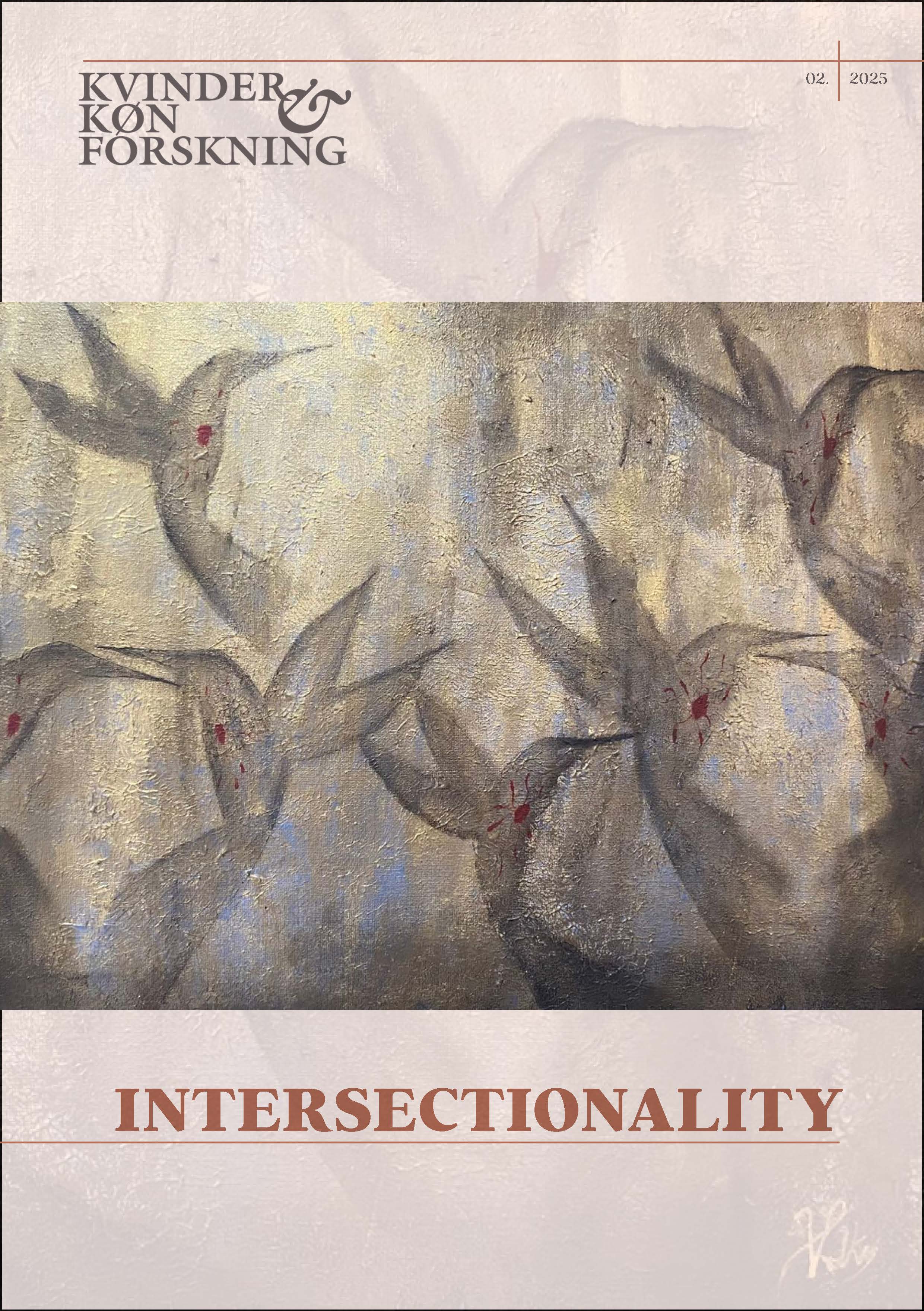
Intersectionality: Resistance, Care, and Decolonial Futures in Crisis Times
DOI:
https://doi.org/10.7146/kkf.v38i2.167706Referencer
Ahmed, S. (2015). Introduction: sexism - a problem with a name. New Formations, 86, 5-13.
Allen, A. (2022). Feminist perspectives on power. In Edward N. Zalta & Uri Nodelman (eds.), The Stanford Encyclopaedia of Philosophy (Fall 2022 Edition), https://plato.stanford.edu/archives/fall2022/entries/feminist-power.
Ashcraft, K. (2022). Wronged and Dangerous. Bristol: Bristol University Press
Ashcraft, K.L. & Muhr, S.L. (2025). A World Without DEI? What Leaders Should Know Before Going With the Flow. IMD.org: https://www.imd.org/ibyimd/diversity-inclusion/a-world-without-dei-what-leadersshould-know-before-going-with-the-flow/?utm_source=ORG_LINKEDIN&utm_medium=referral&utm_campaign=IMD+Podcasts.
Bhabha, H.K. (1996). Culture’s In-Between. In S. Hall & P. du Gay (Eds.), Questions of cultural identity (pp. 53–60). London: SAGE.
Bilge, S. (2014). Whitening intersectionality. Evanescence of race in intersectionality scholarship. In W.D. Hund and A. Lentin (Eds.), Racism and Sociology. Berlin: LIT Verlag.
Blaser, M. (2013). Ontological conflicts and the stories of peoples in spite of Europe: Toward a conversation on political ontology. Current Anthropology, 54(5), 547–568.
Borchorst, A., & Teigen, M. (2010). Political intersectionality: Tackling inequalities in public policies in Scandinavia. Kvinder, Køn & Forskning, 2-3(2010), 19-28.
Braidotti, R. (2013). The Posthuman. Cambridge: Polity Press.
Butler, J. (1990). Gender Trouble. New York: Routledge
Butler, J. (1993). Bodies That Matter. New York: Routledge
Butler, J. (2025). Who’s Afraid of Gender? New York: Random House
Butler, J., & Athanasiou, A. (2013). Dispossession: The Performative in the Political. Hoboken, NJ: John Wiley & Sons.
Collins, P.H. ( 2011). Piecing together a genealogical puzzle: Intersectionality and American pragmatism. European Journal of Pragmatism and American Philosophy, 3(2), 88–112.
Collins, P.H. (2019). Intersectionality as Critical Social Theory. Durham, NC: Duke University Press.
Creary, S.J. (2025). Transforming How Ambivalence About DEI Work is Managed in Organizations. Journal of Management Studies. https://doi.org/10.1111/joms.13206.
Darling-Wolf, F. (2007). The men and women of non-no: Gender, race, and hybridity in two Japanese magazines. Critical Studies in Media Communication, 23(3), 181–199.
Darwish, M. (2021). Nature, masculinities, care, and the far-right. In P.M. Pulé & M. Hultman (Eds.), Men, Masculinities, and Earth: Contending with the (m)Anthropocene. London: Palgrave Macmillan.
Dennissen, M.H.J., Benschop, Y.W.M. & Brink, M.C.L. van den (2020). Rethinking diversity management: An intersectional analysis of diversity networks. Organization Studies, 41 (2), 219-240.
Dhamoon, R. (2015). A feminist approach to decolonizing anti-racism: Rethinking transnationalism, intersectionality, and settler colonialism. Feral Feminisms, 4, 20–37.
Duffy, M., Armenia, A., & Price-Glynn, K. (2023). From Crisis to Catastrophe: Care, COVID, and Pathways to Change. New Brunswick, NJ: Rutgers University Press.
Einarsdóttir, T., & Thorvaldsdóttir, T. (2007). Gender Equality and the Intersectional Turn. Kvinder, Køn & Forskning, 2007(1), 20-31.
Elg, C., Christensen, H.R., & Siim, B. (2010). Intersectionality at work: Concepts and cases. Kvinder, Køn & Forskning, 2010(2-3), 3-6.
Emerek, R. (2017). Intersectionality - an intercategorical empirical approach. Kvinder, Køn & Forskning, 26(1), 18–31.
Escobar, A. (2020). Pluriversal Politics: The Real and the Possible. Durham, NC: Duke University Press.
Fraser, N. (2016). Contradictions of capital and care. New Left Review, 99–117.
Freire, P. (1970). Pedagogy of the Oppressed. New York: Bloomsbury.
Gale de Saxe, J., & Trotter-Simons, B.-E. (2021). Intersectionality, decolonization, and educating for critical consciousness. Journal of Thought, 1/2(55), 3–20.
Gani, J.K., & Khan, R.M. (2024). Positionality statements as a function of coloniality: Interrogating reflexive methodologies. International Studies Quarterly, 68(2), 1-13.
Guschke, B.L., Khawaja, I., & Myong, L. (2023). Racialization and racism in Denmark. Kvinder, Køn & Forskning, 36(2), 8–20.
Haraway, D. (1991). Simians, Cyborgs, and Women: The Reinvention of Nature. Free Association Books.
hooks, b. (1984). Feminist Theory - From Margin to Center. Boston: South End Press.
Hsu, (2025). Trump calls DEI programs ‘illegal’ and ‘immoral.’ Here’s how he’s ending them. Oregon NPR. Retrieved from: https://www.opb.org/article/2025/01/23/trump-says-dei-programs-are-illegal-in-the-federal-government-he-s-ending-them/.
Hvenegård-Lassen, K., Staunæs, D., & Lund, R. (2020). Intersectionality, Yes, but How? Approaches and Conceptualizations in Nordic Feminist Research and Activism. NORA - Nordic Journal of Feminist and Gender Research, 28(3), 173–182.
Hvenegård-Lassen, K., & Staunæs, D. (2020). Race matters in intersectional feminisms. Towards a Danish grammar book, NORA - Nordic Journal of Feminist and Gender Research, 28(3), 224-236.
Jensen, S.Q., & Elg, C. (2010). Intersectionality as embodiment. Kvinder, Køn & Forskning, 2010(2-3), 30-39.
Jensen, S.Q., Larsen, J.F., & Christensen, A.-D. (2018). Voksne etniske minoritetsmænd - marginalisering og intersektionalitet. Kvinder, Køn & Forskning, 27(4), 71–83.
Just, S.N. (2025). Controversial Encounters in the Age og Algorithms. How Digital Technologies are Stiffling Public Debate and What to Do About It. Bristol: Bristol University Press.
Kapoor, I. (2024). Intersectionality, decoloniality, indigenous localism: A critique. Theory, Culture and Society, on-line first, .https://doi.org/10.1177/02632764241303689.
King, T.L. (2015). Post-indentitarian and post-intersectional anxiety in the neoliberal corporate university. Feminist Formations, 273(3), 114–38.
Klitgård, M. (2024). Lockdown limbo: Reviving Marx’s ‘dead labor’ for queer and trans mental distress during COVID-19. Forum for Social Economics, on-line first, https://doi.org/10.1080/07360932.2024.2414215.
Klitgård, M, Liu X. & Horn, L. (2022). Liberating bodies: Sexualities and critiques of capital. Kvinder, Køn & Forskning, 33(1), 8-14.
Lewis, G. (2013). Unsafe travel: Experiencing intersectionality and feminist displacements. Signs: Journal of Women in Culture and Society, 38(4), 869–92.
Luthra, P. & Muhr, S.L. (2024). Leading Through Bias. London: Palgrave.
Lorde, A. (2017). Your Silence Will Not Protect You. London: Silver Press.
Lugones, M. (2007). Heterosexualism and the colonial / Modern gender system. Hypatia, 22(1), 186-209.
Lykke, N. (2009). Non-innocent intersections of feminism and environmentalism. Kvinder, Køn & Forskning, 2009(3-4), 36-44.
Mehrabi, T., Hultman, M., Uldbjerg, S., & Liu, X. (2024). Introduction: Gender and climate catastrophe. Women, Gender & Research, 1: 1–137.
Méndez, R.P. (2007). The limits of equality the intersectionality of gender and sexuality in Spanish policy making. Kvinder, Køn & Forskning, (1), 33-47.
Mignolo, W.D. (2009). Epistemic disobedience, independent thought and decolonial freedom. Theory, Culture & Society, 26(8), 159–181.
Mirza, H.S. (2014). Decolonizing higher education: Black feminism and the intersectionality of race and gender. Journal of Feminist Scholarship, 7(fall), 1-12.
Morin, E. & Kern, A.E. (1999). Homeland Earth: A Manifesto for the New Millenium. New York: Hampton Press.
Mørck, Y., & Staunæs, D. (2003). Introduction: Gender and ethnicity. NORA – Nordic Journal of Feminist and Gender Research, 11(2), 67–68
Nash, J. (2019). Black Feminism Reimagined: After Intersectionality. Durham, NC: Duke University Press.
Nash, J.C. (2014). Institutionalizing the Margins. Social Text 32 (1), 45–65.
Ozturk, M.B. (2021). Editorial: Re-Orienting Diversity and Inclusion: Pursuing the Political, Historical, Relational, Ethical and Technological Dimensions of Theory and Practice. Management Decision, 59(11), 2549–2552.
Phoenix, A. (2006). Interrogating intersectionality: Productive ways of theorising multiple positioning. Kvinder, Køn & Forskning, 2006(2-3), 21-30.
Plotnikof M., Muhr S.L., Holck L., & Just S.N. (2022). Repoliticizing diversity work? Exploring the performative potentials of norm-critical activism. Gender, Work & Organization, 29(2), 466-485.
Prasad, A., & Śliwa, M. (2024). Critiquing the Backlash Against Wokeness: In Defense of DEI Scholarship and Practice. Academy of Management Perspectives, 38, 245–259.
Puar, J.K. (2007). Terrorist Assemblages: Homonationalism in Queer Times. Durham, NC: Duke University Press.
Quijano, A. (2000). Coloniality of power and Eurocentrism in Latin America. International Sociology, 15(2), 215–232.
Ramirez, J., & Böhm, S. (2021). For more pluralistic critiques of colonialism: A response to Dunlap. Energy Research & Social Science, 82, Article 102303.
Ramirez, J., & Munar, A.M. (2022). Hybrid gender colonization: The case of muxes. Gender, Work and Organization, 29(6), 1868-1889.
Ramirez, J., Velez-Zapata, C.P., & Maher, R. (2024). Green colonialism and decolonial feminism: A study of Wayúu women’s resistance in La Guajira. Human Relations, 77(7), 937-964.
Reyes, P. de los. (2016). When feminism became gender equality and anti-racism turned into diversity management. In L. Martinsson, G. Griffin, & K.G. Nygren Challenging the Myth of Gender Equality in Sweden. Bristol: Policy Press.
Rodriguez, J.K., Holvino, E., Fletcher, J.K., & Nkomo, S.M. (2016). The theory and praxis of intersectionality in work and organisations: Where do we go from Here? Gender, Work & Organization, 23(3), 201–222.
Rodriguez, J.K., Nkomo, S., & Rajendran, D. (2025). Editorial: Intersectionality in progressive research: contesting privilege, fostering inclusion. Equality, Diversity and Inclusion: An International Journal, 44(5), 465–473.
Staunæs, D., & Søndergaard, D.M. (2006). Intersektionalitet – udsat for teoretisk justering. Kvinder, Køn & Forskning, 2006(2-3), 43-56.
Srinivas, N., Vijay, D., Alakavuklar, O.N., Shymko, Y., Böhm, S., Van Laer, K., Alamgir, F., Al-Amoudi, I., Barros, M., & Zulfiqar, G.M. (2025). Facing the facts of the Gaza genocide: Refusing complicity, organizing solidarity. Organization, 0(0), available online-first, https://doi.org/10.1177/13505084251384843.
Tate, S.A., & Rodríguez, E.G. (2022). Critical race and gender: Dialogues between decoloniality and intersectionality. In The Palgrave Handbook of Critical Race and Gender (pp. 1–19). New Your: Springer International Publishing.
Thomas, K.B. (2020). Intersectionality and epistemic erasure: A caution to decolonial feminism. Hypatia, 35(3), 509–523.
Tooze, J.A. (2021). Shutdown: How COVID Shook the World’s Economy. New York: Penguin Publishing Group.
van Douwen, N., Benschop, Y., & van den Brink, M. (2025). Spinning in circles. Following the practices of non-performativity of a diversity committee. Equality, Diversity and Inclusion: An International Journal. 44(9), 261–278.
Vertelyte, M., Gjørding, M. R., Khawaja, I., Plotnikof, M., Staunæs, D., & Sandager, J. (2024). Caring about the elephants in feminist classrooms: Affective pedagogies in an intersectional gender studies programme. Tijdschrift voor Genderstudies, 27(2/3), 265-285.
Wynter, S. (2003). Unsettling the coloniality of being/power/truth/freedom: Towards the human, after man, its overrepresentation–An argument. CR: The New Centennial Review, 3(3), 257–337.
Zembylas, M. (2025). Bringing intersectionality and (De)Coloniality into dialogue: Theoretical insights
and political pathways for decolonizing higher education. Social Sciences and Humanities Open, 12, on-line first, https://doi.org/10.1016/j.ssaho.2025.101772.
Downloads
Publiceret
Citation/Eksport
Nummer
Sektion
Licens
Copyright (c) 2026 Mathias Klitgård, Sara Louise Muhr, Ana María Munar, Mie Plotnikof, Jacobo Ramirez

Dette værk er under følgende licens Creative Commons Navngivelse –Ikke-kommerciel (by-nc).
Udgivelser i Kvinder, Køn og Forskning er beskyttet under Creative Commons License: CC Attribution-NonCommercial 4.0
