Hope isn’t innocent
an introduction
DOI:
https://doi.org/10.7146/pl.v47i1.172041Keywords:
hope, critique, optimism, despair, futureAbstract
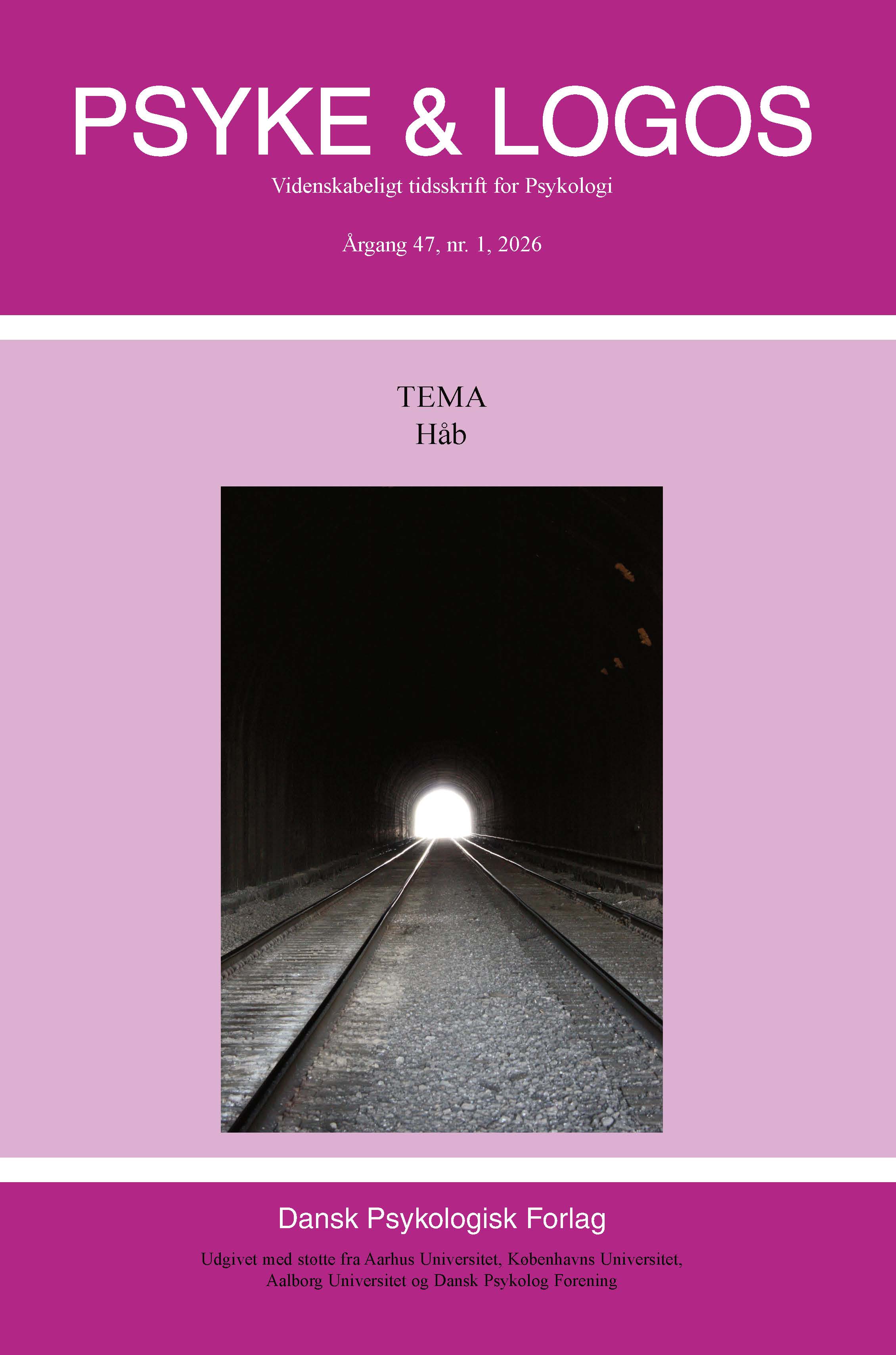
In this issue of Psyke & Logos, we address hope as a conflictual phenomenon in a time marked by crisis and an uncertain future. As a backdrop to the rest of the issue, we introduce important tensions in understandings of hope by way of introducing ideas from Snyder, Marcel, Bloch and Žižek. The first tension concerns whether hope should be understood as connected to optimism and agency, or to despair and powerlessness. The second tension concerns whether hope opens up the possibility of critique, or whether hope itself should be subjected to critique. We conclude with the argument that hope is not innocent, but remains uncertain because so is the future. Finally, we introduce the contents of the issue.
References
Boldyrev, I. (2025). Ernst Bloch. I: E. N. Zalka (red.). The Standford Encyclopedia of Philosophy. https://plato.stanford.edu/archives/fall2025/entries/bloch/
Frydenlund, J. H. (2025). Det potensielle regime: Mot en forebyggelseslogikk med måtehold. I: A. J. W. Andersen, & S. H. Haugland (red.). Perspektiver på psykososial helse. Fagbokforlaget. https://doi.org/10.55669/oa550207
Gallagher, M. W. (2023). The scientific status of hope [Editorial]. Current Opinion in Psychology, 53, Artikel 101684. https://doi.org/10.1016/j.copsyc.2023.101684
Graven, V., & Brødslev Olsen, J. (2018). Hvor der er håb: fra teori til sundhedsfaglig praksis. Samfundslitteratur.
Niss, N. K., Ellegard, C. E., Hansen, N. S., Popp, S. N., & Westerdahl, L. (2021). Betydningen af håb for udsatte for mobning, ensomhed eller partnervold. Mary Fonden. Oxford Research.
Sköld, A. (2022). Vi er det liv, vi ikke lever: Et håbefuldt udkast til dagdrømmens psykologi. Psyke & Logos, 43(1), 87-109. https://doi.org/10.7146/pl.v43i1.133888
Sköld, A., & Lundsgaard-Leth, K. (red.) (2025). Det håbende dyr. Klim.
Snyder, C. R. (red.). (2000). Handbook of hope: Theory, measures, and applications. Academic Press.
Snyder, C. R. (2002). Hope theory: Rainbows in the mind. Psychological Inquiry, 13(4), 249-275. https://doi.org/10.1207/S15327965PLI1304_01 Taylor, C. A., Osgood, J., Bozalek, V., Geerts, E., Zhao, W., & Andersen, C. E. (2024). Feminism (s) and the ‘posts’: towards new educational imaginaries and hope-full renewals. Gender and Education, 36(8), 819-829. https://doi.org/10.1080/09540253 .2024.2430190
Tolkien, J. R. R. (1955/2004). The Lord of the Rings. HarperCollinsPublishers.
Treanor, B., & Sweetman, B. (2021). Gabriel (-Honoré) Marcel. I: E. N. Zalka (red.). The Standford Encyclopedia of Philosophy. https://plato.stanford.edu/archives/sum2021/ entries/marcel/.
Winther-Lindqvist, D. A. (2017). Hope as fantasy: an existential phenomenology of hoping in light of parental illness. I: B. Wagoner, S. H. Awad, & I. Bresco de Luna (red.). The psychology of imagination: History, theory and new research horizons (s. 151-173). Information Age Publishing. https://doi.org/10.1108/978-1-68123-711420251012
Žižek, S. (2018). The courage of hopelesness: Chronicles of a year of acting dangerously. Penguin
Downloads
Published
How to Cite
Issue
Section
License
Ophavsret er tidsskriftets og forfatternes. Det er gældende praksis, at artikler publiceret i Psyke & Logos, som efterfølgende oversættes til andet sprog, af forfatteren frit kan publiceres i internationale tidsskrifter, dog således at det ved reference fremgår, at den oversatte artikel har et forlæg i en dansksproget version i Psyke & Logos. Artikler kan frit deles og linkes til på forsknings- og undervisningsnetværk (så som Blackboard). Link foretrækkes, fordi det giver oplysning om brug af tidsskriftets artikler.