Call for papers: Passepartout #48: The Doll
Edited by Anne-Mette Strange, Ane Preisler Skovgaard and Laura Katrine Skinnebach
The doll is a curious boundary-crosser. Situated at the intersection of image, object, and body, it resists description through categories such as subject and object, living and dead. Rather, it exists in-between categories, or may seem to belong to several opposing categories at once. This special issue of Passepartout is dedicated
to the doll and to the art-historical questions and challenges associated with this ontologically unstable image phenomenon.
Dolls can be self-images of humanity, relocated just enough to let us observe ourselves from the outside. As artificially produced doubles, they become prisms through which we behold changing conceptions of the human. Dolls reveal not only how human beings have understood and staged themselves over time, but also how ideas of the body, gender, identity, normality, and the future have been shaped, tested, and projected onto a human-like figure.
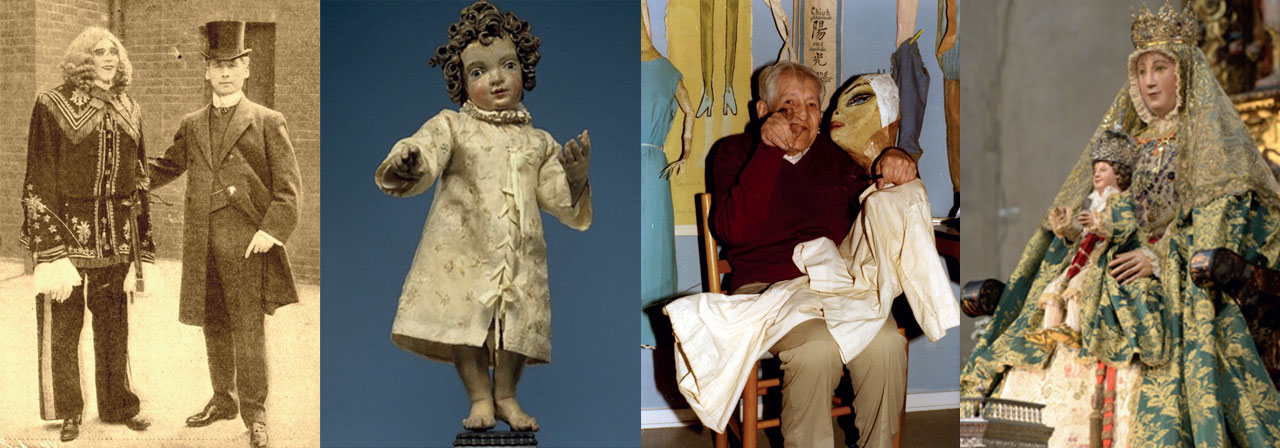
Like the statue and the sculpture, the doll is three-dimensional and shares the space of the beholder. While statues and sculptures have traditionally been regarded as objects to be beheld, a doll is specifically characterised through its potential for action(/animation) and transformation. We can touch it, dress it, move it, manipulate it, animate it, take it apart, and reassemble it. It can function as a substitute for an actual, absent, or imagined person. But where is the boundary between the doll and the statue? Throughout history, the doll has served as a cultic object, a toy, a model, fetish, surrogate, mannequin, automaton, and artwork, and it has moved between art, religion, science, theatre, fashion, popular culture, and technology. The doll is an adaptable body. It can be anything that we want it to be. It can be venerated and idol(l)ised, but at the same time it just wants to be played with and hugged. Being an interactive object that just wants to be loved and cuddled, the doll also invites intense hatred and violence.
The special issue insists on the art historical relevance of the doll and aims to investigate its shifting positions as image, object, body, surrogate, and projection with the intention of presenting how this artificially manufactured human figure has functioned as a special place for negotiating human ontology, now, before, and in the future. We invite studies of how dolls are related to the shifting self-images of humans, and about the objects that have been included in, marginalised, or rejected
from art historical research. We are interested in contributions that investigate the many figurations and applications of dolls, and also in theoretical reflections on the doll as an image type.
Deadline for abstracts:
15 December 2026, maximum 400 words.
Send to: lks@cc.au.dk, anne-mette@ovartaci.dk og akpn@live.dk.
Authors will be contacted shortly thereafter.
The issue is to be published in May 2028.