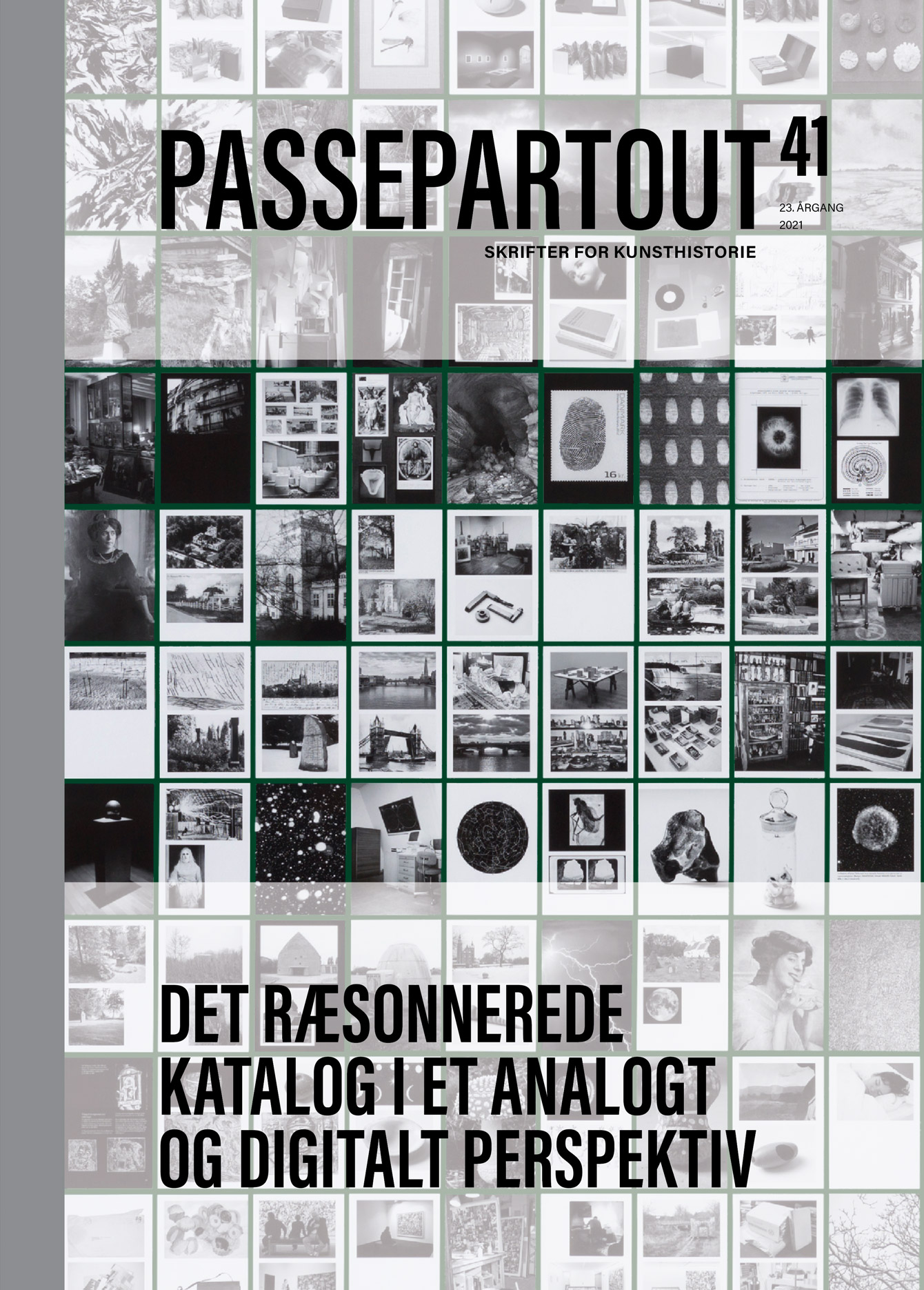
What are all the pictures for?
Cataloging challenges in between cultural heritage institutions and humanities research
Keywords:
Metadata behov, online kataloger, databaser, bildsamlingar, humanistiska forskare, metadataproduktionAbstract
Based on a survey on the production and use of descriptive metadata, this study discloses that there is a divide in interest between on the one hand information specialists in libraries, archives, and museums and, on the other hand, university scholars in the humanities, a very specific yet substantial end-user group for visual heritage material. 168 researchers at universities in Sweden were queried, using an online survey with multiple choice questions. A similar online survey were answered by 45 information specialists in museums, archives, and university libraries in Sweden. The survey discloses that while the interest in information about the historical origin and context of images are equally high in both groups, there is a decisive gap between the interest in image content between the two groups. In effect, the production of descriptive metadata does not match the needs and interest of researchers in the humanities, but rather other end users. An increased dialogue is needed between these two groups concerning what metadata should be attached to images. In extension, this could potentially lead to a broader and more extended scholarly use of visual heritage material.
References
Armitage, L. H. and Enser, P. G. B.: “Analysis of user need in image archives” in Journal of Information Science, 23(4), 1997, pp. 287–299.
Atwater, E.: “The Changing Form of the Catalogue Raisonné: Hurdles of Transitioning from Print to Web” in Art Documentation: Journal of the Art Libraries Society of North America, 31(2), 2012, pp. 186–198.
Baca, M. et al.: Cataloging Cultural Objects. A Guide to Describing Cultural Works and Their Images. Chicago: American Library Association, 2006.
Baca, M. (red.): Introduction to Metadata. 3rd edn. Los Angeles, Getty Publications, 2016.
Beaudoin, J. E.: “Visual Materials and Online Access: Issues Concerning Content Representation”, in Art Documentation: Journal of the Art Libraries Society of North America, 26(2), 2007, pp. 24–28.
Birkin, J.: “Institutional metadata and the problem of context” in Journal of Digital Culture and Society, 6(2), 2020, pp. 19–36.
Capurro, C. and Plets, G.; “Europeana, EDM, and the Europeanisation of Cultural Heritage Institutions” in Journal of Digital Culture and Society, 6(2), 2020, pp. 163–189.
Cardinali, M.: “Digital Tools and Technical Views: The Intersection of Digital Art History and Technical Art History in a Digital Archive on the Painting Technique of Caravaggio and His Followers in Visual Resources, 35(1–2), 2019, pp. 52–73.
Carpo, M. : “Big Data and the End of History” in International Journal for Digital Art History, (3), 2018, pp. 20–35.
Chen, H. : “An analysis of image queries in the field of art history” in Journal of the American Society for Information Science and Technology, 52(3), 2001, pp. 260–273.
Christensen, H. D. and Pedersen, M. H.: “Museum Communication between Enlightenment and Experience An Introduction” in Nordisk Museologi, (1), 2019, pp. 5–10.
Curtis, N. (ed.): The pictorial turn. London, Routledge, 2011.
Dahlgren, A.: ”Tankar om tillgänglighet och fotografier i arkiv”in Dahlgren, A. and Snickars, P. (eds.), I bildarkivet: om fotografi och digitaliseringens effekter, Stockholm, Mediehistoriskt arkiv, 13, 2009, pp. 59–89.
Dahlgren, A.: ”Dated Photographs: The Personal Photo Album as Visual and Textual Medium” in Photography and Culture, 3(2), 2010, pp. 175–194.
Dahlgren, A.: Ett medium för visuell bildning: kulturhistoriska perspektiv på fotoalbum 1850-1950. Göteborg, Makadam förlag, 2013.
D’Alleva, A.: Methods & theories of art history, 2. ed. London, Laurence King, 2012.
Digitization and IPR in European Museums. (2020). NEMO, Network of European Museum Organisations. Available at: www.ne-mo.org.
Edwards, E.: Photographs, Objects, Histories. On the Materiality of Images. London, Routledge, 2004.
Elkins, J. (ed.): Visual practices across the university, München, Wilhelm Fink Verlag, 2007.
Gil-Fuentetaja, I. and Economou, M.: ”Communicating Museum Collections Information Online: Analysis of the Philosophy of Communication Extending the Constructivist Approach” in Journal on Computing and Cultural Heritage, 12(1), 2019, pp. 1–16.
Harris, J.: The new art history: a critical introduction, London, Routledge, 2007.
Hollink, L. et al.: ”Classification of user image descriptions” in International Journal of Human-Computer Studies, 61(5), 2004, pp. 601–626.
Jordanova, L. J.: The look of the past: visual and material evidence in historical practice. Cambridge, Cambridge University Press, 2012.
Lager Vestberg, N.: ”Flytande fotografier – originalitet och upphovsrätt i det digitala arkivet” in Dahlgren, A. and Snickars, P. (eds.), I bildarkivet: om fotografi och digitaliseringens effekter. Stockholm: Mediehistoriskt arkiv, 13, 2009, pp. 33–58.
Manghani, S.: Image studies: Theory and practice. London, Routledge, 2013.
Müller, M. G., Bateman, J. A. and Seizov, O.: ”Visual archives in the digital age” in Visual Studies, 31(2), 2016, pp. 93–94.
Nauta, G. J., Heuvel, W. van den and Teunisse, S.: Europeana DSI 2– Access to Digital Resources of European Heritage. D4.4. Report on ENUMERATE Core Survey 4, 2017. Available at: https://pro.europeana.eu/files
Orna, E. and Pettitt, C.: Information management in museums, 2nd ed. Aldershot, Hants, Gower, 1998.
Pepi, M.: ”Is a Museum a Database? Institutional Conditions in Net Utopia” in E-Flux Journal, (60), 2014. Available at: www.e-flux.com/journal/60/61026/is-a-museum-a-database-institutional-conditions-in-net-utopia/.
Prown, J. D.: ”Mind in Matter: An Introduction to Material Culture Theory and Method” in Winterthur Portfolio, 17(1), 1982, pp. 1–19.
Riley, J.: Understanding metadata. What is metadata and what us it for? Baltimore: National Information Standards Organization (NISO), 2017. Available at: https://www.niso.org/publications/understanding-metadata-2017.
Schneider, S. and Kohle, H.: ”The Computer as Filter Machine: A Clustering Approach to Categorize” in Artl@s Bulletin, 6(3), article 6, 2017.
Seeman, D. and Dean, H.: ”Open Social Knowledge Creation and Library and Archival Metadata”in KULA: Knowledge Creation, Dissemination, and Preservation Studies, 3, 2019.
Tasovac, T., Chambers, S. and Tóth-Czifra, E.: Cultural Heritage Data from a Humanities Reserahc Perspective: A DARIAH Position Paper. hal-02961317. HAL archives-ouvertes, 2020. Available at: hal.archives-ouvertes.fr.
Wolff, J.: The social production of art. Reprinted, Basingstoke, Macmillan Education (Communications and culture), 1988.
Woodward, E.: ”Metadata for Image Collections” in American Libraries, 45(6), 2014, pp. 42–44.