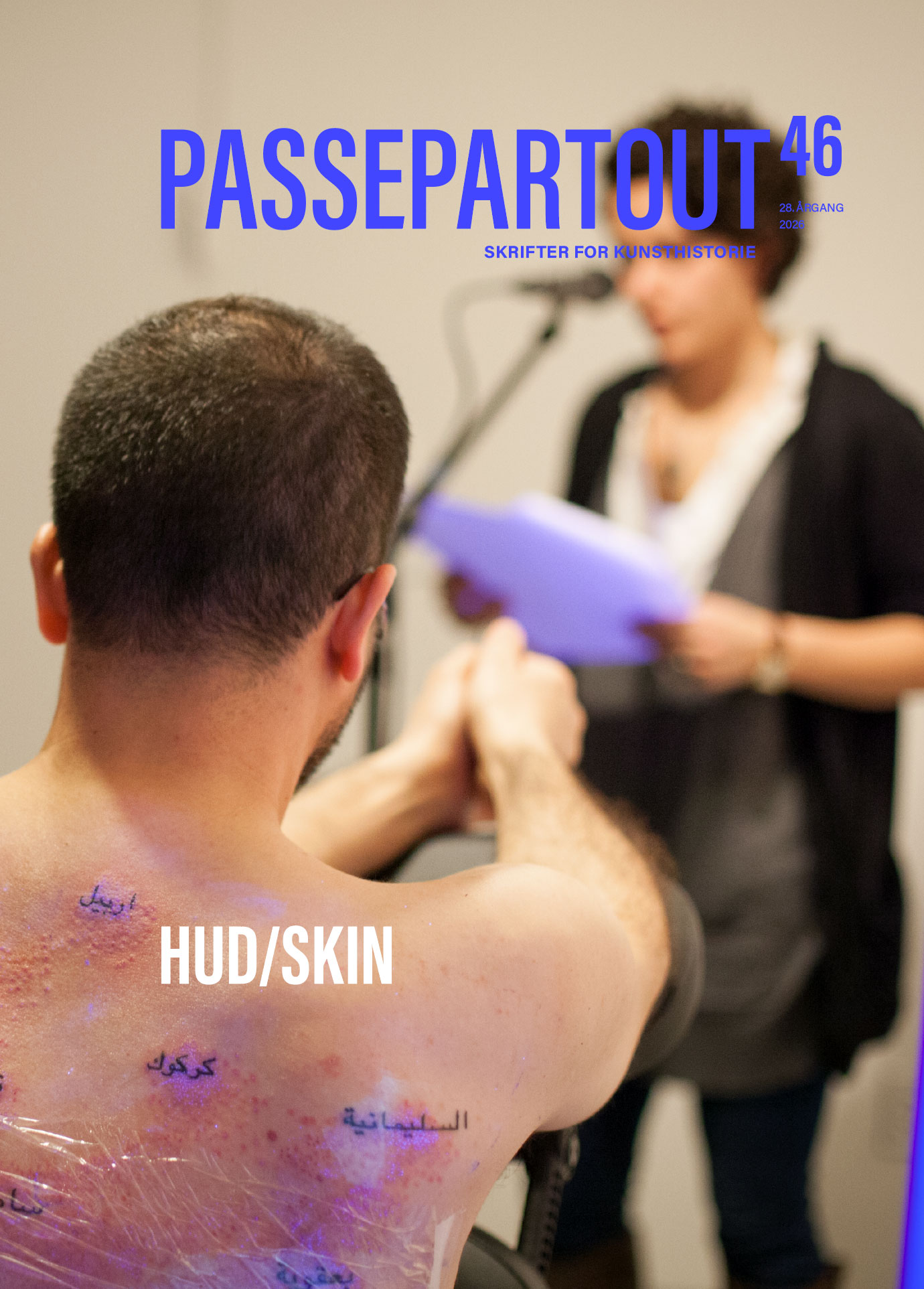
Critique through the Skin
Wafaa Bilal’s and Counting…
Nøgleord:
Skin, Body art, Tattoo, War, Subjectivity, Politics, ImperialismResumé
Skin, one of the crucial components of body art performances, is indispensable to Wafaa Bilal’s durational performance and Counting… (2010). This article proposes to analyze the semiotics of the skin as a pivotal component of this truly unique artwork, in which the artist merges durational performance art with the act of tattooing. The essay clarifies how Bilal reveals unexpected avenues for thinking about racism and American imperialism, as well as the traumatic effects of global violence by resorting to vulnerability and pain as aesthetic devices. The skin of the artist acts as an interface between the public, the artist, and the deceased of the war in Iraq to produce a reflection on life and loss. Drawing on phenomenology, psychoanalysis, and performance studies, among other things, the analysis examines the potential for performance to generate forms of intersubjective exchange. Bridging the ever-expanding field of skin studies with performance studies and art history, this article theorizes how artistic interpretations of wars may deploy the personal as universal, connecting seemingly remote cultural contexts and relating the history of global violence to the Western public.
Referencer
Ahmed, Sara, and Jackie Stacey (eds.): “Introduction: Dermographies” in Thinking Through the Skin, New York, Routledge, 2001, pp. 1-17.
Atia, Nadia: “Death and Mourning in Contemporary Iraqi Texts” in Interventions: International Journal of Postcolonial Studies, vol. 21, no. 8, 2019, pp. 1068-1086.
Barron, Lee: Tattoo Culture: Theory and Contemporary Contexts, New York, Rowman & Littlefield International, 2017.
Bilal, Wafaa, and Kari Lydersen: Shoot an Iraqi: Art, Life and Resistance under the Gun, San Francisco, City Lights, 2008.
Le Breton, David: “Les scarifications comme actes de passage” in L’information psychiatrique, vol. 82, no. 6, 2006, pp. 475-480.
Le Breton, David: “Body Art: la blessure comme œuvre chez Gina Pane” in Communications, vol. 1, no. 92, 2013, pp. 99-110.
Butler, Judith: Frames of War: When Is Life Grievable?, New York, Verso, 2009.
Calchi-Novati, Gabriella: “Paradigms of Participation Wim Delvoye and Wafaa Bilal’s Tattooing Performances” in Performance Research, vol. 16, no. 4, 2011, pp. 34-45.
Caplan, Jane: “Introduction,” in Written on the Body: The Tattoo in European and American History, Princeton, Princeton University Press, 2000, p. xv.
Cascarino, Adrien: “Le Body Art: un autre modèle pour penser les scarifications” in L’évolution psychiatrique, vol. 83, no. 1, 2018, pp. 149-160.
Cavanagh Sheila L., Angela Failler, and Rachel Alpha Johnston Hurst (eds.): “Enfolded: Skin, Culture and Psychoanalysis” in Skin, Culture and Psychoanalysis, New York: Palgrave Macmillan, 2012, pp. 1-15.
Dimitrakaki, Angela: “The Spectacle and Its Others: Labor, Conflict, and Art in the Age of Global Capital” in Globalization and Contemporary Art, Jonathan Harris (ed.), Oxford, Wiley-Blackwell, 2011, pp. 191-211.
Etz, Karly Allison: “Inked Encounters and Expanded Narratives: Exploring the Tattoo Medium in Contemporary Art,” PhD Diss., The Pennsylvania State University, 2023.
Fanon, Frantz: Peau noire masques blancs, Paris, Éditions du Seuil, 1952.
Farouk-Sluglett, Marion, and Peter Sluglett: Iraq Since 1958: From Revolution to Dictatorship, London, I.B. Tauris, 2001.
Fields, Barbara J., and Karen E. Fields: Racecraft: The Soul of Inequality in American Life, London/New York, Verso, 2012.
Govenar, Alan: “The Changing Image of Tattooing in American Culture, 1846-1966” in Written on the Body: The Tattoo in European and American History, Jane Caplan (ed.), Princeton, Princeton University Press, 2000.
Hatab Samhan, Heleen: “Politics and Exclusion: The Arab American Experience” in Journal of Palestine Studies, vol. 16, no. 2, Winter 1987, pp. 11-28.
Jones, Amelia: Body Art / Performing the Subject, Minneapolis, University of Minnesota Press, 1998.
Jones, Amelia: Seeing Differently: A History and Theory of Identification and the Visual Arts, New York, Routledge, 2012.
Kamat, Anjali: “Interview with Iraqi Artist Wafaa Bilal” in The Arab Studies Journal, vol. 18, no. 1, Spring 2010, pp. 316-329.
Kapadia, Ronak K.: Insurgent Aesthetics: Security and the Queer Life of the Forever War, Durham, Duke University Press, 2019.
King, Dorothée: “Whose Skin? Curating Tattooed Tableaux Vivants in Contemporary Art” in Journal of Curatorial Studies, vol. 8, no. 1, 2019, pp. 6-22.
Lafrance, Marc: “From the Skin Ego to the Psychic Envelope: An Introduction to the Work of Didier Anzieu” in Skin, Culture and Psychoanalysis, Sheila L. Cavanagh, Angela Failler, and Rachel Alpha Johnston Hurst (eds.), New York, Palgrave Macmillan, 2012, pp. 16-44.
Lafrance, Marc: “Skin Studies: Past, Present and Future” in Body & Society, vol. 24, no. 1-2, 2018, pp. 3-32.
Lodder, Matt: Painted People: Humanity in 21 Tattoos, London, William Collins, 2022.
Lombroso, Cesare: Crime: Its Causes and Remedies, Henry P. Horton (trans.), Boston, Little, Brown, and Company, 1911.
Loos, Adolf: “Ornament and Crime” in Crime and Ornament: The Arts and Popular Culture in the Shadow of Adolf Loos, Melony Ward and Bernie Miller (eds.), Toronto, YYZ Books, 2002.
Marks, Laura U.: The Skin of the Film: Intercultural Cinema, Embodiment and the Senses, Durham, Duke University Press, 2000.
McGowan, Todd: The Racist Fantasy: Unconscious Roots of Hatred, New York, Bloomsbury Academic, 2022.
Nodell, Bobbi: “Study: Nearly 500,000 perished in Iraq War,” UW News, October 15, 2013. https://www.washington.edu/news/2013/10/15/study-nearly-500000-perished-in-iraq-war/. (accessed September 28, 2024).
O’Dell, Kathy: Contract with the Skin: Masochism, Performance art, and the 1970s, Minneapolis, University of Minneapolis Press, 1998.
Pellegrinelli, Lara: “Artist Tattoos Indelible Iraq Memorial Into His Skin,” NPR, June 1, 2010. https://www.npr.org/2010/06/01/127348258/artist-tattoos-indelible-iraq-memorial-into-his-skin (accessed September 28, 2024).
Reinarz, Jonathan: “Scratching the Surface: An Introduction” in A Medical History of Skin: Scratching the Surface, Jonathan Reinarz and Kevin Siena (eds.), New York, Routledge, 2013, pp. 1-15.
Roque, Sylvie, and Georges Vigarello: “La fascination de la peau” in Communications 1, no. 92, 2013, pp. 85–97.
Said, Edward W.: Orientalism, New York, Vintage Books, 1979.
Sajjad Hussain and Azhar Ahmad: “The Rise of Authoritarianism in the 21st Century and the World Order” in Journal of Contemporary Studies, vol. 9, no. 1, 2020, p. 72.
van Sertima, Adam: “Wafaa Bilal’s Domestic Tension: A Politics of Performance in Gamic Space”, MA thesis, Concordia University, 2011.
Smeaton, Winifred: “Tattooing among the Arabs of Iraq” in American Anthropologist, vol. 39, no. 1, 1937, pp. 53-61.
Websites
Bilal, Wafaa: “and Counting…”, Works: http://wafaabilal.com/and-counting/ (accessed September 25, 2024).
Bilal, Wafaa: “Frequently Asked Questions: What Is Domestic Tension About?” Wafaa Bilal: Domestic Tension, https://web.archive.org/web/20070620111358/http://www.wafaabilal.com/faq.html (accessed November 5, 2023).
Watson Institute for International and Public Affairs: “Iraqi Civilians”, Costs of War: https://watson.brown.edu/costsofwar/costs/human/civilians/iraqi (accessed December 15, 2023).