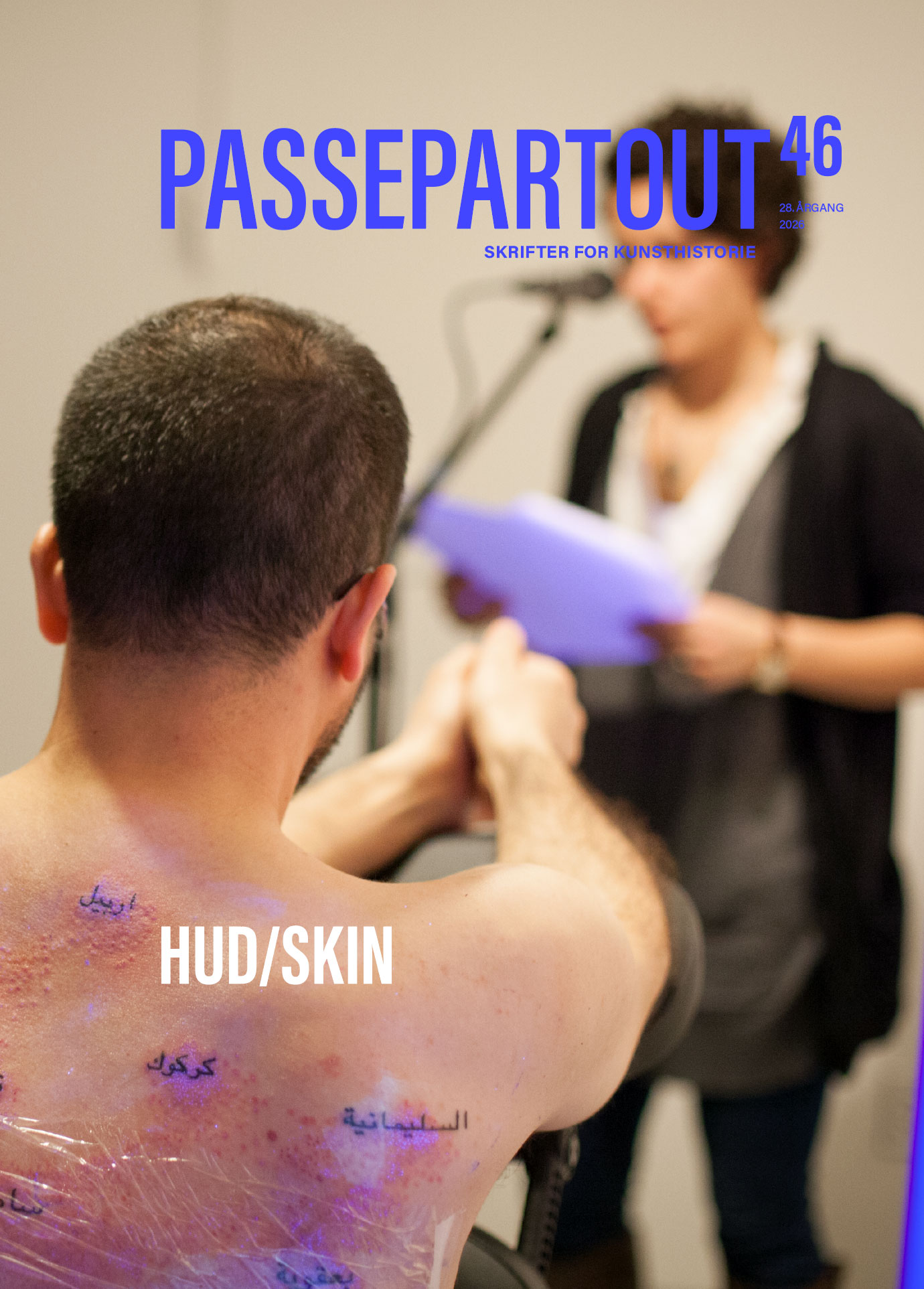
Hud
Resumé
Skin is contradictory. It is the site of creation and destruction, transformation and regeneration. On the one hand, the skin is the largest organ and outermost covering of the human body, protecting the internal organs from external assaults. It forms a shield against harmful microorganisms and chemicals, and it regulates the body temperature while simultaneously containing the body’s vital fluids. The skin is a resistant membrane which can heal and renew itself by replacing old cells with new ones. On the other hand, skin is vulnerable. It is porous and can be attacked or decomposed by illness, microbes, and bacteria. It is soft and thin, and can easily be penetrated, lacerated, broken, flayed, burned, and scarred. Skin can also harden, crack, peel, flake, stretch, wrinkle, blush, blemish, and blister.
Skin is a contentious cultural artefact. It constitutes the body’s encounter with the world and may be read like a map of our lives and identities. But the different signs inscribed on our skin – its pigments, decorations, holes, scars, and hair (or lack thereof) – embody cultural meanings that throughout history have led to discrimination and repression, or privilege and power. Skin is a field of cultural debate and calls for further critical study. From a new-materialist perspective, we might trouble the tendency to treat the skin in anthropocentric terms, for does the tree not have skin? And what of the sculpture, the robot, the animal, or the face of the earth – skin surfaces that meet and negotiate with their surroundings?
Skin is pervasive. It envelops bodies – our own and those of others – and constitutes the inescapable interaction between all entities. The skin senses and it is sensed. Skin also permeates our speech, as revealed by numerous figurative expressions: “beauty is only skin deep,” “by the skin of one’s teeth,” “no skin off one’s nose,” “to be comfortable in one’s own skin,” “to be skin and bone,” “to be thick- or thin-skinned,” “to get under one’s skin,” “to have skin in the game,” “to jump out of one’s skin,” “to make one’s skin crawl.” These phrases concern the resilience of skin, as well as its penetrability. Most importantly, they demonstrate that skin receives and produces metaphorical meanings. Skin is necessarily related to the visual by virtue of its visibility. Indeed, since antiquity, skin has occupied a prominent position in the visual arts. Tattooing, scarification, and body paint, for example, make the surface of the human skin a canvas, and likewise, the bodily surface lends itself as a metaphor for a pictorial surface or support used in artistic representation.
Skin – human or other-than-human – is a frontier between outside and inside, surface and depth, visibility and invisibility. As matter and metaphor, skin offers an opportunity to investigate negotiations between the visual and the sensory from various historical and cross-cultural perspectives. In this theme issue of Passepartout, we explore the problem of skin and its intersections with art and visual culture. How are the material properties and metaphorical potentialities of skin incorporated in art and visual culture? How does skin connect such disciplines as language, literature, philosophy, art, medicine, and science? The following thirteen articles probe various issues concerning skin as a material, conceptual, metaphorical, bodily, or artistic interface; collectively, they interrogate skin as a multisensory organ, the materiality of skin, the skin of matter, and the troubling relation between skin and identity.
Referencer
Hauser, Jens (ed.): Sk-interfaces: Exploding Borders – Creating Membranes in Art, Technology and Society, Liverpool, FACT and Liverpool University Press, 2008.
Hron, Irina: “Sit venia verbo: A Case for Dermacriticism” in Orbis Litterarum, vol. 79, 2024, pp. 449-471.