
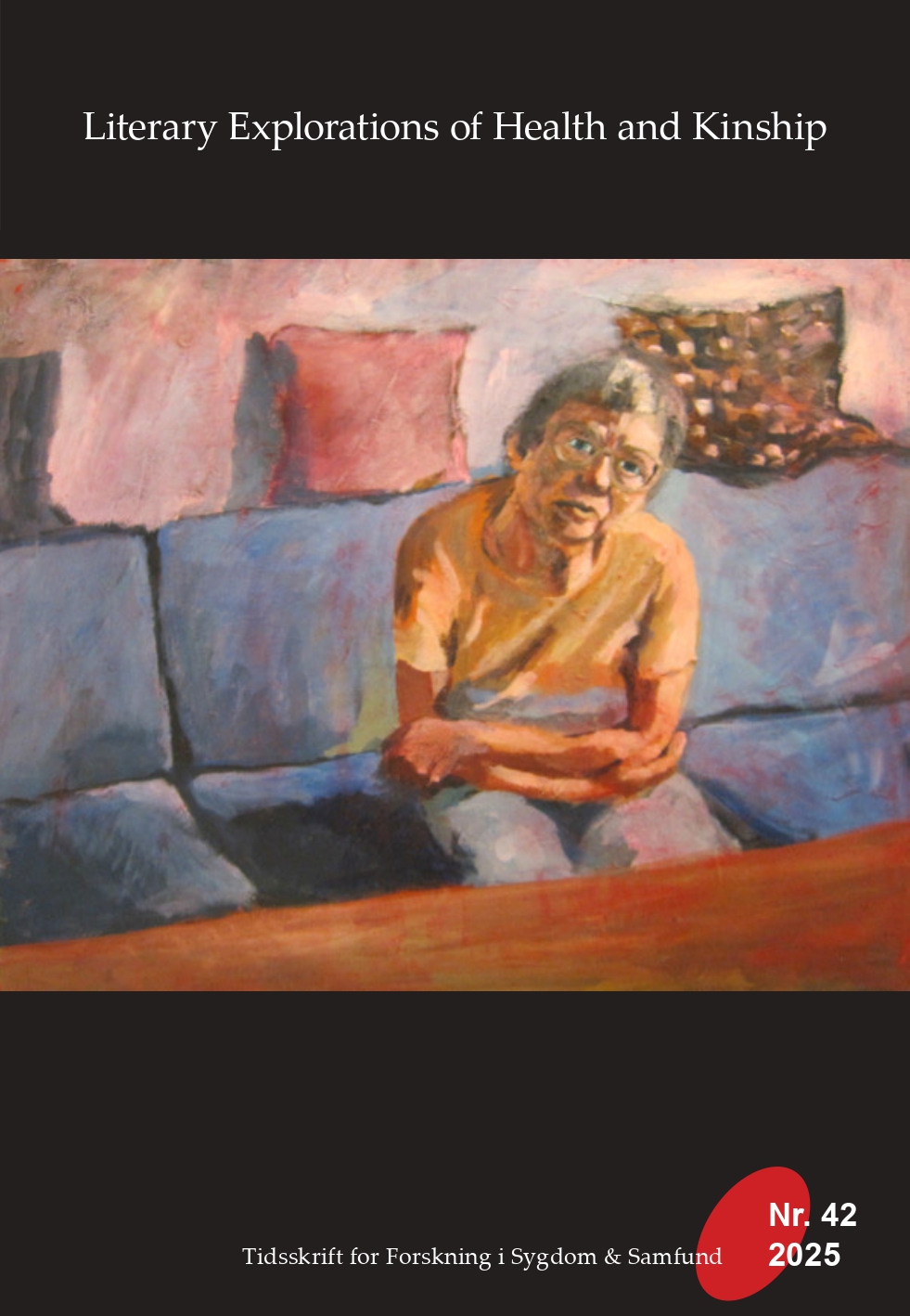
Published 2025-06-05
Keywords
- Graphic Novels,
- Dementia,
- Relational pespectives
How to Cite
Copyright (c) 2025 Silje Haugen Warberg

This work is licensed under a Creative Commons Attribution-NonCommercial 4.0 International License.
Abstract
Comparing two contemporary Norwegian graphic novels depicting a son’s experience with a parent’s dementia, this article explores what a relational perspective on dementia entails and how processes of kinship are mediated in the comics form. The first part of the article outlines several “relational challenges” connected with dementia literature and other forms of life writing from a caregiver’s perspective. In the second part of the article, I analyse and compare Trond Bredesen’s Mora mi (My Mother, 2023) and Martin Erntsen’s Men hvem er du? (But Who Are You? 2023), focusing on how these graphic novels show and perform mnemonic practises that can be linked to a processual view on kinship. Building on this view on kinship and relationality as intersubjective processes in need of mediation, I return to the relational challenges of dementia literature to suggest a shift in focus: from the dialectic between the carer and the vulnerable person towards the relationship itself, and from questions about narrative and narratability towards questions about media and mediation. This perspective is summed up in the term remedium, which provides a conceptual framework for understanding the remediating, and potentially remedying, cultural processes connected with aesthetic and literary media considering their media specificity.
References
- Berman, J. (2020). The Art of Caregiving in Fiction, Film, and Memoir (1st ed.). Bloomsbury Publishing Plc. https://doi.org/10.5040/9781350166608
- Bredesen, T. (2023). Mora mi. No comprendo press.
- Bjørkøy, A. M. B. (2020). Samtidslitterære alderdommer. Oslo, Universitetsforlaget, 2020. https://doi.org/10.18261/9788215032474-2020
- Bloom H. (1973). [1997] The anxiety of influence; a theory of poetry. Oxford University Press.
- Bloom H. (1975). A map of misreading : with a new preface (2nd ed.). Oxford University Press.
- Bolter, J. D., & Grusin, R. (1999). Remediation : understanding new media (pp. XI, 295 , pl.). MIT Press.
- Carsten, J. (2000). Cultures of relatedness : new approaches to the study of kinship (pp. IX, 215). Cambridge University Press.
- Chute, H. L. (2010). Graphic Women: Life Narrative and Contemporary Comics. Columbia University Press.
- Couser, G. T. (2018). Is There a Body in This Text? Embodiment in Graphic Somatography. Auto/biography Studies, 33(2), 347–373. https://doi.org/10.1080/08989575.2018.1445585
- Couser, G. T. (2009). Signifying bodies : disability in contemporary life writing. University of Michigan Press.
- DeFalco, A. (2018). Imagining Care : Responsibility, Dependency, and Canadian Literature. University of Toronto Press.DeFalco, A. (2023). Curious Kin in Fictions of Posthuman Care (1st ed.). Oxford University Press, Incorporated. https://doi.org/10.1093/oso/9780192886125.001.0001
- DeFalco, A. (2010). Uncanny Subjects : Aging in Contemporary Narrative. Ohio State University Press.
- DeFalco, A. (2016). Graphic Somatography: Life Writing, Comics, and the Ethics of Care. The Journal of Medical Humanities, 37(3), 223–240. https://doi.org/10.1007/s10912-015-9360-6
- Eakin, P. J. (2019). Relational Selves, Relational Lives: Autobiography and the Myth of Autonomy. In How Our Lives Become Stories (pp. 43–98). Cornell University Press. https://doi.org/10.7591/9781501711831-003
- Erll, A. (2011). Locating Family in Cultural Memory Studies. Journal of Comparative Family Studies, 42(3), 303–318. https://doi.org/10.3138/jcfs.42.3.303
- Erll, A., & Rigney, A. (2009). Mediation, Remediation, and the Dynamics of Cultural Memory (1. Aufl., Vol. 10). De Gruyter. https://doi.org/10.1515/9783110217384
- Erntsen, M. (2023). Men hvem er du? Gyldendal.
- Sako, K., & Falcus, S. (2022). Contemporary Narratives of Ageing, Illness, Care (1st ed.). Routledge. https://doi.org/10.4324/9781003058618
- Fineman, M. (2004). The autonomy myth: A theory of dependency. The New Press.
- Frank, A. W. (2022). King Lear: Shakespeare's Dark Consolations (1st ed.). Oxford University Press. https://doi.org/10.1093/oso/9780192846723.001.0001
- Frank, A. W. (1995). The Wounded Storyteller. Body, Illness, and Ethics. University of Chicago Press.
- Gilbert, S. & Gubar, S. (1980). The Madwoman in the Attic. Yale University Press
- Goldman, M. (2017). Forgotten: narratives of age-related dementia and Alzheimer's disease in Canada. In Forgotten (1st ed.). McGill-Queen's University Press. https://doi.org/10.2307/j.ctt1w1vjdp
- Groensteen, T. (2011). Bande dessinée et narration (Système de la bande dessinée vol. 2). PUF.
- Halbwachs, M. (1992). On collective memory. Ed. and trans, by Lewis Coser. Chicago: University of Chicago Press
- Hawkins, A. H. (1999). Reconstructing Illness. Studies in Pathographies. Purdue University.
- Hirsch, M. (2008). The Generation of Postmemory. Poetics Today, 29(1), 103–128. https://doi.org/10.1215/03335372-2007-019
- Holland, M. (2012.) Social bonding and nurture kinship: compatibility between cultural and biological approaches. CreateSpace Independent Publishing
- Howes, C. (2020, October 27). Life Writing. Oxford Research Encyclopedia of Literature. Retrieved 25 Feb. 2024, from https://oxfordre.com/literature/view/10.1093/acrefore/9780190201098.001.0001/acrefore-9780190201098-e-1146.
- Jason (2015). Frida Kahlos papegøye. Magikon.
- Kittay, E. F. (2013). Love's Labor: Essays on Women, Equality and Dependency (1st ed.). Taylor and Francis. https://doi.org/10.4324/9781315021218
- Ingvild Hagen Kjørholt. (2019). Når nasjonens likevekt rystes». En komparativ analyse av kanonlitteraturens rolle etter terrorangrep. Edda, 106, 294–307. https://doi.org/10.18261/issn.1500-1989-2019-04-05
- Kleinman, A. (2019). The soul of care : the moral education of a husband and a doctor (1st ed.). Viking, an imprint of Penguin Random House LLC.
- Kvammen, A. N. (2021). Jeg husker ikke... Historier om demens. Kirkens bymisjon og No Comprendo Press.
- Mikkonen, K. (2017). The Narratology of Comic Art. Taylor & Francis.
- Morris, D. B. (2017). Eros and Illness. Harvard University Press.
- Navne, L. E., & Svendsen, M. N. (2018). Careography: Staff Experiences of Navigating Decisions in Neonatology in Denmark. Medical Anthropology, 37(3), 253–266. https://doi.org/10.1080/01459740.2017.1313841
- Nesby, L. H. (2023). Curografi. Innflytelse og løsrivelse i pårørendefortellingen som genre og i Hanne Ørstaviks ti amo (2020). Norsk litterær årbok, Simonhjell, N. & Jager, B. Samlaget, 219-239.
- Nesby, L. H. (2021). Sinne, samhold og kjendiser: Sykdomsskildringer i skandinavisk samtidslitteratur. Scandinavian University Press (Universitetsforlaget). https://doi.org/10.18261/9788215045122-2021
- Nesby, L. H. (2019). Patografien som genre og funksjon. Edda. https://doi.org/10.18261/issn.1500-1989-2019-01-05
- Rigney, Ann. (2018). «Remembrance as Remaking: Memories of the Nation Revisited». Nations and Nationalism 24 (2): 240–57. https://doi.org/10.1111/nana.12388.
- Simonhjell, N. (2017). Gavene og sinnets gåter. Cecilie Engers Mors gaver som demensfortelling. In C. Hamm, B. Markussen & S. H. Lindøe (Red.), Lidelsens estetikk. Sår, sorg og smerte i litteratur, film og medier (s. 159–182). Alvheim og Eide Akademisk forlag.
- Simonhjell, N. (2017). Beyond shadow and play. Routledge. https://doi.org/10.4324/9781315207315-9
- Tronto, J. C. (1993). Moral boundaries : a political argument for an ethic of care (pp. XII, 226). Routledge.
- Warberg, & Kjørholt. (2023). Pårørendelitteratur som remedium. Helsefagligformidling og litterær estetikk i Anders N. Kvammens Jeg husker ikke... Historier om demens(2021). https://doi.org/https://doi.org/10.58215/ella.13
- Zimmermann, M. (2017). The Poetics and Politics of Alzheimer’s Disease Life-Writing (1st ed. 2017.). Springer International Publishing : Imprint: Palgrave Macmillan.