
Meaningful Mesolithic Martens?
A Multispecies Reassessment of the Mustelid remains from Tybrind Vig, Denmark
DOI:
https://doi.org/10.7146/ks.v2025i2.162911Nøgleord:
Multispecies archeology, Mesolithic, Hunter-gatherers, Pine marten, human-animal relationshipsResumé
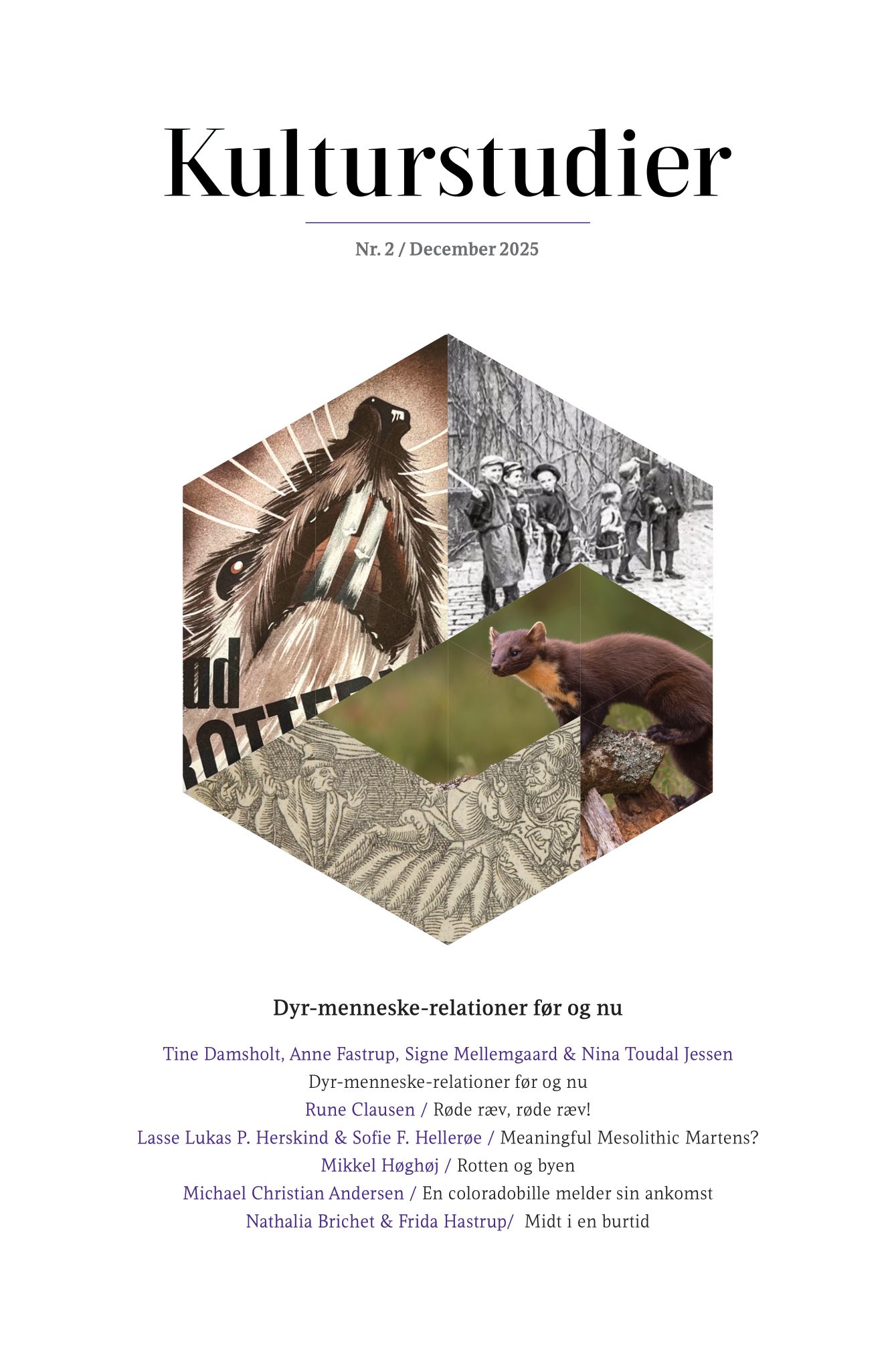
The presence of pine martens at prehistoric hunter-gatherer settlements has predominantly been interpreted as evidence of fur harvesting. In line with recent decades’ criticism of anthropocentric interpretations, this article revisits the interactions between pine martens and humans at the well-known hunter-gatherer site of Tybrind Vig (ca. 5600-4000 BC) on the island of Funen. The pine marten remains at Tybrind Vig have been interpreted as evidence of specialised hunting reflecting early fur economies. At this settlement, several pine martens were skinned and the remains discarded on the outskirts of the settlement. From a socio-zooarchaeological perspective, we question this one-sided economic interpretation and, on the contrary, pinpoint indications that this particular species was deliberately and respectfully deposited after being skinned. In doing so, we draw inspiration from recent trends in the interpretation of archaeological evidence and contribute to the picture of animal-human relations in our distant past.
Referencer
Aaris-Sørensen, Kim and Andreasen, Tine Nord 1992: “Small mammals from Danish Mesolithic sites.” Journal of Danish Archaeology 11, p. 30-38.
Andersen, Søren H. 1995: “Ringkloster – Ertebølle trappers and wild boar hunters in eastern Jutland – A survey.” Journal of Danish Archaeology 12, p. 13-59.
Andersen, Søren. H. 2013: Tybrind Vig: Submerged Mesolithic Settlements in Denmark. Jysk Arkæologisk Selskab, Højbjerg.
Andersson Cederholm, Erika et al. 2014: Exploring the Animal Turn: Human-animal relations in Science, Society and Culture. The Pufendorf Institute for Advanced Studies, Lund University, Lund.
Armstrong Oma, Kristin 2018: “Humanity and Animality”. Sandra L. López Varela (ed.): The Encyclopedia of Archaeological Sciences, p. 1-5.
Armstrong Oma, Kristin and Goldhahn, Joakim 2020: “Introduction: Human-Animal Relationships From a Long-Term Perspective.” Current Swedish Archaeology 28, p. 11-22.
Bailey, Geoff and Jöns, Hauke 2020: “The Baltic and Scandinavia: Introduction.” Geoff Bailey et al. (ed.): The archaeology of Europe’s drowned landscapes. Springer Open, Cham.
Bailey, Geoff et al. 2020: “Denmark: Mesolithic Coastal Landscapes Submerged.” Geoff Bailey et al. (ed.): The archaeology of Europe’s drowned landscapes. Springer Open, Cham.
Balestrieri, Alessandro et al. 2018: “Far from the madding crowd: Tolerance toward human disturbance shapes distribution and connectivity patterns of closely related Martes spp.” Population Ecology 61:7, p. 289-299. DOI: 10.1002/1438390X.12001.
Birks, Johnny 2017: Pine Martens. The British Natural History Collection vol. 8. Whittet Books, London.
Birks, Johnny et al. 2005: “Are scat surveys a reliable method for assessing distribution and population status of pine martens?” Daniel J. Harrison et al. (ed.): Martens and Fishers (Martes) in human-altered environments: an international perspective. Springer, Dordrecht.
Boyd, Brian 2017: “Archaeology and Human-Animal Relations: Thinking Through Anthropocentrism.” Annual Review of Anthropology 46, p. 299-316. DOI: 10.1146/annurev-anthro-102116-041346.
Brainerd, Scott M. et al. 1995: “Pine marten (Martes martes) selection of resting and denning sites in Scandinavian managed forests.” Annales Zoologici Fennici, 32 (1), II North European Symposium on the Ecology of Small and Medium-sized Carnivores, Lammi, Finland, 8-11 April, 1994. p. 151-157.
Bridgen, Adam 2023: “From the Pleistocene to COVID-19. A Brief History of Fur.”
Andrew Linzey and Clair Linzey (ed.) The Ethics of Fur: Religious, Cultural, and Legal Perspectives. Lexington Books/Fortress Academic, p. 15-27.
Brittain, Marcus and Overton, Nick J. 2013: “The Significance of Others: A Prehistory of Rhythm and Interspecies Participation.” Society and Animals 21:2, p. 134–149. DOI: 10.1163/15685306-12341298.
Broch, Harald Beyer 2009: “Tracks that Matter: On Space, Place and Hare Indian Ethnobiology with special reference to the Marten (Martes americana).” Acta Borealia 26:1, p. 77–95. DOI: 10.1080/08003830902951540.
Charles, Ruth 1997: “The Exploitation of Carnivores and Other Fur-bearing Mammals during the North-western European Late and Upper Paleolithic and Mesolithic.” Oxford Journal of Archaeology 16:3, p. 253–277. DOI: 10.1111/14680092.00040.
Chatterton, Richard 2006: “Ritual.” Chantal Conneller and Graeme Warren (ed.): Mesolithic Britain and Ireland. New Approaches. Tempus, Stroud, 101-120.
Conneller, Chantal 2004: “Becoming deer. Corporeal transformations at Star Carr.” Archaeological Dialogues 11:1, p. 37–56.
Conneller, Chantal 2022: The Mesolithic in Britain – Landscape and Society in Times of Change. Routledge, Abingdon.
Croose, Elizabeth et al. 2013: “Expansion zone survey of pine marten (Martes martes) distribution in Scotland.” Scottish Natural Heritage Commissioned Report no. 520.
De Marinis, Anna M. and Masseti, Marco 1995: “Feeding habits of the pine marten Martes martes L., 1758, in Europe: a review.” Hystrix, the Italian Journal of Mammalogy 7:1-2, p. 143-150.
Edelblutte, Émilie 2022: “Animal agency in wildlife conservation and management.” Conservation Biology p. 1– 15. DOI: 10.1111/cobi.13853.
Enghoff, Inge Bødker 2011: Regionality and biotope exploitation in Danish Ertebølle and adjoining periods. Det Kongelige Danske Videnskabernes Selskab.
Feit, Harvey A. 1986: “James Bay Cree Indian Management and Moral Considerations of Fur bearers.” Native People and Renewable Resource Management. 1986 Symposium of the Alberta Society of Professional Biologists (ASPB). Edmonton, p. 49-65.
Fowler, Chris 2004: The archaeology of personhood: An anthropological approach. Routledge, London.
Fudge, Erica 2013: “The Animal Face of Early Modern England.” Theory, Culture & Society 30:7–8, p. 177–198. DOI: 10.1177/0263276413496122.
Grant, Annie 1991: “Economic or Symbolic? Animals and Ritual Behaviour.” Paul Garwood et al. (ed.): Sacred and Profane – Proceedings of a Conference on Archaeology, Ritual and Religion. Oxford, 1989. Oxford Committee for Archaeology, Oxford, p. 109-114.
Haraway, Donna 2007: When Species Meet. University of Minnesota Press, Minneapolis.
Harrington, Laura A. et al. 2017: “People and wild musteloids.” David W. Macdonald et al. (ed.): Biology and Conservation of Musteloids. Oxford University Press, Oxford, p. 189–215.
Harris, Susanna 2014: “Sensible Dress: The Sight, Sound, Smell and Touch of Late Ertebølle Mesolithic Cloth Types.” Cambridge Archaeological Journal 24:1, p. 37-56. DOI: 10.1017/S0959774314000031.
Harris, Oliver J.T. and Cippola, Craig N. 2017: “Multi-species archaeology – People, plants and animals.” Oliver J.T. Harris and Craig N. Cippola (ed.): Archaeological Theory in the New Millenium. Routledge, Abingdon, p. 153-170.
Helldin, Jan Olof 2000: “Population trends and harvest management of pine marten Martes martes in Scandinavia.” Wildlife Biology 6:2, p. 111-120. DOI: 10.2981/wlb.2000.006.
Hill, Erica 2013: “Archaeology and Animal Persons: Toward a Prehistory of Human Animal Relations.” Environment and Society: Advances in Research 4:1, p. 117–136.
Holliday, Trenton W. 1998: “The Ecological Context of Trapping among Recent Hunter‐Gatherers: Implications for Subsistence in Terminal Pleistocene Europe.” Current Anthropology 39:5, p. 711–719. DOI: 10.1086/204794.
Hussain, Shumon T. et al. 2022: ”Being-with other predators: Cultural negotiations of Neanderthal-carnivore relationships in Late Pleistocene Europe.” Journal of Anthropological Archaeology 66. DOI: 10.1016/j.jaa.2022.101409.
Latour, Bruno 1991/2006: Vi har aldrig været moderne. Et essay om symmetrisk antropologi. Hans Reitzel.
Layton, Robert H. 2001: “Hunter-gatherers, their neighbours and the Nation State.” Catherine Panter-Brick et al. (ed.). Hunter-Gatherers – An Interdisciplinary Perspective. Cambridge University Press, Cambridge, p. 292-321.
Lévi-Strauss, Claude 1963: Totemism. Translated by R. Needham. Beacon Press, Boston.
Lindström, Erik R. 1997: Lär känna skogsmården. Svenska Jägareförbundet, Spånga.
Lõugas, Lembi 2017: “Mesolithic hunting and fishing in the coastal and terrestrial environments of the eastern Baltic.” Umberto Albarella et al. (ed.): The Oxford Handbook of Zooarchaeology. Oxford University Press, Oxford. p. 52-68.
MacPherson, Jenny and Denman, Huw 2015: “Pine Martens in Britain and Ireland – Recovery, Restoration and relevance for forestry.” The Royal Forestry Society 109:3, p. 181-185.
Manzo, Emiliano et al. 2011: “Estimation of population density of European pine marten in central Italy using camera trapping.” Acta Theriologica 57, p. 165-172. DOI: 10.1007/s13364-011-0055-8.
Maroo, S. and Yalden, Derek William 2000: “The Mesolithic mammal fauna of Great Britain.” Mammal Review 30, p. 243-248.
Morris, James 2010: “Associated bone groups; going beyond the Iron Age”. J. Morris, M. Maltby (Eds.), Integrating Social and Environmental Archaeologies: Reconsidering Deposition. British Archaeological Reports Internation Series 2077, Archaeopress, Oxford (2010), p. 12-23.
Mudappa, Divya 2013: “Herpestids, viverrids and mustelids.” AJT Johnsingh and Nima Manjrekar (ed.): Mammals of South Asia 1, Universities Press, India, p. 471-498.
Nadasdy, Paul 2007: “The gift in the animal: The ontology of hunting and human-animal sociality.” American Ethnologist 34:1, p. 25–43. DOI: 10.1525/ae.2007.34.1.25.
Ordonez, Alejandro and Riede, Felix 2022: “Changes in limiting factors for forager population dynamics in Europe across the last glacial-interglacial transition.” Nature Communications 13:1. DOI: 10.1038/s41467-022-32750-x.
Overton, Nick J. 2014: Memorable Meetings in the Mesolithic: Tracing the Biography of Human-Nonhuman Relationships in the Kennet and Colne Valleys with Social Zooarchaeology. University of Manchester administered thesis: PhD.
Overton, Nick J. 2016: “More than Skin Deep: Reconsidering Isolated Remains of ‘Fur-Bearing Species’ in the British and European Mesolithic.” Cambridge Archaeological Journal 26:4, p. 561-578.
Overton, Nick J. 2018a: “The Rhythm of Life – Exploring the role of daily and seasonal rhythms in the development of human-nonhuman relationships in the British Early Mesolithic.” Suzanne Pilaar Birch (ed.): Multispecies Archaeology. Routledge, London, p. 295-309.
Overton, Nick J. 2018b: “Can hunter-gatherers ever ‘get to know’ their prey?: The role of environmental experiences and daily interactions in the formation of human–nonhuman relationships in the British Mesolithic and beyond.” Hunter Gatherer Research 4:2, p. 193–226. DOI: 10.3828/hgr.2018.10.
Overton, Nick J. and Hamilakis, Yannis 2013: “A manifesto for a social zooarchaeology. Swans and other beings in the Mesolithic.” Archaeological Dialogues 20:2, p. 111-136.
Price, T. Douglas, 1983: “The European Mesolithic.” American Antiquity 48:4, p. 761-778.
Priestley, Erica 2020: “Beating the Dead Horse?: Using Ethnography for Middle Palaeolithic Zooarchaeological Contexts in North-West Europe.” Kyra Kaercher et al. (ed.). New Frontiers in Archaeology: Proceedings of the Cambridge Annual Student Archaeology Conference 2019, p. 136–152.
Proctor, Helen 2012: “Animal Sentience: Where Are We and Where Are We Heading?” Animals 2:4, p. 628-639. DOI: 10.3390/ani2040628.
Proulx, Gilbert and Santos-Reis, Margarida 2012: “A Century of Change in Research and Management on the Genus Martes.” Keith B. Aubry et al. (ed): Biology and Conservation of Martens, Sables, and Fishers: A New Synthesis. Cornell University Press, New York, p. 471-489.
Proulx, Gilbert et al. 2005: “World Distribution and status of the genus Martes in 2000.” Daniel J. Harrison et al. (ed.): Martens and Fishers (Martes) in human-altered environments: an international perspective. Springer, Boston, p. 21-76.
Pilaar Birch, Suzanne 2018: Multispecies Archaeology. Routledge, London.
Rasmussen, Kaare Lund 2013: “Radiocarbon dates from Tybrind Vig.” Søren H. Andersen (ed.): Tybrind Vig: Submerged Mesolithic Settlements in Denmark. Jysk Arkæologisk Selskab, Højbjerg, p. 363-365.
Reitz, Elisabeth J. and Wing, Elizabeth S. 2008: Zooarchaeology (2nd ed.). Cambridge University Press, Cambridge.
Richter, Jane and Noe-Nygaard, Nanna 2003: “A Late Mesolithic Hunting Station at Agernæs, Fyn, Denmark: Differentiation and Specialization in the late Ertebølle Culture, heralding the Introduction of Agriculture?” Acta Archaeologica 74:1, p. 1-64.
Richter, Jane 2005: “Selective hunting of pine marten, Martes martes, in Late Mesolithic Denmark.” Journal of Archaeological Science 32:8, p. 1223–1231. DOI: 10.1016/j.jas.2005.03.005.
Rowley-Conwy, Peter 1995: “Meat, Furs and Skins: Mesolithic Animal Bones from Ringkloster, a Seasonal Hunting Camp in Jutland.” Journal of Danish Archaeology 12:1, p. 87-98.
Russell, Nerissa 2012: Social zooarchaeology: humans and animals in prehistory. Cambridge University Press, Cambridge.
Sheehy, Emma et al. 2014: “A non-invasive approach to determining pine marten abundance and predation.” European Journal of Wildlife Research 60, p. 223–236. DOI: 10.1007/s10344-013-0771-2.
Singer, Peter 2015: Animal liberation. 40th anniversary edition. The Bodley Head, London.
Sommer, Robert and Benecke, Norbert 2004: “Late- and Post-Glacial history of the Mustelidae in Europe.” Mammal Rev. 34:4, p. 249–284. DOI: 10.1111/j.13652907.2004.00043.x.
Steffen, Martina L. 2023: “Can transport costs explain the near absence of marmot bones at shoreline archaeological sites on Vancouver Island? Finding input values for central place modelling with biological scaling.” Journal of Archaeological Science 150. DOI: 10.1016/j.jas.2023.105725.
Strid, Lena 2000: To eat or not to eat? The Significance of the Cutmarks on the Bones from wild canids, mustelids and felids from the Danish Ertebølle site Hjerk Nor. Master’s Thesis: University of Southampton.
Trolle, Tine 2013: “Human and animal bones from Tybrind Vig.” Søren H. Andersen (ed.): Tybrind Vig: Submerged Mesolithic Settlements in Denmark. Jysk Arkæologisk Selskab, Højbjerg, p. 413- 498.
Trolle-Lassen, Tine 1986: “Human Exploitation of the Pine Marten (Martes mates (L)) at the Late Mesolithic Settlement of Tybrind Vig in Western Funen.” Striae 24, p. 119-124.
Trolle-Lassen, Tine 1987: “Human exploitation of fur animals in Mesolithic Denmark.” Archaeozoologia, I:2, p. 85–102.
Trolle-Lassen, Tine 1990: “Butchering of Red Deer (Cervus elaphus L.)—A Case Study from the Late Mesolithic Settlement of Tybrind Vig, Denmark.” Journal of Danish Archaeology 9, p. 7–37.
Watanabe, Shigeru 2013: “Animal Aesthetics from the Perspective of Comparative Cognition.” Shigeru Watanabe and Stan Kuczaj (ed.). Emotions of animals and humans: comparative perspectives. Springer, p. 129-164.
Weil, Kari 2010: “A Report on the Animal Turn.” Differences, 21:2, p. 1–23. DOI: 10.1215/10407391-2010-001.
Wilson, Bob 1992: “Considerations for the identification of ritual deposits of animal bones in Iron Age pits.” International Journal of Osteoarchaeology 2, p. 341– 349. DOI: 10.1002/oa.1390020411.
Wendrich, Willleke Z. 2021: “Fowler, C. 2004. The archaeology of personhood. An anthropological approach. London/New York, Routledge.” PalArch’s Journal of Archaeology of Egypt / Egyptology 3:1, p. 1-2.
Zalewski, Andrzej and Jedrzejewski, Wlodzimierz 2006: “Spatial organisation and dynamics of the pine marten Martes martes population in Bialowieza Forest (E. Poland) compared with other European woodlands.” Ecography 29, p. 31–43. DOI: 10.1111/.2005.0906-7590.04313.x.
Downloads
Publiceret
Citation/Eksport
Nummer
Sektion
Licens
Copyright (c) 2025 Redaktionssekretær Kulturstudier; Lasse Lukas P. Herskind, Sofie F. Hellerøe

Dette værk er under følgende licens Creative Commons Navngivelse – Ikke-kommerciel – Ingen Bearbejdede Værker (by-nc-nd).
Tidsskriftet forbeholder sig ret til førsteudgivelsen, mens ophavsretten til artiklen tilfalder forfatteren.
Artikler udgivet af Kulturstudier licenseret under en Creative Commons Navngivelse-IkkeKommerciel-IngenBearbejdelse 4.0 International Licens


