
Design og kulturkritik
At være genstand for modstand
DOI:
https://doi.org/10.7146/ks.v2025i1.158443Nøgleord:
kritisk design, sociologi, materiel kultur, parafunktionalitet, Dunne og RabyResumé
Hvad kendetegner vores tingsrelationer? Hvordan hænger disse relationer sammen med den kulturelle og historiske virkelighed, vi er forankret i? Og kan kritisk tænkning og praksis bidrage til at synliggøre og måske ændre disse relationer?
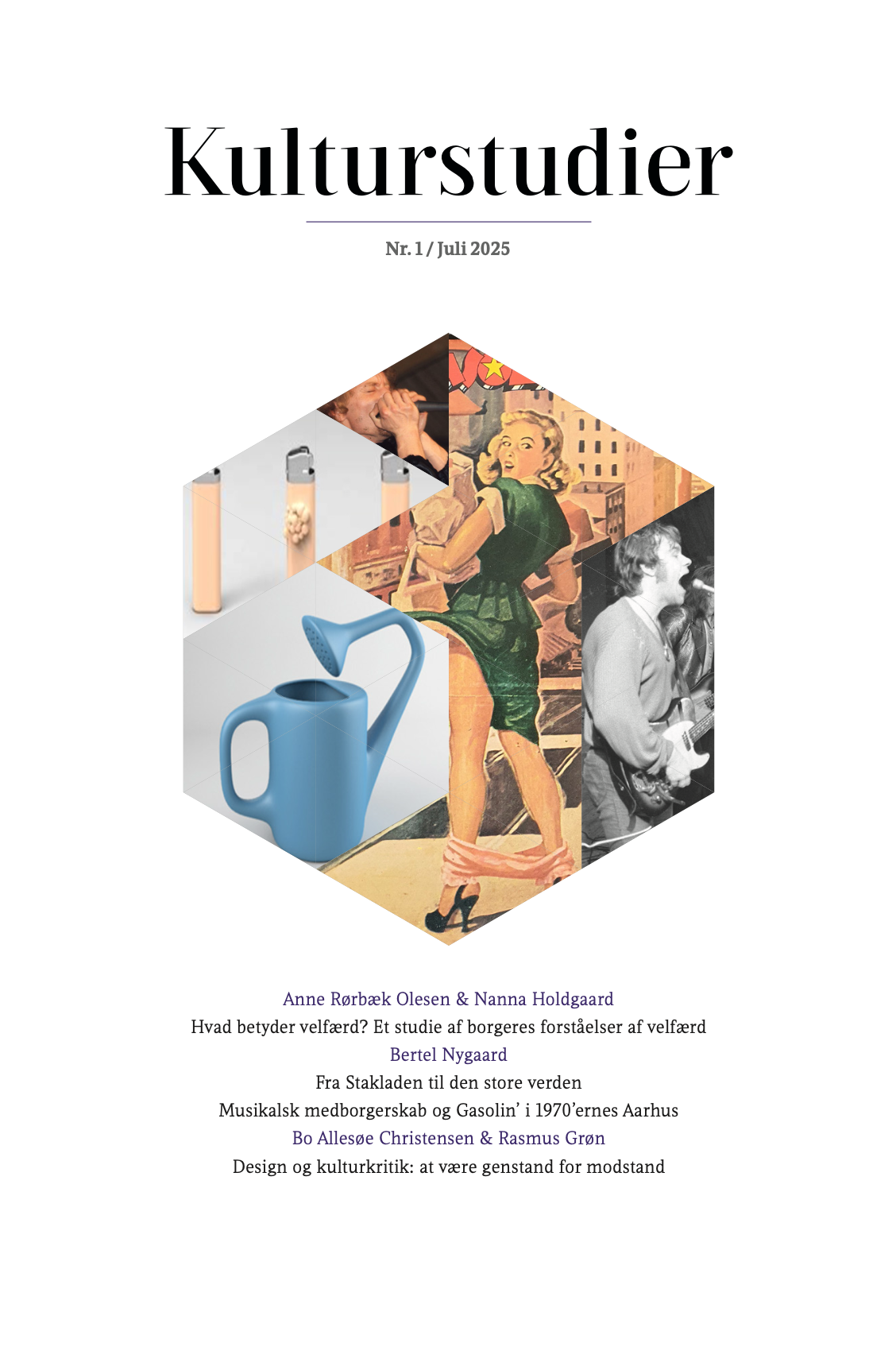
Artiklen vil adressere disse spørgsmål med udgangspunkt i den kritiske designtradition, som bl.a. udfordrer designobjekters traditionelle instrumentelle identitet med begrebet om ’parafunktionalitet’. Gennem en analyse af et kritisk
designprojekt undersøger vi, hvordan kritiske, parafunktionelle designobjekter kan skabe et brud med vores vanemæssige omgang med objekter og derved åbne for nye praksisser og en udvidet forståelse af vores relation til tingsverdenen.
I artiklens sidste del forsøger vi at karakterisere denne udvidede forståelse, ved at skelne mellem tingens objekt- og genstandskarakter.
Referencer
Adorno, Theodor 1997: Aesthetic Theory. London: Continuum.
Auger, James 2012: Why Robot? London: Royal College of Art.
Berker, Thomas (red.) 2006: Domestication of Media and Technology. Open University Press.
Bruner, Jerome 1990: Acts of meaning. Cambridge (Mass.): Harvard University Press.
Callon, Michel 1984: “Some elements in a sociology of translation: domestication of the scallops and fishermen of St Brieuc Bay”, Sociological Review, 32/1, 196-233.
Christensen, Bo Allesøe 2023: “Revisiting the Experience Machine. A Philosophical Note on the Limits of Experience Design”, Design Issues: 39:2, 14-26.
Costall, Allan 1995: “Socializing Affordances”, Theory & Psychology, 5:4, 467-81.
Davis, Jenny 2020: How Artifacts Afford. Cambridge (Mass.): MIT Press.
DSL (Det Danske Sprog- og Litteraturselskab) 2024: Den Danske Ordbog. URL: https://ordnet.dk/ddo.
Dunne, Anthony og Raby, Fiona 2001: Design Noir. The Secret Life of Electronic Objects. London: Bloomsbury Publishing.
Dunne, Anthony og Raby, Fiona 2002: “The Placebo Project”, i Proceedings of the 4th conference on Designing interactive systems: processes, practices, methods, and techniques, 11-14 https://doi.org/10.1145/778712.778714.
Dunne, Anthony 2006: Hertzian tales: Electronic products, aesthetic experience, and critical design. Cambridge (Mass.): MIT press.
Dunne, Anthony og Gaver, William 1999: “The Pillow: Artist-Designers in the Digital Age”, CHI 97, Late-Braking/Short Talks, 361-62.
Folkmann, Mads 2016: Designkulturer. København: Samfundslitteratur.
Garfinkel, Harry 1967: Studies in Ethnomethodology. Englewood Cliffs: Prentice-Hall.
Geiger, A. 2022. “What is a critical object? Design as «desubjugation» (after Foucault)” i Mareis, C., Greiner-Petter, M. and Renner, M. (red.): Critical by Design?: Genealogies, Practices, Positions. Bielefeld: transcript Verlag, 32-49. https://doi.org/10.1515/9783839461044-002.
Gentes, Annie & Mollon, Max 2015: “Critical Design. A Delicate Balance Between the Thrill of the Uncanny and the Interrogation of the Unknown” i D. Bihanic (ed.): Empowering Users through Design,79-101. Heidelberg: Springer Verlag.
Gibson, James 1979: The Ecological Approach to Visual Perception. Hillsdale: Lawrence Erlbaum Ass.
Goffman, Ervin 1983: “The interaction order: American Sociological Association, 1982 presidential address”, American Sociological Review, 48/1, 1-17.
Heidegger, Martin 1927: Sein und Zeit. Tübingen: Max Niemayer Verlag.
Horkheimer, Max og Adorno, Theodor 2002 (1947): Dialectic of Enlightenment. Philosophical Fragments. Stanford: Stanford University Press.
Kamprani, Katerina 2020: The Uncomfortable. https://www.theuncomfortable.com/ (besøgt 20/10 2024).
Latour, Bruno 1999: Pandora’s hope: essays on the reality of science studies. Cambridge (Mass.): Harvard University Press.
Lie, Merete og Sørensen, Knut 1996: “Making technology our own? Domesticating technologies into everyday life” i Lie, Merete og Sørensen, Knut (red.): Making Technology Our Own? Domesticating Technologies into Everyday Life. Oslo: Scandinavian University Press, 1-30.
Lupton, Deborah 2018: “Towards Design Sociology”, Sociology Compass, 12:1, 1-11 https://doi.org/10.1111/soc4.12546.
Malpass, Matt 2015: “Criticism and function in critical design practice”, Design Issues, 31:2, 59-71.
Malpass, Matt 2017: Critical Design in Context. History, Theory, and Practices. London: Bloomsbury.
Norman, Donald 1990: The design of everyday things. New York: Currency Doubleday.
Pierce. J. et al. 2015: “Expanding and Refining Design and Criticality in HCI”, CHI 2015, Crossings, Seoul, Korea, 2083-92.
Raby, Fiona 2008: “Critical Design”, Erlhoff, Michael og Marshall, Tim (red.): Design Dictionary. Board of International Research in Design, 91-93. Birkhäuser Basel. https://doi.org/10.1007/978-3-7643-8140-0_64.
Rossi, C. 2015: “Bricolage, Hybridity, Circularity: Crafting Production Strategies in Critical and Conceptual Design”, Design and Culture, 5:1, 69-87.
Rogers, Yvonne og Marshall, Paul 2017: ”Research in the Wild”, Synthesis Lectures on Human-Centered Informatics, 10/3, i-97.
Tharp, B. M. og Tharp, S. 2018: Discursive Design: Critical, Speculative, and Alternative Things. Cambridge (Mass.): MIT Press.
Trettvik, Johan 2001: “En økologisk tilgang til perception og aktivitet”, Psyke og Logos 22/2, 485-514.
Websteder:
Culture Trip 2018: The World’s Most Stressful Objects. [Video]. YouTube. URL: https://www.youtube.com/watch?v=MjXCUZf2G6I.
DSL (Det Danske Sprog- og Litteraturselskab) 2024: Den Danske Ordbog. URL: https://ordnet.dk/ddo.
Kamprani, Katerina 2020: The Uncomfortable. https://www.theuncomfortable.com/ (besøgt 20/10 2024).
Downloads
Publiceret
Citation/Eksport
Nummer
Sektion
Licens
Copyright (c) 2025 Redaktionssekretær Kulturstudier

Dette værk er under følgende licens Creative Commons Navngivelse – Ikke-kommerciel – Ingen Bearbejdede Værker (by-nc-nd).
Tidsskriftet forbeholder sig ret til førsteudgivelsen, mens ophavsretten til artiklen tilfalder forfatteren.
Artikler udgivet af Kulturstudier licenseret under en Creative Commons Navngivelse-IkkeKommerciel-IngenBearbejdelse 4.0 International Licens


