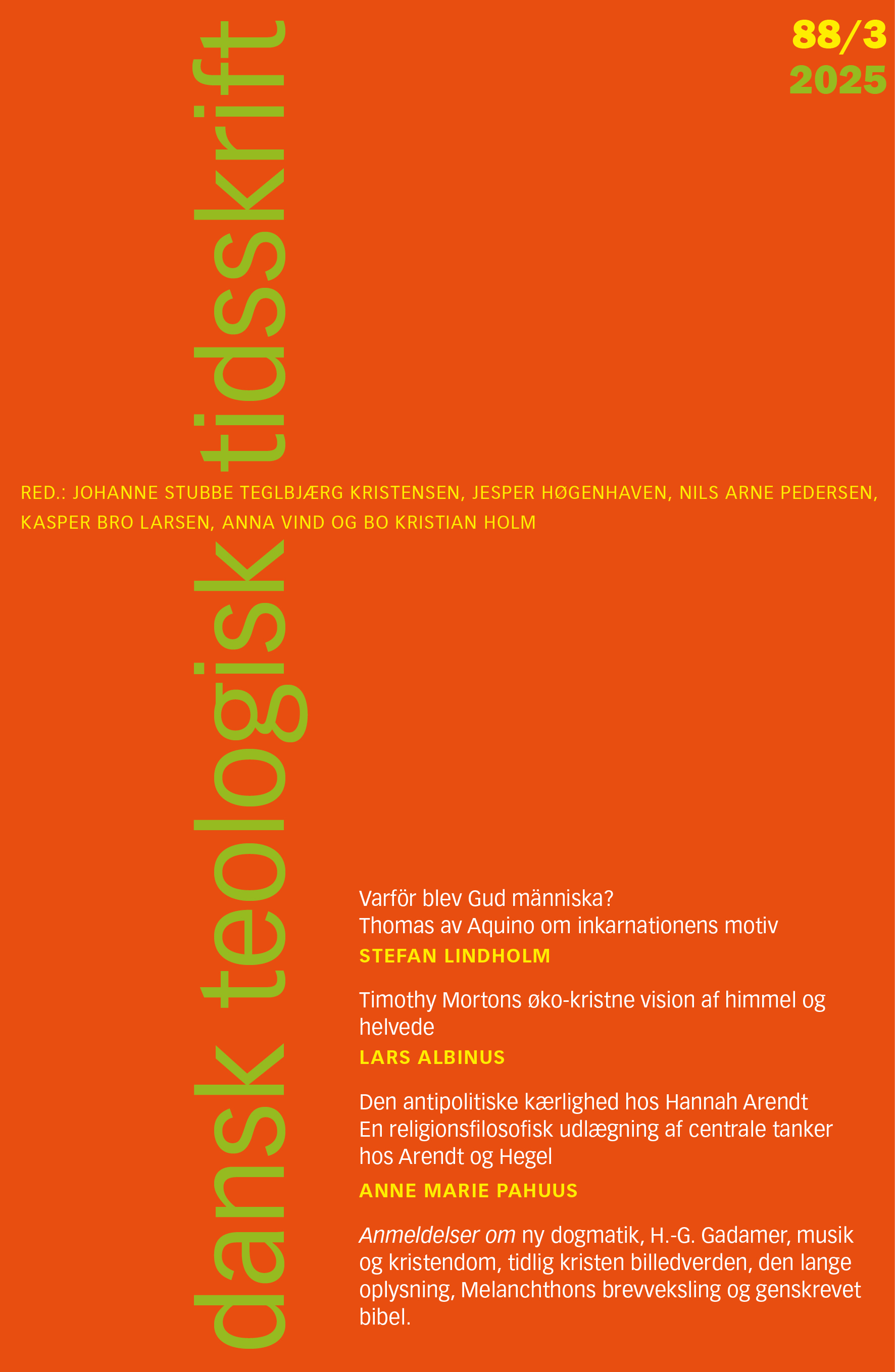
Timothy Mortons øko-kristne vision af himmel og helvede
DOI:
https://doi.org/10.7146/dtt.v88i3.160406Nøgleord:
Økologi, buddhistisk meditation, William Blake, Helvede, Kristen omvendelseResumé
Widely acclaimed philosopher Timothy Morton discloses that after having been involved with Tantric Buddhism for 40 years they (i.e., Morton) have recently become born-again-Christian. That personal note aside, they offer a challenging vision of the connection between Christianity and ecology in their latest book Hell: In Search of a Christian Ecology (2024). Loosely framed as an interpretation of – and thinking together with – William Blake’s work, Morton brings their own commitment to an object-oriented-ontology to bear on a drama between heaven and hell, appreciating the earth’s biosphere as the sacred reference for Christ’s announcement of the divine kingdom “to be at hand”. Christian ecology is, according to Morton, the faith in a future that is different from the Anthropocene’s hellish biotope of deluge and conflagration. The leading question of the present article is in what sense Morton’s ecological thinking attains a certain profile through their Christian self-understanding?
Referencer
Bryant, Levi R. 2011. The Democracy of Objects. Open Humanities Press [DOI: http://dx.doi.org/10.3998/ohp.9750134.0001.001]
Derrida, Jacques. 1998. “Faith and Knowledge: The Two Sources of ‘Religion’ at the Limits of Reason Alone.” I Religion, red. Jacques Derrida og Gianni Vattimo, 1-78. Cambridge: Polity Press.
Derrida, Jacques. 2008. The Animal That Therefore I Am. Overs. David Wills. New York: Fordham University Press.
Freud, Sigmund. 1930. Das Unbehagen in der Kultur. Wien: Internationaler Psychoanalytischer Verlag.
Heidegger, Martin. 1980. Holzwege. Frankfurt a.M.: Suhrkamp.
Heidegger, Martin. 1984. Die Frage Nach dem Ding: Zu Kants Lehre von den transzendentalen Grundsätzen. Gesammtausgabe, Vol. 41. Frankfurt a.M.: Vittorio Klostermann.
Hoffmeyer, Jesper. 2005. Biosemiotik – en afhandling om livets tegn og tegnenes liv. København: Forlaget Ries.
Morton, Timothy. 2010. The Ecological Thought. Cambridge, Massachusetts: Harvard University Press.
Morton, Timothy. 2013a. Realist Magic: Objects, Ontology, Causality. University of Michigan Library. Ann Arbour: Open Humanities Press.
Morton, Timothy. 2013b. “Thinking the Charnel Ground (The Charnel Ground Thinking): Auto-commentary and Death in Esoteric Buddhism.” I Glossator: Practice and Theory of the Commentary Volume 7: The Mystical Text (Black Clouds Course Through Me Unending . . . ), red. Nicola Masciandaro og Eugene Thacker, 73-94. Scotts Valley: CreateSpace Independent Publishing Platform,.
Morton, Timothy. 2018a. Dark Ecology: For a Logic of Future Coexistence. New York: Columbia University Press.
Morton, Timothy. 2018b. Being Ecological. London: Penguin House.
Morton, Timothy. 2019. Humankind: Solidarity with Nonhuman People, London og Brooklyn: Verso.
Morton, Timothy. 2023. The Stuff of Life. London: Bloomsbury Publishing.
Morton, Timothy. 2024. Hell: In Search of a Christian Ecology. New York: Columbia University Press.
Weil, Simone. 2002. Gravity and Grace, oversat af E. Crawford og M. van der Ruhr, London og New York: Routledge.
Downloads
Publiceret
Citation/Eksport
Nummer
Sektion
Licens
For årgange indtil 2008 tilhører copyright forfatteren og Dansk Teologisk Tidsskrift.
For årgangene 2008-2025 tilhører copyright forfatteren og Eksistensen Akademisk.
Artikler udgivet 2008-2025 må læsere downloade, linke til, og citere. Man må ikke ændre i teksten og heller ikke videreformidle artikler eller dele af artikler til kommercielt brug.
For årgange fra 2026 tilhører copyright forfatteren.
Fra 2026 udgives artikler i Dansk Teologisk Tidsskrift under en Creative Commons-licens: Attribution-NonCommercial-ShareAlike 4.0 International (CC BY-NC-SA 4.0).