
Hybris in Demosthenes’ Against Conon
Abstract
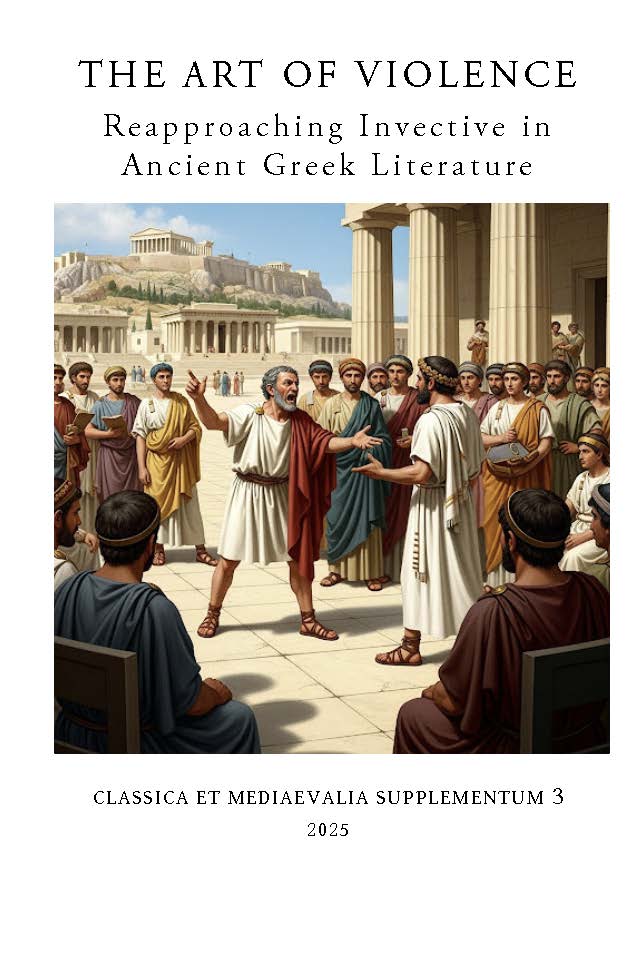
The speech Against Conon from the corpus Demosthenicum addresses the dispute between Ariston and Conon due to physical aggression by Conon’s son against Ariston, which has the contours of hybris, a term that appears in more than half of the sections. Despite the recurrence, the legal action is not a graphe hybreos, but a dike aikeias. This paper aims to analyse the role of hybris in the speech to characterize exacerbated violence, such that father and son are considered unfit for political life. The violence is physical, since Ariston is bedridden after the attack and symbolic, through the imitation of the rooster crowing over his beaten and naked body. Hybris is also associated with youth and wealth, topics presented by Aristotle in Rhetoric as a means of stirring up pathos and depicting ethos.
Downloads
Published
How to Cite
Issue
Section
License

This work is licensed under a Creative Commons Attribution 3.0 Unported License.
Authors who publish with this journal agree to the following terms:
- Authors retain copyright and grant the journal right of first publication with the work simultaneously licensed under a Creative Commons Attribution License that allows others to share the work with an acknowledgement of the work's authorship and initial publication in this journal.
- Authors are able to enter into separate, additional contractual arrangements for the non-exclusive distribution of the journal's published version of the work (e.g., post it to an institutional repository or publish it in a book), with an acknowledgement of its initial publication in this journal.
- Authors are permitted and encouraged to post their work online (e.g., in institutional repositories or on their website) prior to and during the submission process, as it can lead to productive exchanges, as well as earlier and greater citation of published work (see The Effect of Open Access).


