
Keywords
Grafteori
Klyngetilstande
How to Cite
Abstract
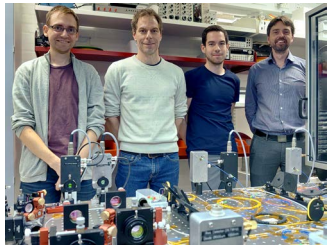
Hvordan bygger man en kvantecomputer, der faktisk kan bruges? Svaret kan ligge i grafteori og laserlys! I denne spændende artikel løfter fire kvanteforskere fra DTU sløret for, hvordan optiske kvantecomputere kan konstrueres ved hjælp af lys, klynger og matematiske grafer. De forklarer, hvordan komplekse beregninger i kvanteverdenen organiseres som netværk – og hvordan grafteori ikke bare hjælper med at beskrive strukturen, men med selve databehandlingen. Det er fysik og matematik i skarp symbiose – og et fascinerende indblik i morgendagens teknologi. Hvis du vil forstå, hvad kvantecomputere i praksis handler om, så er det her, du skal starte!
References
[1] R.P. Feynman (1982) "Simulating Physics with Computers", Int. J. Theor. Phys., bind 21, side 467.
https://doi.org/10.1007/BF02650179
[2] J.S. Bell (1964) "On the Einstein Podolsky Rosen paradox", Physics, bind 1, side 195.
https://doi.org/10.1103/PhysicsPhysiqueFizika.1.195
[3] A. Aspect m.fl. (1981) "Experimental Tests of Realistic Local Theories via Bell's Theorem", Phys. Rev. Lett., bind 47, side 460.
https://doi.org/10.1103/PhysRevLett.47.460
[4] B. Hensen m.fl. (2015) "Loophole-free Bell inequality violation using electron spins separated by 1.3 kilometers", Nature, bind 526, side 682.
https://doi.org/10.1038/nature15759
[5] D. Deutsch og B. Jozsa (1992) "Rapid solution by quantum computation", Proc. R. Soc. London, bind 439, side 553.
https://doi.org/10.1098/rspa.1992.0167
[6] S. Lloyd (1993) "A Potentially Realizable Quantum Computer", Science, bind 261, side 1569.
https://doi.org/10.1126/science.261.5128.1569
[7] S. Lloyd (1996) "Universal Quantum Simulators", Science, bind 273, side 1073.
https://doi.org/10.1126/science.273.5278.1073
[8] P.W. Shor (1994) "Algorithms for quantum computation: discrete logarithms and factoring", Proceedings 35th Annual Symposium on Foundations of Computer Science, IEEE Comput. Soc. Press, side 124-134.
https://doi.org/10.1109/SFCS.1994.365700
[9] J. Preskill (2018) "Quantum Computing in the NISQ era and beyond", arXiv:1801.00862v3.
https://doi.org/10.22331/q-2018-08-06-79
[10] https://www.nobelprize.org/uploads/2018/06/popular-physicsprize2012.pdf
[11] F. Arute m.fl. (2019) "Quantum supremacy using a programmable superconducting processor", Nature, bind 574, side 505.
[12] R. Rausendorff m.fl. (2001) "A One-Way Quantum Computer", Phys. Rev. Lett., bind 86, side 5188.
https://doi.org/10.1103/PhysRevLett.86.5188
[13] M.V. Larsen m.fl. (2019) "Deterministic generation of a two-dimensional cluster state", Science, bind 366, side 369.
https://doi.org/10.1126/science.aay4354
[14] W. Asavanant m.fl. (2019) "Generation of time-domain-multiplexed two-dimensional cluster state", Science, bind 366, side 373.
https://doi.org/10.1126/science.aay2645
[15] M.V. Larsen m.fl. (2020) "Deterministic multi-mode gates on a scalable photonic quantum computing platform", arXiv:2010.14422.
Counting from volume 37 (2026 -), articles published are licensed under Creative Commons Attribution-NonCommercial CC BY-NC 4.0.
Articles in volume 1-36 (1990 - 2025) are not licensed under Creative Commons. In these volumes, all rights are reserved to the authors of the articles respectively.