
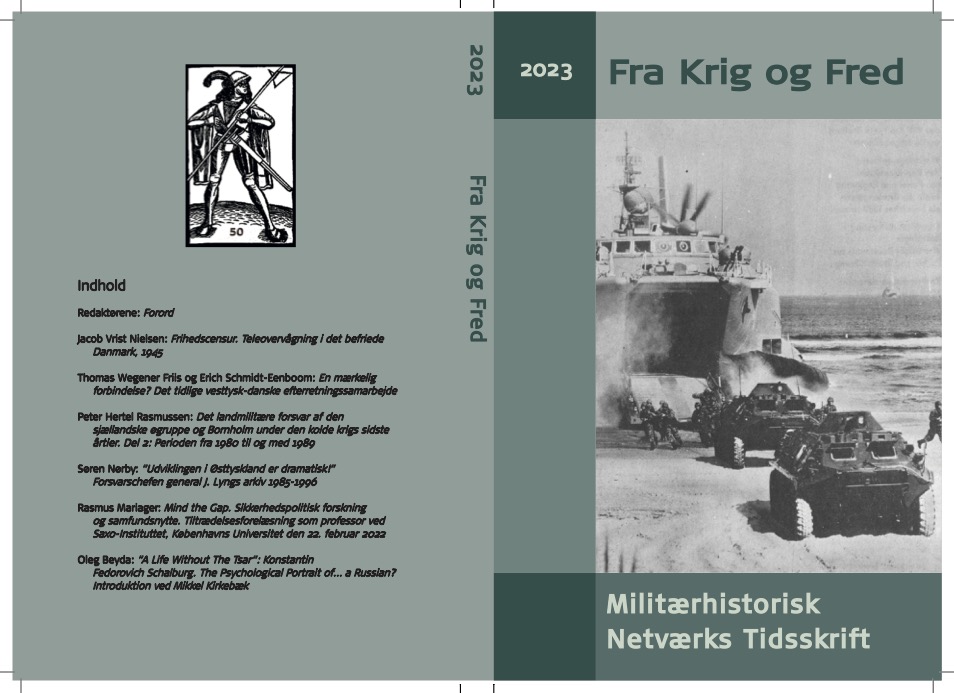
Det landmilitære forsvar af den sjællandske øgruppe og Bornholm under den kolde krigs sidste årtier. Del 2: Perioden fra 1980 til og med 1989.
Resumé
This article is the second and last of two articles analyzing the defence of the eastern part of Denmark, that is the Zealand group of islands and Bornholm during the last decades of the Cold War. The first article dealt with the developments in the 1970s and highlighted the negative effects of the continued numerical reduction of the Danish forces in the eastern part of Denmark. One significant element was the disbandment in 1973 of one of the three armoured infantry brigades, which until then had provided the only mobile reserve in the defence of Zealand. With only two armoured infantry brigades left, the defence would from now on lack the necessary reserve to cope with unforeseen events. At the same time, the military, air and naval forces of the Warsaw Pact in the Baltic continued their build-up. Apart from qualitative improvements in the Soviet and Polish amphibious forces, the 1980s witnessed a significant enlargement of airborne and helicopter-borne troops. The overall Danish strategy was to concentrate the main part of their defensive measures in a static defence against the amphibious forces, leaving the destruction of the Soviet and Polish airborne troops to the two armoured brigades. It was foreseen that when this had been accomplished, the two brigades would rush eastwards and join what was left of the coastal defence batalions in a counterattack against the enemy bridgeheads and hopefully destroy them. An essential element in the Danish defence of Zealand was the reinforcement by British troops. However, the continued reductions of Danish forces on Zealand made it questionable whether the British would in the last resort send a mobile force to Zealand. If the aim seen from the other side of the North Sea was to hinder Warsaw Pact naval forces from using the Danish straits in their efforts to join the Soviet Northern Fleet in the Atlantic, this could just as well be done by reinforcing the West German and Danish forces in Jutland. In the last years of the 1980s a possible shift in allocating British forces to Jutland instead of Zealand was evident. The expectations for the future, harbored by successive commanders of the Danish forces on Zealand in the last years of the 1980s were indeed bleak. It was not only the effect of the continued reductions in personnel and materiel, which contributed to this view, but just as well the likelihood that the defence of Zealand could in the least resort end up being a purely Danish affair.
Downloads
Publiceret
Citation/Eksport
Nummer
Sektion
Licens
Copyright (c) 2026 Forfatterne og Fra Krig og Fred

Dette værk er under følgende licens Creative Commons Navngivelse – Ikke-kommerciel – Ingen Bearbejdede Værker (by-nc-nd).
Forfattere og udgiveren bevarer deres ophavsret og ret til første publicering, samtidigt med at værket 5 år efter publiceringen er omfattet af en Creative Commons Attribution-licens, der giver andre ret til at dele værket med en anerkendelse af værkets forfatter og første publicering i nærværende tidsskrift.
Sherpa Romeo licens BLUE - www.sherpa.ac.uk/romeo/definitions.php
Tidskriftet er ikke ansvarlig for indhentelse af tilladelse fra tredjepart i forhold til brug af illustrationer mm. ved eventuel genudgivelse af materialet.
