
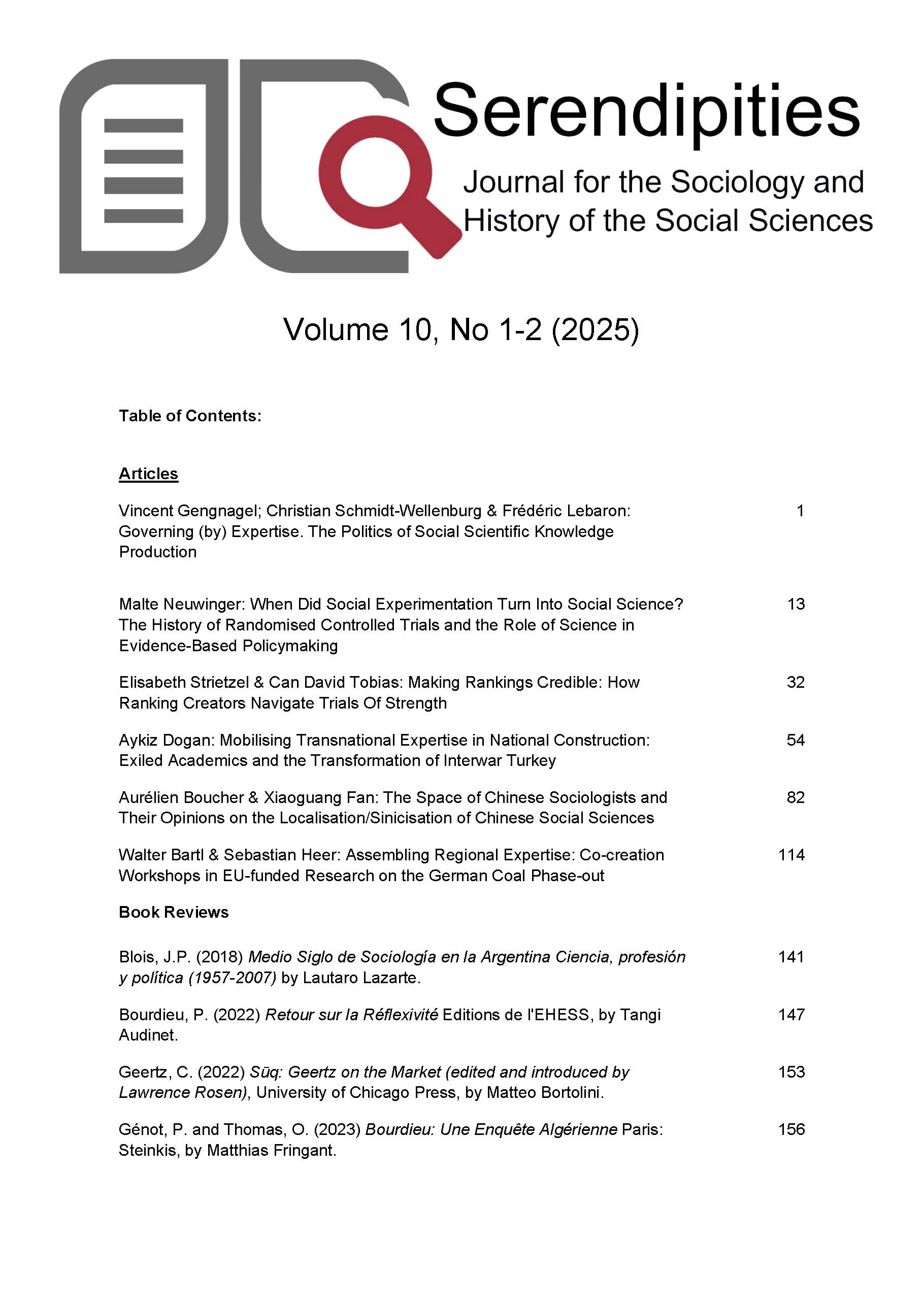
Assembling Regional Expertise: Co-creation Workshops in EU-funded Research on the German Coal Phase-out
DOI:
https://doi.org/10.7146/serendipities.v10i1-2.164272Keywords:
Mode 2, academic knowledge, practical knowledge, socially robust knowledge, multilevel governanceAbstract
Regional expertise is a crucial aspect of effective and legitimate policy formulation within the multilevel governance system of the European Union (EU). We argue that EU-funded research contributes to the multilevel network governance in the EU. However, until now, this aspect of expertise formation has undergone little analysis. Drawing on materials from an EU-funded research project on energy transition processes as well as our participation in this project as contracted researchers, we investigate how regional expertise is assembled in co-creation workshops of scientists and regional stakeholders. We first reconstruct the implicit programme theory of transformative research which emphasises the value of practical knowledge of (regional) stakeholders in complementing scientific knowledge for governance purposes. Using our analysis of the interactions between workshop participants, we point out the benefits and challenges of assembling regional expertise from heterogeneous actors. Finally, we compare this hybrid mode of knowledge co-creation with (hypothetical) more segregated forms of expertise.
References
Abend, G. (2023). Words and distinctions for the common good: Practical reason in the logic of social science. Princeton University Press.
Abson, D. J., Fischer, J., Leventon, J., Newig, J., Schomerus, T., Vilsmaier, U., Wehrden, H. von, Abernethy, P., Ives, C. D., Jager, N. W., & Lang, D. J. (2017). Leverage points for sustainability transformation. Ambio, 46(1), 30–39. https://doi.org/10.1007/s13280-016-0800-y
Barbosa Mendes, A., Bruns, C., Mahr, D., & Driessen, S. (2024). Understanding methodological innovation in participatory research: insights from participatory EU-funded projects. Journal of Science Communication, 23(06), N03. https://doi.org/10.22323/2.23060803
Baron, D., & Bartl, W. (2024). The Coal Phase-Out in Germany and its Regional Impacts on Economic Worries. Social Sciences, 13, 339. https://doi.org/10.3390/socsci13070339
Barrett, T. (2022). Lusatia Case Study Report (ENTRANCES D3.2). Leibniz Institute of Ecological Urban and Regional Development (IOER). https://entrancesproject.eu/wp-content/uploads/2022/12/D3.2-Lusatia-Case-Study-Report.pdf
Bartl, W., Heinisch, K., Holtemöller, O., Sackmann, R., & Schult, C. (2022). Central Germany Case Study Report (Energy Transitions from Coal and Carbon: Effects on Societies [ENTRANCES] D3.4). https://entrancesproject.eu/wp-content/uploads/2022/12/D3.4-CentralGermany-Case-Study-Report.pdf
Bartl, W., Heinisch, K., Holtemöller, O., & Schult, C. (2022). Rhineland Case Study Report (Energy Transitions from Coal and Carbon: Effects on Societies [ENTRANCES] D3.3). https://entrancesproject.eu/wp-content/uploads/2022/12/D3.3-Rhineland-Case-Study-Report.pdf
Bauer, M. W., & Börzel, T. A. (2010). Regions and the European Union. In H. Enderlein, S. Wälti, & M. Zürn (Eds.), Handbook on multi-level governance (pp. 253–263). Edward Elgar.
Bechmann, G. (2003). The Rise and Crisis of Scientific Expertise. In G. Bechmann & I. Hronszky (Eds.), Expertise and its interfaces: the tense relationship of science and politics (pp. 17–34). edition sigma.
Beck, U. (1992). From industrial society to the risk society: Questions of survival, social structure and ecological enlightenment. Theory, Culture & Society, 9(1), 97–123. https://doi.org/10.1177/026327692009001006
Beck, U., & Bonß, W. (1989). Verwissenschaftlichung ohne Aufklärung? Zum Strukturwandel von Sozialwissenschaft und Praxis. In U. Beck & W. Bonß (Eds.), Weder Sozialtechnologie noch Aufklärung? Analysen zur Verwendung sozialwissenschaftlichen Wissens (pp. 7–45). Suhrkamp.
BGBl (2020). Strukturstärkungsgesetz Kohleregionen. Vom 8. August 2020. Bundesgesetzblatt, Teil I(37), 1795–1817.
Bickman, L. (1987). The functions of program theory. In L. Bickman (Ed.), Using program theory in evaluation (pp. 5–18). Jossey-Bass. https://doi.org/10.1002/ev.1443
Boezeman, D., & Coninck, H. de (2018). Improving collaborative knowledge production for climate change mitigation: lessons from EU Horizon 2020 experiences. Sustainable Earth, 1(1), 6. https://doi.org/10.1186/s42055-018-0007-0
Börzel, T. A., & Heard-Lauréote, K. (2009). Networks in EU Multi-level Governance: Concepts and Contributions. Journal of Public Policy, 29(2), 135–151. https://doi.org/10.1017/S0143814X09001044
Bovens, M., & Wille, A. (2017). Diploma democracy: the rise of political meritocracy. Oxford University Press.
Brachert, M., Heinisch, K., Holtemöller, O., Kirsch, F., Neumann, U., Rothgang, M., Schmidt, T., Schult, C., Solms, A., & Titze, M. (2023). Begleitende Evaluierung des Investitionsgesetzes Kohleregionen (InvKG) und des STARK-Bundesprogramms. Zwischenbericht vom 30.06.2023: Gutachten im Auftrag des Bundesministeriums für Wirtschaft und Klimaschutz. Leibniz-Institut für Wirtschaftsforschung Halle (IWH).
Buschmann, P., & Oels, A. (2019). The overlooked role of discourse in breaking carbon lock‐in: The case of the German energy transition. WIREs Climate Change, 10(3), e574. https://doi.org/10.1002/wcc.574
Büttner, S., & Laux, T. (Eds.). (2021). Umstrittene Expertise: Zur Wissensproblematik der Politik. Nomos.
Carayannis, E. G., & Campbell, D. F. J. (2010). Triple Helix, Quadruple Helix and Quintuple Helix and how do knowledge, innovation and the environment relate to each other? a proposed framework for a trans-disciplinary analysis of sustainable development and social ecology. International Journal of Social Ecology and Sustainable Development, 1(1), 41–69.
Collins, H. M., & Evans, R. (2002). The Third Wave of Science Studies: Studies of Expertise and Experience. Social Studies of Science, 32(2), 235–296. https://doi.org/10.1177/0306312702032002003
David, M., & Gross, M. (2019). Futurizing politics and the sustainability of real-world experiments: what role for innovation and exnovation in the German energy transition? Sustainability Science, 14(4), 991–1000. https://doi.org/10.1007/s11625-019-00681-0
Demszky, A., & Nassehi, A. (2012). Perpetual loss and gain: Translation, estrangement and cyclical recurrence of experience based knowledges in public action. Policy and Society, 31(2), 169–181. https://doi.org/10.1016/j.polsoc.2012.04.006
Dienel, P. C. (2002). Die Planungszelle: Der Bürger als Chance (5. Auflage, mit Statusreport 2002). Westdeutscher Verlag. https://doi.org/10.1007/978-3-322-80842-4 (Original work published 1978)
Diluiso, F., Walk, P., Manych, N., Cerutti, N., Chipiga, V., Workman, A., Ayas, C., Cui, R. Y., Cui, D., Song, K., Banisch, L. A., Moretti, N., Callaghan, M. W., Clarke, L., Creutzig, F., Hilaire, J., Jotzo, F., Kalkuhl, M., Lamb, W. F., . . . Minx, J. C. (2021). Coal transitions—part 1: a systematic map and review of case study learnings from regional, national, and local coal phase-out experiences. Environmental Research Letters, 16(11), 113003. https://doi.org/10.1088/1748-9326/ac1b58
Elsässer, L., Hense, S., & Schäfer, A. (2017). „Dem Deutschen Volke“? Die ungleiche Responsivität des Bundestags. Zeitschrift Für Politikwissenschaft, 27(2), 161–180. https://doi.org/10.1007/s41358-017-0097-9
Epstein, S. (2023). The Meaning and Significance of Lay Expertise. In G. Eyal & T. Medvetz (Eds.), The Oxford Handbook of Expertise and Democratic Politics (pp. 76–102). Oxford University Press.
European Commission. (n.d.). The Just Transition Mechanism: making sure no one is left behind.
Eyal, G. (2013). For a Sociology of Expertise: The Social Origins of the Autism Epidemic. American Journal of Sociology, 118(4), 863–907. https://doi.org/10.1086/668448
Eyal, G., & Medvetz, T. (2023). Introduction. In G. Eyal & T. Medvetz (Eds.), The Oxford Handbook of Expertise and Democratic Politics (pp. 1–26). Oxford University Press.
Fazey, I., Schäpke, N., Caniglia, G., Hodgson, A., Kendrick, I., Lyon, C., Page, G., Patterson, J., Riedy, C., Strasser, T., Verveen, S., Adams, D., Goldstein, B., Klaes, M., Leicester, G., Linyard, A., McCurdy, A., Ryan, P., Sharpe, B., . . . Young, H. R. (2020). Transforming knowledge systems for life on Earth: Visions of future systems and how to get there. Energy Research & Social Science, 70, 101724. https://doi.org/10.1016/j.erss.2020.101724
Folkers, A. (2022). Preventing the Unpreparable. Catastrophe Thresholds from Covid to Climate. Sociologica, 15(3), 85–106. https://doi.org/10.6092/ISSN.1971-8853/13564
Fritz, L., Schilling, T., & Binder, C. R. (2019). Participation-effect pathways in transdisciplinary sustainability research: An empirical analysis of researchers’ and practitioners’ perceptions using a systems approach. Environmental Science & Policy, 102, 65–77. https://doi.org/10.1016/j.envsci.2019.08.010
Gaudry, A. J. P. (2011). Insurgent Research. Wicazo Sa Review, 26(1), 113–136. https://doi.org/10.5749/wicazosareview.26.1.0113
Geels, F. W., & Schot, J. (2007). Typology of sociotechnical transition pathways. Research Policy, 36(3), 399–417. https://doi.org/10.1016/j.respol.2007.01.003
Gellner, W. (1995). Ideenagenturen für Politik und Öffentlichkeit. VS Verlag für Sozialwissenschaften. https://doi.org/10.1007/978-3-322-95636-1
Gengnagel, V., Zimmermann, K., & Büttner, S. M. (2022). ‘Closer to the Market’: EU Research Governance and Symbolic Power. Journal of Common Market Studies, 60(6), 1573–1591. https://doi.org/10.1111/jcms.13326
Gold, R. L. (1958). Roles in Sociological Field Observations. Social Forces, 36(3), 217–223. https://doi.org/10.2307/2573808
Groves, C. (2017). Emptying the future: On the environmental politics of anticipation. Futures, 92, 29–38. https://doi.org/10.1016/j.futures.2016.06.003
Grundmann, R. (2017). The Problem of Expertise in Knowledge Societies. Minerva, 55(1), 25–48. https://doi.org/10.1007/s11024-016-9308-7
Haffert, L. (2024). Unequal Geographic Representation in a Mixed-Member Electoral System: Evidence from the German Bundestag. German Politics, 33(1), 86–109. https://doi.org/10.1080/09644008.2021.1982901
Heaton, J. (2008). Secondary analysis of qualitative data: An overview. Historical Social Research, 33(3), 33–45.
Heer, S. (2020). Bürgerbeteiligung im Lausitzer Strukturwandel. Ziele und Ausgestaltung bürgerschaftlicher Teilhabe im Zuge des Braunkohleausstiegs (IZS Policy Briefs). Leibniz Institute of Ecological Urban and Regional Development (IOER). https://doi.org/10.26084/06hc-t057
Heer, S., Büssers, S., Krehl, A., & Knippschild, R. (2024). Towards an integrative, interdisciplinary perspective on governing regional lignite phase-out in Germany, (Discussion Paper 14/2024). Niederrhein Institute for Regional and Structural Research. https://www.hs-niederrhein.de/fileadmin/dateien/Institute_und_Kompetenzzentren/NIERS/Discussion_Paper_Nr.17_2024_MS_17_Heer_etal_Braunkohle_.pdf
Heer, S., Wirth, P., Knippschild, R., & Matern, A. (2021). Guiding principles in transformation processes of coal phase-out. The German case of Lusatia. The Extractive Industries and Society, 8(1), 159–167. https://doi.org/10.1016/j.exis.2020.07.005
Herberg, J., Kamlage, J. H., Gabler, J., Goerke, U., Gürtler, K., Haas, T., Löw Beer, D., Luh, V., Knobbe, S., Reinermann, J., Staemmler, J., & Venghaus, S. (2020). Partizipative Governance und nachhaltiger Strukturwandel: Zwischenstand und Handlungsmöglichkeiten in der Lausitz und im Rheinischen Revier. Institute for Advanced Sustainability Studies (IASS).
Hölscher, K., Wittmayer, J. M., Hirschnitz-Garbers, M., Olfert, A., Walther, J., Schiller, G., & Brunnow, B. (2021). Transforming science and society? Methodological lessons from and for transformation research. Research Evaluation, 30(1), 73–89.
Isakova, A., Neuwinger, M., Schulze Waltrup, R., & Uraiqat, O. (2024). Global challenges in world politics and their modes of construction. In A. Isakova, M. Neuwinger, R. Schulze Waltrup, & O. Uraiqat (Eds.), Constructing Global Challenges in World Politics (pp. 3–20). Routledge.
Jansen, A., & Schirner, S. (2020). Die Fachkräftesituation in Deutschlands Kohleregionen (KOFA kompakt 10/2020). Kompetenzzentrum Fachkräftesicherung (KOFA). https://www.bildung-rheinisches-revier.de/fileadmin/user_upload/Dokumente/Kohleregionen.pdf
Kaldewey, D. (2018). The grand challenges discourse: Transforming identity work in science and science policy. Minerva, 56(2), 161–182. https://doi.org/10.1007/s11024-017-9332-2
Keeler, B. L., Chaplin-Kramer, R., Guerry, A. D., Addison, P. F. E., Bettigole, C., Burke, I. C., Gentry, B., Chambliss, L., Young, C., Travis, A. J., Darimont, C. T., Gordon, D. R., Hellmann, J., Kareiva, P., Monfort, S., Olander, L., Profeta, T., Possingham, H. P., Slotterback, C., . . . Vira, B. (2017). Society Is Ready for a New Kind of Science-Is Academia? Bioscience, 67(7), 591–592. https://doi.org/10.1093/biosci/bix051
Kim, J., & Yoo, J. (2019). Science and Technology Policy Research in the EU: From Framework Programme to HORIZON 2020. Social Sciences, 8(5), 153. https://doi.org/10.3390/socsci8050153
Knoblauch, H., & Löw, M. (2020). The Re-Figuration of Spaces and Refigured Modernity – Concept and Diagnosis. Historical Social Research, 45(2), 263–292. https://doi.org/10.12759/HSR.45.2020.2.263-292
Kosow, H., & Gaßner, R. (2022). Methoden der Zukunfts- und Szenarioanalyse: Überblick, Bewertung und Auswahlkriterien (Werkstattbericht No. 103). Institut für Zukunftsstudien und Technologiebewertung (IZT). https://www.izt.de/media/2022/10/IZT_WB103.pdf
Kuckartz, U. (2014). Qualitative text analysis: A guide to methods, practice & using software. Sage.
Levelt, M., & Metze, T. (2013). The legitimacy of regional governance networks: Gaining credibility in the shadow of hierarchy. Urban Studies, 51(11), 2371–2386. https://doi.org/10.1177/0042098013513044
Lietzmann, H. J., Renn, O., Freier, N., Kirby, N., & Oppold, D. (2021). Bürgerräte als eine zeitgemäße Ergänzung der repräsentativen Demokratie: Handreichung für eine Implementation deliberativer Bürgerräte. Institut für Demokratie- & Partizipationsforschung (i:DPF). https://doi.org/10.25926/rj2t-2763
Luderer, G., Kost, C., & Sörgel, D. (Eds.). (2021). Ariadne-Report: Deutschland auf dem Weg zur Klimaneutralität 2045. Szenarien und Pfade im Modellvergleich. Kopernikus-Projekt Ariadne, Potsdam-Institut für Klimafolgenforschung (PIK). https://doi.org/10.48485/pik.2021.006
Luhmann, N. (1977). Theoretische und praktische Probleme der anwendungsorientierten Sozialwissenschaften. In N. Luhmann (Ed.), Interaktion von Wissenschaft und Politik: Theoretische und praktische Probleme der anwendungsorientierten Sozialwissenschaften (pp. 16–39). Campus.
Luhmann, N. (1989). Ecological communication. Translated and introduced by John Bednarz Jr [Ökologische Kommunikation]. Polity Press.
MacKenzie, D. (2009). Making things the same: Gases, emission rights and the politics of carbon markets. Accounting, Organizations and Society, 34(3), 440–455. https://doi.org/10.1016/j.aos.2008.02.004
Markard, J., Isoaho, K., & Widdel, L. (2022). Discourses around decline: Comparing the debates on coal phase-out in the UK, Germany and Finland. In Z. Koretsky, P. Stegmaier, B. Turnheim, & H. van Lente (Eds.), Technologies in Decline (pp. 118–144). Routledge.
McDowall, W. (2024). Exploring cultures of evidence in energy policymaking in the UK, Germany, and the Netherlands. Policy and Society, 43(4), 463–478. https://doi.org/10.1093/polsoc/puae035
MDR. (2022). Kohleausstieg – festhalten oder verschieben? Mitteldeutscher Rundfunk (MDR). MDR fragt. https://www.mdr.de/nachrichten/mitmachen/mdrfragt/mdrfragt-ergebnisse-kohle-100-downloadFile.pdf
MDR. (2023). Habeck-Vorstoß: Kohle-Aus 2030 - nach NRW nun auch im Osten? Mitteldeutscher Rundfunk (MDR). MDR fragt. https://www.mdr.de/nachrichten/mitmachen/mdrfragt/mdrfragt-ergebnisse-kohleausstieg-100-downloadFile.pdf
Measham, T., Walker, J., McKenzie, F., Kirby, J., Williams, C., D’Urso, J., Littleboy, A., Samper, A., Rey, R., Maybee, B., Brereton, D., & Boggs, G. (2024). Beyond closure: A literature review and research agenda for post-mining transitions. Resources Policy, 90, 104859. https://doi.org/10.1016/j.resourpol.2024.104859
Meier, T., Penta, L., & Richter, A. (Eds.). (2022). Community Organizing: eine Einführung. Beltz Juventa.
Meisch, S. (2020). Transformative Research: The IASS Approach (IASS Discussion Paper). Institute for Advanced Sustainability Studies (IASS). https://doi.org/10.2312/iass.2020.021
Nowotny, H. (2003). Democratising expertise and socially robust knowledge. Science and Public Policy, 30(3), 151–156.
Nowotny, H., Scott, P., & Gibbons, M. (2001). Re-Thinking Science: Knowledge and the Public in an Age of Uncertainty. Polity Press.
Pärli, R., Fischer, M., Späth, L., & Lieberherr, E. (2022). Transdisciplinary research for sustainable development‐doing research about research. GAIA, 31(4), 238–242.
Prager, K., & Nicholas, G. (2024). Co-creation. In F. Darbellay (Ed.), Elgar Encyclopedia of Interdisciplinarity and Transdisciplinarity (pp. 50–53). Edward Elgar. https://doi.org/10.4337/9781035317967.ch12
Rabeharisoa, V., Moreira, T., & Akrich, M. (2014). Evidence-based activism: Patients’, users’ and activists’ groups in knowledge society. BioSocieties, 9(2), 111–128. https://doi.org/10.1057/biosoc.2014.2
Radaelli, C. M. (1999). The public policy of the European Union: whither politics of expertise? Journal of European Public Policy, 6(5), 757–774. https://doi.org/10.1080/135017699343360
Radtke, J., & David, M. (2024). How Germany is phasing out lignite: insights from the Coal Commission and local communities. Energy, Sustainability and Society, 14(1), 7. https://doi.org/10.1186/s13705-023-00434-z
REA. (n.d.). Horizon Europe - How to apply. https://rea.ec.europa.eu/horizon-europe-how-apply_en
Renn, O. (2021). Transdisciplinarity: Synthesis towards a modular approach. Futures, 130, 102744. https://doi.org/10.1016/j.futures.2021.102744
Ribbeck-Lampel, J., Spohr, P., & Otto, A. (2023). Revier ist nicht gleich Revier: Die Bedeutung von Raumstrukturen für die Transformation der Braunkohleregionen in Deutschland. Bundesinstitut für Bau-, Stadt- und Raumforschung (BBSR). urn:nbn:de:101:1-2023062811070627379870
Rittelmeyer, P., Lubell, M., Hovis, M., Heikkila, T., Gerlak, A., & Pozzi, T. (2024). Knowledge is not power: Learning in polycentric governance systems. Review of Policy Research. Advance online publication. https://doi.org/10.1111/ropr.12606
Rudnicki, S., & Wojnicka, K. (2024). Leaping the Abyss: The Problematic Translation of Social Research Results into Policy Recommendations. Sociological Research Online, Article 13607804241228688. Advance online publication. https://doi.org/10.1177/13607804241228688
Ruser, A. (2018). Climate Politics and the Impact of Think Tanks: Scientific Expertise in Germany and the US. Palgrave Macmillan.
Scheffer, T. (2002). Das Beobachten als sozialwissenschaftliche Methode - Von den Grenzen der Beobachtbarkeit und ihrer methodischen Bearbeitung. In D. Schaeffer & G. Müller-Mundt (Eds.), Qualitative Gesundheits- und Pflegeforschung (pp. 351–374). Huber.
Schneidewind, U., Singer-Brodowski, M., & Augenstein, K. (2016). Transformative Science for Sustainability Transitions. In H. G. Brauch, Ú. Oswald Spring, J. Grin, & J. Scheffran (Eds.), Handbook on Sustainability Transition and Sustainable Peace (pp. 123–136). Springer. https://doi.org/10.1007/978-3-319-43884-9_5
Schuck-Zöller, S., Cortekar, J., & Jacob, D. (2017). Evaluating co-creation of knowledge: from quality criteria and indicators to methods. Advances in Science & Research, 14, 305–312. https://doi.org/10.5194/asr-14-305-2017
Scott, J. C. (1998). Seeing like a state: How certain schemes to improve the human condition have failed. Yale University Press.
Seibicke, H. (2024). Investigating stakeholder rationales for participating in collaborative interactions at the policy–science nexus. Policy and Politics, 52(3), 477–500. https://doi.org/10.1332/03055736Y2023D000000010
Stock, M., Mitterle, A., & Baker, D. P. (2024). Academization: A New Perspective on Occupations. In M. Stock, A. Mitterle, & D. P. Baker (Eds.), How Universities Transform Occupations and Work in the 21st Century: The Academization of German and American Economies (pp. 1–24). Emerald Publishing. https://doi.org/10.1108/S1479-367920230000047001
Strambo, C., Aung, M. T., & Atteridge, A. (2019). Navigating coal mining closure and societal change: learning from past cases of mining decline. Stockholm Environment Institute. https://www.sei.org/wp-content/uploads/2019/07/navigating-coal-mining-closure-and-societal-change.pdf
Strohschneider, P. (2014). Zur Politik der Transformativen Wissenschaft. In A. Brodocz, D. Herrmann, R. Schmidt, D. Schulz, & J. Schulze Wessel (Eds.), Die Verfassung des Politischen (pp. 175–192). Springer VS. https://doi.org/10.1007/978-3-658-04784-9_10
Thune, T., Reymert, I., Gulbrandsen, M., & Simensen, E. (2023). Populating the science-policy co-production space: academic and policymaker perspectives on knowledge exchange. Studies in Higher Education, 48(5), 733–746. https://doi.org/10.1080/03075079.2023.2187772
Trevors, J. T., Pollack, G. H., Saier, M. H., & Masson, L. (2012). Transformative research: Definitions, approaches and consequences. Theory in Biosciences, 131(2), 117–123. https://doi.org/10.1007/s12064-012-0154-3
WBGU. (2011). World in Transition: A Social Contract for Sustainability (Flagship Report). German Advisory Council on Global Change (WBGU). https://www.wbgu.de/fileadmin/user_upload/wbgu/publikationen/hauptgutachten/hg2011/pdf/wbgu_jg2011_en.pdf
Weaver, R. K. (1989). The changing world of think tanks. Political Science & Politics, 22(3), 563–578.
Weingart, P. (1983). Verwissenschaftlichung der Gesellschaft - Politisierung der Wissenschaft. Zeitschrift Für Soziologie, 12(3), 225–241. https://doi.org/10.1515/zfsoz-1983-0303
Weingart, P. (2008). How robust is “socially robust knowledge”? In M. Carrier, D. Howard, & J. A. Kourany (Eds.), The challenge of the social and the pressure of practice: Science and values revisited (pp. 131–145). University of Pittsburgh Press.
Wilkinson, A., Kupers, R., & Mangalagiu, D. (2013). How plausibility-based scenario practices are grappling with complexity to appreciate and address 21st century challenges. Technological Forecasting and Social Change, 80(4), 699–710. https://doi.org/10.1016/j.techfore.2012.10.031
Wolfram, M. (2016). Conceptualizing urban transformative capacity: A framework for research and policy. Cities, 51, 121–130.
Wynne, B. (1989). Sheepfarming after Chernobyl: A Case Study in Communicating Scientific Information. Environment, 31(2), 10–39. https://doi.org/10.1080/00139157.1989.9928930
Downloads
Published
How to Cite
Issue
Section
License
Copyright (c) 2026 Walter Bartl , Sebastian Heer

This work is licensed under a Creative Commons Attribution-NonCommercial-NoDerivatives 4.0 International License.
CC-BY-NC-ND


