Social Interaction
Video-Based Studies of Human Sociality
The Moral Organization of Postural Readjustments in Edo-Bayashi
Junichi Yagi
Kyoto University1
Abstract
Drawing on multimodal conversation analysis and Goffman's notions of tracks and anchoring, this study examines the moral organization of postural readjustments (PRs) during Edo-Bayashi instruction. In this traditional style of Japanese taiko drumming, trainees need to remain still and attentive while seated in seiza, a posture whose physical demands make PRs a recurrent practical issue for participants. An analysis of an extended correction sequence, which entails the teacher's demonstration, shows how observing trainees position PRs around moments of salient instructional relevance (MSIRs) in ways that are sensitive to emergent syntax, rhythm, and the spatial configuration of the setting. In so doing, participants display their in-situ understanding of the teacher's talk and of what counts as "good" trainee behavior. As embodied accounts of participants' unofficial conduct, PRs anchor Edo-Bayashi instruction in the corpomaterial world while sustaining the coherence and recognizability of the main activity.
Keywords: Edo-Bayashi, multimodal conversation analysis, music, postural readjustments, unofficial conduct
1. Introduction
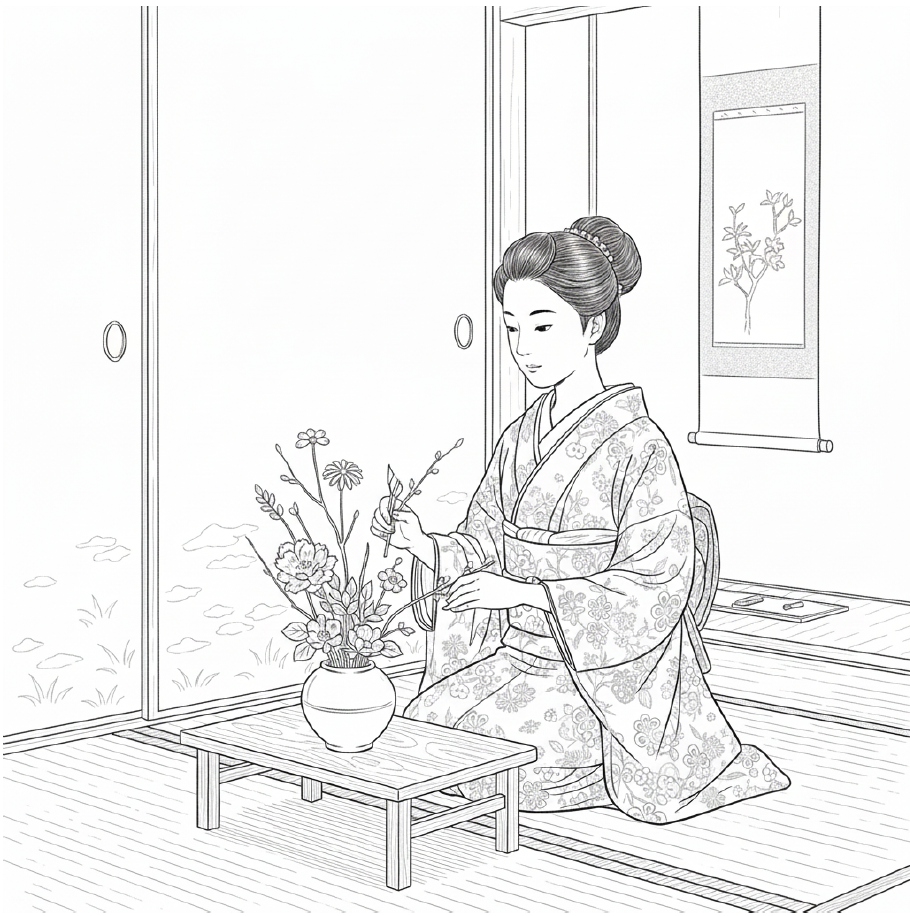
In traditional Japanese performing arts such as ikebana (Japanese flower arrangement) and shōgi (Japanese chess), participants commonly assume the seiza posture (lit. "proper sitting"), folding their legs beneath their thighs and resting their weight on their heels (Figure 1). Conventionally associated with formality, attentiveness, and discipline in Japanese culture (Suzuki, this volume), the seiza posture severely restricts blood circulation in the lower body, thus necessitating repeated bodily adjustments, particularly for younger or less physically conditioned participants. A central concern of this paper is the moral organization of postural readjustments (PRs)—that is, participants' recognizable attempts to alleviate discomfort—during observation in Edo-Bayashi instruction.2
Figure 1. A Japanese Woman Performing Ikebana in Seiza. (Source: Image generated by author with Gemini.)
There is a practical issue inherent in observing while seated in seiza: participants are expected to remain still and attentive, whereas the physical demands of the posture make prolonged stillness difficult to sustain. In response to this tension, PRs are produced in restrained and carefully timed ways so as not to disrupt the ongoing instructional activity. At the same time, observation involves not only minimizing movement, but also visibly displaying attentiveness. Thus, the issue for participants is not simply whether they are cognitively attentive, but whether they are accountably doing "being a good observer" through their embodied conduct (e.g., gaze, posture) during instructional activity. This reflexive relationship between bodily needs and publicly accountable attentiveness forms the analytic focus of the paper.
That said, the current paper examines how PRs are accountably fitted to the local contingencies of the teacher's talk, the bodily needs of the trainees, and the spatial configurations of the setting. An analysis of an extended correction sequence,3 in which the teacher demonstrates the basic patterns of Edo-Bayashi, shows how observing trainees manage the timing and visibility of such unofficial behavior so as not to disrupt the official instructional work. This is accomplished by placing PRs around contingently established focal points in correction and demonstration—what I term moments of salient instructional relevance (MSIRs).4 Based on these findings, I argue that PRs are accountably organized as an intrinsic feature of Edo-Bayashi. As embodied accounts of participants' unofficial conduct, PRs help preserve the recognizability of the main instructional activity while materially anchoring it in the lived experiences of taiko performers (Goffman, 1986).
In what follows, I first review the historical background of Edo-Bayashi within taiko traditions and then contextualize PRs using Goffman's analytic concepts. After the data-and-method section, I present an overview of an extended correction sequence, which entails a demonstration by the teacher, and then examine the target phenomenon in detail. The first two cases illustrate how PRs are systematically placed before demonstrations in relation to ongoing correction talk. The third case extends this observation to demonstrations themselves, where the timing of PRs is shaped not only by talk but also by the rhythmic and temporal organization of the demonstrated music. The final case shows how even more conspicuous bodily actions can remain accountable when organized in ways that preserve their legitimacy within the ongoing activity. The paper concludes with discussion and final remarks.
2. Background
2.1. Edo-Bayashi
Taiko is a "decidedly contemporary form of ensemble drumming that is built on the bones of Japanese festival drumming" (Wong, 2019, p. 4). Performers play a range of barrel-shaped wooden drums that vary in size and shape (Bender, 2012), including the ō-daiko (a large drum mounted on a raised wooden stand), chū-daiko (a medium-sized drum), and shime-daiko (a small, high-pitched drum), arranged in a manner comparable to an orchestral percussion section (Bender, 2012). In Japan, the taiko boom emerged as part of "nationalist folklore movements" in the 1950s and 1960s (Wong, 2019, p. 5). In the late 1960s, taiko drumming was brought to North America, primarily the West Coast, by Seiichi Tanaka and has since played an important role in Asian American identity construction (Wong, 2019).
Against this historical background, Edo-Bayashi—a traditional repertoire performed by an ensemble of shime-daiko and a Japanese flute—came to be treated as a source of authenticity within taiko communities seeking stronger connections to tradition. As Shibata (2019) notes, Edo-Bayashi has been formally established and transmitted within the Wakayama Ryū, a school of traditional folk performing arts based in downtown Tokyo. The teacher in the present study belongs to this lineage. Shibata (2019) argues that Edo-Bayashi is legitimated through "multiple modes of authentication" (p. 28), including, first, establishing ties to an origin and demonstrating convincing orthodox reproduction, and second, receiving validation from an authoritative figure whose status is socially recognized. Because many taiko performers sought a sense of authenticity that was not readily available in kumi-daiko (Yagi, 2022)—often treated as a relatively modern form of ensemble drumming—Edo-Bayashi gradually came to occupy a higher status as a more "authentic" and "traditional" form of taiko performance.5
Participants in the present data similarly orient to the faithful reproduction of Edo-Bayashi performances in ways conventionally recognized as "authentic" by individuals with certified authority. As a result, opportunities for creativity are purposefully constrained, and members treat creative capacity as accountably irrelevant. According to Shibata (2019), "[a]uthenticity in traditional Japanese performing arts is most often conceived as the performer's ability to correctly reproduce a past practice" (p. 36). To sustain the idea that what is being transmitted is authentic, taiko traditions—like many other Japanese performing arts—have historically relied on the iemoto ("headmaster") system for the transmission of professional knowledge and skill. This system is characterized by a hierarchical, pyramid-shaped organization, with the iemoto at the top, followed by teachers, and then a broader base of trainees (O'Neill, 1984; see also Hsu, 1975; Ortolani, 1969). The ways members orient to such hierarchy in the real-time sequential unfolding of interaction warrant closer inspection from an ethnomethodological perspective.
2.2. Postural readjustments
In his framework of keyings, Goffman (1986) proposed demonstration as a specific type of technical redoing designed to provide observing students with a "close picture of the doing of the activity" (p. 66). Demonstration is not only an activity in its own right but also a members' resource for organizing larger instructional activities. Building on Goffman, Råman (2018, 2019) investigated how budo practitioners, both teachers and students, manage transitions between teaching and practicing. Råman showed how these activity phases occur sequentially—with a teacher's demonstration followed by a student's practice attempt, and vice versa—and argued that this structural organization constitutes part of the membership knowledge of budo practitioners (ten Have, 2002; Yagi, 2024), an observation also present in my taiko data.
Demonstrations are not simply linearly ordered, as participants delicately manage entrances into and exits from the main activity alongside subsidiary courses of action (Haddington et al., 2014; Robinson & Stivers, 2001). Accordingly, a few other concepts are immediately relevant to the current study. Goffman (1986) noted that social encounters are organized through multiple tracks (or channels) of activity: (a) the main track, (b) the disattend track, (c) the directional track, and (d) the concealment track (see also Nardi, 1984). The key point here is the distinction between an official main activity and bodily behaviors that are treated as unofficial yet recognizably related to it. Furthermore, activity is inevitably "anchored" in the material world and in the embodied conditions of its production (Goffman, 1986, pp. 247–300). Because the seiza posture restricts blood circulation in the lower body, bodily adjustments become a recurrent feature of Edo-Bayashi. In this view, PRs can be seen as "allowable deviations from the behavioral discipline" (Kendon, 1990, p. 243), anchoring Edo-Bayashi performances and training sessions in material reality. In other words, participants maintain the coherence and recognizability of the main instructional activity by producing PRs as discreetly as possible.
Physiologically speaking, participants cannot fully suppress "creature releases" (Goffman, 1963, pp. 68–69). Unofficial conduct occasionally intrudes into the main activity and, when it does, is treated as disruptive. As documented in conversation-analytic studies on noises such as coughing, throat-clearing, and sniffing (Broth, 2011; Hoey, 2020), participants orient to such potential disruptiveness in various ways, shaping the sequential trajectory of ongoing practical activities (Heinemann & Rauniomaa, 2016; Rauniomaa & Heinemann, 2014). This tension is particularly heightened in performance-based settings. For instance, Broth (2011) showed how audience noises in theater performances are systematically positioned at performance "hinges" (p. 115), or within a "noise space" (p. 117), indicating an audience orientation to minimizing attention to themselves as individuals. Building on these observations, the present paper examines how taiko ensemble members visibly orient to PRs as unofficial conduct in Edo-Bayashi, illustrating how these creature releases are accountably organized within ongoing instruction.
2.3. On doing "observing": Temporality, rhythm, and alignment
In instructional activities such as practice, training, or rehearsals, expert demonstration can be treated as an embodied performance in its own right. As in budo training (Råman, 2018, 2019), trainees in my taiko data are tasked with observing the teacher's corrective demonstration. The observation of expert demonstration normatively demands that trainees monitor the demonstration-in-progress and the teacher's performing body while also displaying their recipiency (Nishizaka, 2006). This means that trainees must minimize disruption by carefully managing the timing and visibility of PRs. Insofar as participants orient to keeping their PRs minimally disruptive to the main activity, their conduct is morally organized and publicly accountable.
Participants' orientation to demonstrations as "produced for witness" (Nevile, 2007, p. 9) for co-present others is locally organized through distinct modes of seeing. Suzuki (this volume) provides a detailed account of how the director's postural changes indicate different modes of seeing in a theater rehearsal. Yet, not looking at the speaker does not necessarily indicate a lack of attention. Krug's (2023) study of theater rehearsals illustrates how an assistant director employs multimodal resources to monitor the progressivity of the ongoing performance and determine the precise timing of intervention. In so doing, the prompter manages the temporal complexities of multiactivity, as they can engage either in reading the script or in visually monitoring the actor at any given moment, but not both simultaneously. Different postures and gaze aversion may therefore indicate different modes of seeing, requiring participants to remain attentive to their interactional consequences.
The doing of "observing" is sequentially organized in close coordination with the emergent structures of ongoing talk and activity (Goodwin, 1979; Nishizaka, 2006). In music, members' conduct is also shaped by rhythm and tempo (Weeks, 1990, 1996), both of which are tightly intertwined with alignment in interaction (Ehmer, 2021; Keevallik, 2020). Furthermore, taiko performers are equipped with kuchi-shōga, a semi-conventionalized repertoire of taiko-specific ideophones (Yagi, 2022), such as teke teke and don don. This choral chanting offers a vocal resource for various instructional purposes. For instance, kuchi-shōga can be used to identify a specific element of the performance as a correctable, much like nonlexical vocalizations (Keevallik, 2010). Combined with gesture, the chanting operates within a "distinctive temporal organization characterized by the rhythmic constraints of the taiko music" (Yagi, 2022, p. 49). My Edo-Bayashi data likewise show the teacher employing kuchi-shōga during correction talk and subsequent demonstration, which makes interactional and musical alignment relevant from the recipients' end.
To summarize, observing trainees time their PRs in ways that are systematically fitted to both the emergent syntax of the teacher's talk and the rhythmic structure of his corrective demonstration. They must continually calibrate their bodily actions against the demonstration-in-progress, retarding, accelerating, and suspending them as necessary (Lerner & Raymond, 2021). As will be shown, the temporal elasticity of these embodied calibrations contributes to the disattended status of PRs, thereby preserving the coherence and recognizability of the main activity.
3. Data and Method
The current taiko dataset was originally collected from 2018 to 2019 for my dissertation project. I trained with a professional taiko ensemble in Hawaiʻi for approximately a year and a half (Yagi, 2022), during which I learned various styles of taiko drumming, including Sukeroku-Daiko (Bender, 2012; Wong, 2019) and Edo-Bayashi (Shibata, 2019). The training session, normally about two hours long, is organized as follows.
Training regularly begins at 10 or 11 o'clock in the morning. Whoever has the keys to the dojo arrives early to open the room. Novice trainees clean the floor, while others begin warming up and stretching. When the teacher and his wife arrive, everyone gathers in the center of the room. After a briefing on the upcoming schedule and logistics, the training officially begins with an aisatsu ("greeting"), chorally produced in Japanese. Unless there is an upcoming concert, the session usually starts with Edo-Bayashi, for which novice trainees arrange cushions and shime-daiko on the floor. The second half of the session is dedicated to practicing contemporary kumi-daiko pieces (mostly the teacher's own compositions), which constitute the majority of the ensemble's repertoire. The training concludes with another briefing on logistics and, finally, a post-training aisatsu.
The target segment was selected for analysis because it was one of the few instances of Edo-Bayashi instruction in which all participants were clearly visible and because it constituted the most extended session recorded during the fieldwork. As a physiological phenomenon, PRs are omnipresent in seiza, as bodily movement is necessary for blood circulation. Although the analysis focuses on a single episode of interaction, the abundance of the target phenomenon allows the segment to be treated as a "single clip collection," featuring "[multiple] participants facing not only an identical, but actually the same, practical problem" (Broth & Keevallik, 2014, p. 110).
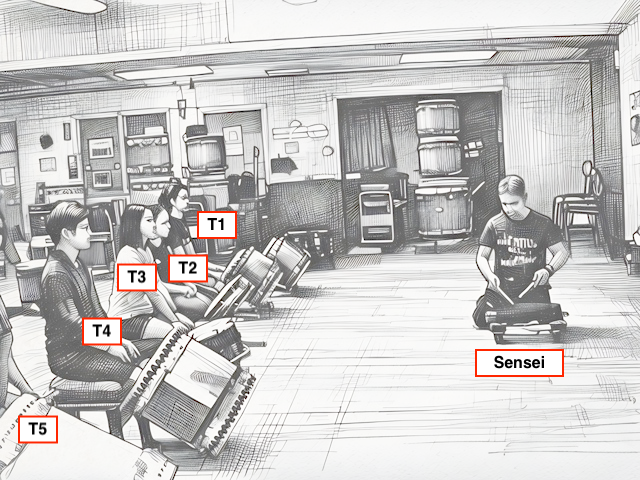
Participants in the analyzed segment consisted of the teacher (S: Sensei; lit. "teacher") and five trainees (T1–T5), including the researcher (T4).6 Their skill levels ranged from novice to upper-intermediate. The members (except for T4) were all L1 speakers of English. Japanese was rarely used for instruction, although it frequently appeared in formulaic expressions such as greetings and kuchi-shōga (chanting). The ensemble's teacher had trained in renowned schools in Tokyo, where he learned Edo-Bayashi and other forms of hōgaku (traditional Japanese music) firsthand. This intensive training experience, together with his extensive knowledge and performing skills, grants him notable authority as a legitimate successor of Wakayama Ryū.
For purposes of anonymization, all names appearing in this paper were altered, and frame grabs were filtered using editing software. Talk was transcribed according to Jefferson's (2004) conventions, while participants' embodied actions were represented using a simplified version of Mondada's (2018) system, which uses the plus (+) symbol for all embodied actions for better accessibility. The term "repos," a shorthand for "repositioning," indicates an occurrence of PR.7 Parenthetical numbers in the analysis (e.g., 1, 2, 3…) indicate the corresponding line numbers in the excerpts. Frame grabs are preceded by the plus (+) symbol and numbered using the sharp (#) symbol (e.g., #1, #2…). In the excerpts, the five trainees (T1–T5) face the teacher (S) (Figure 2).
Figure 2. Edo-Bayashi Participants.
4. Analysis
Before proceeding to the analysis, a brief overview of the target correction sequence is in order. In this part of the training, the teacher is explaining the basic patterns of Edo-Bayashi to his trainees. After closing the trainees' performance and announcing a resumption, he identifies a particular element as a correctable: the ku should be played louder than the tsu. The referential use of kuchi-shōga is commonly observed in taiko communities (Bender, 2012; Endo, 1999). Thanks to its semi-conventionality, kuchi-shōga enables performers to identify which stroke is played with which hand simply by hearing the chanting (Yagi, 2022). The correction here targets the volume of the performance (i.e., soft vs. loud playing) in relation to the corresponding sticking (i.e., left vs. right hand). This is followed by an embodied demonstration, which is briefly aborted and then redone. The teacher treats the second version as practically sufficient and prompts the trainees to resume playing.
To establish the phenomenon, I first examine two candidate cases in which PRs are placed prior to demonstrations and analyze their positioning in relation to unfolding correction talk. In so doing, I show how observing trainees position PRs around MSIRs to display their in-situ understanding of the teacher's talk and of what counts as "good" trainee behavior within the activity-in-progress. The third case extends this observation to PRs during the demonstration, where timing is shaped not only by talk but also by the rhythmic and temporal organization of the performance. The final case shows that even more conspicuous bodily actions can be treated as accountable when organized in ways that preserve their legitimacy within the ongoing activity. I begin below with PRs placed before the demonstration.
4.1. Postural readjustments before the demonstration
The main sequential positions of the target phenomenon observed in the current dataset are as follows: (a) before the demonstration (verbal elements of the correction), (b) during the demonstration (expert performance), and (c) after the demonstration (prior to practice resumption); the current paper focuses on the first two types. PRs can be further categorized with respect to their execution, including speed, audibility, and visibility (Lerner & Raymond, 2017, 2021; Rauniomaa & Heinemann, 2014).8 While gaze plays a crucial role across these dimensions, gaze aversion does not necessarily indicate a lack of attention. As will be shown, PRs are produced in sequential environments in which trainees can accountably minimize the disruption caused by their unofficial behavior (i.e., correction hinges; cf. Broth, 2011), that is, before or after an MSIR. A canonical example of what may be termed pre-demonstration PRs is provided below.
Excerpt 1. Back-Straightening
Open in a separate windowJust as the teacher initiates a turn ("an' (.)"; 5) after closing the trainees' performance with third-position assessments (line not shown), T5 starts to lean forward (#1), gazing at T4 sitting next to her as T4 puts his sticks down on the floor. Note that the apexes of the two participants' leaning-forward moves are synchronized (Ehmer, 2021). This is achieved as T5 accelerates and retards her leaning so as to match the tempo of T4's sticks-down action (Lerner, 2002; Lerner & Raymond, 2021). With the teacher's initiated turn still emerging ("an' all these"; 5), the talk has not yet reached any focal point (i.e., an MSIR).
T5 then shifts her gaze downward (5), seemingly toward her feet, which can be seen wiggling from an alternative camera angle (#2).9 The point is, T5 averts her gaze, albeit momentarily, from the teacher. T5 then inhales (7) as she straightens her back (#3) and flips her hair (8), refocusing her gaze toward the teacher before averting it again. Notice how the leaning forward is aligned with the prosodic peak of the teacher's turn ("an' all these"; 5). Her inhalation and back-straightening are executed nearly in sync with a possible completion point ("left-handed"; 6), almost as if punctuating the talk with the hair-flipping (8). T5's second gaze shift, which appears to be part of this motion sequence, occurs after the possible completion of the correction talk.
On the other hand, T1's leaning forward (#2) is slightly displaced from the prosodic peak ("an' all these"; 5). T1 shifts his gaze to the right to bring the teacher's body into sight—this occurs after the prosodic marking of an instructable (i.e., "all these [patterns]")—and sustains that leaned-in position until the completion of the teacher's "left-handed" instruction (6). A split second after the clank sound (9), which closely aligns with T5's hair-flipping (8), T1 readjusts his sitting posture by bringing his upper body back up. In this light, the precise timing of the clank sound (9), produced by T3,10 can be understood as the result of her waiting for an "allowable" time slot (Goffman, 1986), in which she can accountably execute the sticks-down action without being heard as disruptive.
The excerpt above shows how PRs are positioned around specific MSIRs, including the prosodic peak and the possible completion of the teacher's correction. The sequential positioning of PRs demonstrates that recipients, despite some individual differences, orient to both the local construction of the unfolding talk and the potential disruptiveness of their embodied conduct. Importantly, the identification and production of these focal moments are reflexively achieved; they are contingently established in specific sequential positions through members' embodied arrangements within the instructional space.
A direct continuation of the first excerpt, Excerpt 2 offers another case of pre-demonstration PRs. Following the "clank" sound caused by T3's placing her sticks on the floor (9), T4 (the researcher) lifts and reorients his gaze toward the teacher (8). This occurs after the teacher closes the trainees' performance with third-position assessments (line not shown) and the "left-handed" instruction (5–6), which makes relevant the introduction of a new correctable.
Excerpt 2. Gaze Coordination
Open in a separate windowT4 fixes his gaze on the teacher for a while, but as it becomes recognizable through perturbations (10) that the talk is not immediately forthcoming, he shifts his gaze to T5, who is sitting on his right (#4). This gaze shift by T4 likely displays an orientation to T5's immediately prior PRs (5–9), suggesting that T4 has recognized a correction hinge (cf. Broth, 2011) and taken the opportunity to produce PRs as discreetly as possible. In line 11, the teacher announces a practice resumption. It is during this turn—in which the trainees' re-playing of the target patterns is announced as a future action (Szczepek Reed et al., 2013)—that T4 looks down and readjusts his sitting posture (#5). Coupled with gaze coordination, these embodied readjustments constitute an inherent feature of Edo-Bayashi that materially anchors the ongoing instructional activity in the lived experiences of taiko performers.
In line 11, the targeted correctable is not yet hearably available, as it is signposted as a prospective indexical ("it"; Goodwin, 1996). T4 continues readjusting his posture, during which he rests his legs, and finally shifts his gaze upward (#6), recapturing the teacher's gesturing hands in vision. The upward gaze shift is synchronized with the verbal production of the "tsukus" (12), the very moment at which the indexical reference is fulfilled. PRs are therefore structurally occasioned within a specific correction hinge in which a focal point has yet to be addressed. At the same time, the positioning of PRs marks particular components of the surrounding talk as focal, through which participants exhibit their situated understanding of activity boundaries. MSIRs are thus reflexively constituted in correction talk through members' accountable production of PRs.
4.2. Postural readjustments during the demonstration
This section examines PRs during the teacher's demonstration, illustrating how they can be placed and shaped not only by the surrounding talk but also by the rhythmic structure of the demonstrated pattern. Excerpt 3 begins a few lines after Excerpt 2. In line 16, T4 (the researcher) slowly leans in as the teacher initiates a corrective demonstration. The initial demonstration (16) is immediately cut off by the insertion of a quotative marker—which fills in the syntactic gap (Keevallik, 2010)—and is then continued by a second demonstration (17).11 At the suspension of the demonstration, T4 returns to the home position (Sacks & Schegloff, 2002), largely aligned with the linguistic precedent ("so it's-"; 16).
Excerpt 3. Freeze Look
Open in a separate windowAs soon as T4 withdraws, T5 starts leaning forward (17), coupled with a freeze look (Manrique & Enfield, 2015; Yagi, 2021) of notable length (#10). T5 then withdraws—much like T4 did a few seconds earlier—as the teacher's playing unfolds. This withdrawal, both interactionally and musically speaking, is executed in an extremely intricate manner.
Figure 3 shows the music notation of the demonstration, which is organized into two 4/4 measures. In music, a 4/4 measure consists of four beats arranged into a recurring rhythmic unit, with each beat occupying an equal duration. In Edo-Bayashi, basic patterns are likewise structured through such repeating four-beat measures, which participants orient to as recognizable rhythmic segments (Yagi, 2022).
Figure 3. Music Notation of the Corrective Demonstration.
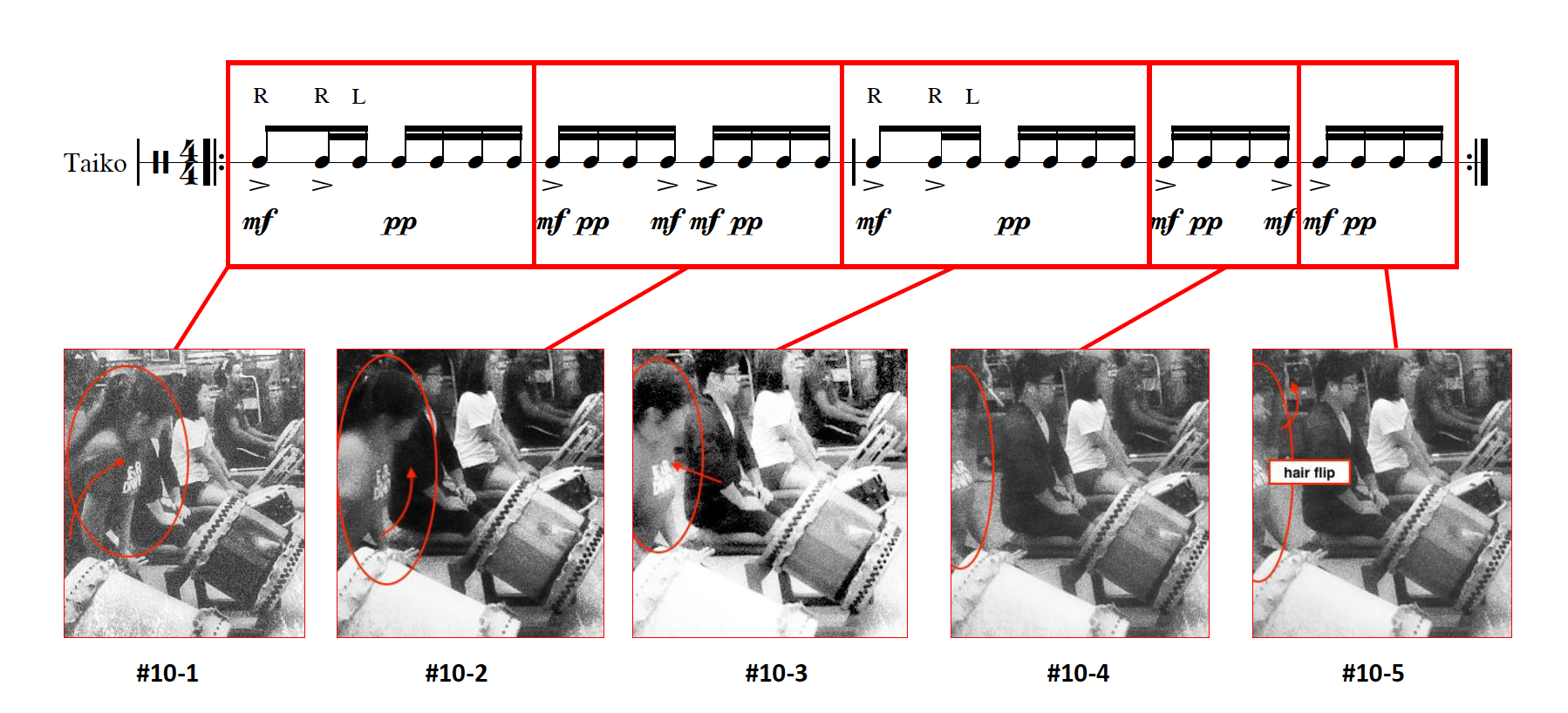
Note how T5's leaning-forward reaches its apex during the first two beats of the first measure (#10-1). She then slowly retracts, bringing her upper body back during the second half of the first measure (#10-2). By the beginning of the second measure, T5's upper body is almost vertical (#10-3). Following a brief gaze aversion (#10-4)—her gaze shifts downward for a moment—T5 performs another hair flip (#10-5), which is synchronized with the last accent, that is, the first note of the final sixteenth notes. PRs are thus produced in close alignment with the rhythmic structure of the demonstrated pattern.
It would appear, then, that T5 claims recognition that the second measure will simply be a repetition of the first through the musical alignment of PRs—which in itself serves as a display of understanding that the phrase being demonstrated can be restructured as a pair of separable rhythmic units (Yagi, 2021). Such embodied segmentation bridges the current observation and a subsequent redoing, allowing the trainee to draw on this knowledge when she is instructed to replay the pattern with the other trainees after the correction.
4.3. "Conspicuous" postural readjustments during the demonstration
I have so far examined cases in which the occurrence of PRs is made accountable by reference to the surrounding components of correction talk (Excerpts 1–2), as well as to the rhythmic organization of embodied demonstration (Excerpt 3). Across these cases, the sequential positioning of PRs aligns with previous findings that treat visual orientation as a constituent feature of instruction (e.g., Nevile, 2007; Nishizaka, 2006).
On the basis of the preceding analysis, several principles underlying the production of PRs may be formulated. First, trainees are discouraged from "looking away" from the teacher during talk or demonstration, reflecting the moral organization of gaze. Second, trainees are normatively expected to minimize the potential disruptiveness of PRs, which strongly indicates an orientation to their audibility, visibility, and timing. Third, when PRs are unavoidable—for instance, when participants can no longer sustain seiza—they are sequentially placed at correction hinges with reference to MSIRs so as not to interrupt the ongoing instruction.
As stressed throughout, the identification and production of MSIRs are locally contingent. The analytic claims advanced here are grounded primarily in the participants' public displays of orientation to particular moments in the unfolding activity as "allowable and disattendable" slots for producing creature releases through embodied coordination (Goffman, 1986, p. 220). The analyst's (and reader's) commonsense knowledge that sequential positions such as the onset of correction and the introduction of a correctable are normatively treated as focal to the activity-at-hand serves as a resource for identifying these moments. The analysis itself, however, is warranted by the accountable ways in which participants visibly orient to them through their bodily conduct.
To further refine the discussion of the target phenomenon, let us now turn to a contrastive case in which an observing trainee produces more conspicuous behaviors: standing up and walking backward during the teacher's talk and demonstration. Excerpt 4 directly continues Excerpt 2, overlapping with Excerpt 3. The excerpt centers on T2, a female novice trainee.
Excerpt 4. Walking Back
Open in a separate windowAs examined earlier (Excerpt 1), line 12 is where the teacher provides the correctable ("the tsukus"). In light of this, it would appear to go against the above-mentioned principles that T2 produces PRs during such an MSIR (12). Yet T2 proceeds to engage in arguably more conspicuous actions—namely, standing up (#7) and walking backward (13–15)—most likely to increase blood circulation. This may well be seen as disengagement from the activity-at-hand.
Throughout the teacher's talk (13–15)—that is, while T2 is walking backward—her gaze is not directed at the teacher; instead, she looks down while turning her torso backward (#8; Schegloff, 1998). This constellation of bodily behaviors can be described as T2's doing "inspecting her surroundings," through which she ensures that she does not trip and fall by accident—a mishap that, if it occurred, could lead to even greater disruption. T2 then halts the walking (#9) and readjusts her posture (15), standing upright approximately one second before the teacher's first demonstration (16). This observation warrants the account that the spatial reconfiguration achieved through standing up and walking backward, though initially appearing disruptive, may in fact be occasioned by T2's orientation to practical needs for creature releases.
Therefore, the standing position provides the observing trainee with a better view of the emerging demonstration than the seiza posture. Note that this practice is not generally recommended; it would, after all, be ideal if one could sustain seiza throughout the correction sequence to display one's attentiveness. Within this particular sequential environment, however, the embodied constellation can be understood as an occasioned solution to a practical problem posed by the physiological and perceptual demands of the activity-at-hand. In fact, T2 was not being "lazy" or "unattentive." Rather, standing up and walking backward afford an accountable method for producing creature releases without being seen as excessively disruptive. Accordingly, what may initially appear to be a deviation from the taiko norms can, upon closer inspection, be understood as testimony to the trainee's embodied sensitivity to the local spatial configuration of the setting.
5. Concluding Remarks
The current study examined a corrective sequence in Edo-Bayashi instruction that took the form of a demonstration of the basic patterns. The analyzed segment, from which four instances of the target phenomenon were selected, showed how PRs could provide embodied accounts of members' unofficial conduct over the course of the activity. As demonstrated in the analysis, the production of PRs was not merely physiologically motivated; rather, each occurrence was carefully placed at a correction hinge with reference to an MSIR. Reflexively, the sequential placement of PRs contingently established surrounding components as focal, thereby displaying participants' real-time interpretations of the talk-and-performance-in-progress. The moral organization of PRs was methodically achieved through the use of the emergent syntax of talk (Excerpts 1–2) and the rhythmic structure of the demonstrated music (Excerpt 3) as interactional resources.
Furthermore, the study showed how the framework of PRs could be accountably extended to more conspicuous bodily actions such as standing up and walking backward (Excerpt 4), both of which may not be so readily "disattendable" (Goffman, 1986). Occasioned by particular sequential contexts within the instructional activity, the bodily constellation of gaze withdrawal, downward gaze, and walking backward becomes recognizable as doing "inspecting one's surroundings." Insofar as the spatial environment is restructured as discreetly as possible, such seemingly deviant conduct can be presented as an effort to "not make a noise" (Broth, 2011; Yagi, 2021)—that is, as an embodied orientation to the activity-in-progress and its soundscape (Rauniomaa & Heinemann, 2014). Accordingly, issues of when, where, and how to readjust one's posture emerge as practical concerns for members engaged in instructional activities.
There are, admittedly, several limitations to the current study. Although the dataset contained numerous instances of PRs, the analysis was still based on a single clip drawn from a particular setting: Edo-Bayashi instruction in a Hawai'i-based taiko ensemble. Additional cases from other settings and activities are needed to broaden the scope of these observations, including other taiko ensembles in Japan, where participants may orient to different normative expectations, and more mundane activities such as parent–child interaction (e.g., children wiggling during scolding). Nonetheless, these creature releases are part of what makes instruction ontologically real. The moral organization of PRs anchors the teaching of Edo-Bayashi in corpomaterial reality, sustaining the activity through the embodied conditions of its production. The lively and festive sound of Edo-Bayashi is sustained through swollen legs, shifting knees, and participants' careful management of their bodies.
In discussions of Western performing arts such as theater, creativity has often been associated with improvisational variation in performance (Krug, this volume). Little room is afforded for such creativity in Edo-Bayashi, where performance is normatively organized around the faithful reproduction of a historically established form of music. At the same time, participants must continually adapt their bodily conduct to emergent physical and interactional contingencies. The authentic aesthetics of this traditional performing art persist through members' concerted efforts to keep creature releases unofficial while preserving the official character of the instruction. In so doing, trainees present themselves as "diligent observers," displaying their understanding of what counts as "good" trainee behavior.
In conclusion, stillness and movement are not mere opposites, and creativity need not be embedded only in the official performance. Where variation in the musical product is restricted, local contingencies may be displaced into the unofficial bodily work (i.e., PRs), through which the faithful reproduction of the music is practically sustained. This is not to say that participants themselves treat these PRs as "creative" conduct; rather, such contingent adaptation may characterize forms of embodied work that make creative performance possible in the first place. The present study thus invites reconsideration of what counts as creativity, when and where variation is permitted, and which forms of practical adaptation remain outside of conventional understandings of creative performance.
Acknowledgments
This paper was first presented at a panel at IIEMCA 2024 in Seoul, South Korea. I am grateful to the panel organizers for giving me the opportunity to present this work. My sincere thanks go to Sensei and all the members of the taiko school for allowing me to conduct this project. This study would not have been possible had they not welcomed me as a trainee, even if only for a short time. I would also like to thank Gabriele Kasper, Eric Hauser, and many other colleagues for their insightful comments and encouragement. Finally, I would like to thank Axel Schmidt and Maximilian Krug for their patience and guidance, as well as the two anonymous reviewers for their critical feedback on earlier versions of this manuscript. Any remaining errors are my own.
References
Arano, Y. (2020). Doing reflecting: Embodied solitary confirmation of instructed enactment. Discourse Studies, 22(3), 261–290. https://doi.org/10.1177/1461445620906037
Bender, S. M. (2012). Taiko boom: Japanese drumming in place and motion. University of California Press.
Broth, M. (2011). The theatre performance as interaction between actors and their audience. Nottingham French Studies, 50(2), 113–133. https://doi.org/10.3366/nfs.2011-2.006
Broth, M., & Keevallik, L. (2014). Getting ready to move as a couple: Accomplishing mobile formations in a dance class. Space and Culture, 17(2), 107–121. https://doi.org/10.1177/1206331213508483
Ehmer, O. (2021). Synchronization in demonstrations: Multimodal practices for instructing body knowledge. Linguistics Vanguard, 7(4), 20200038. https://doi.org/10.1515/lingvan-2020-0038
Endo, K. (1999). Yodan uchi: A contemporary composition for taiko [Unpublished master's thesis]. University of Hawai'i at Mānoa.
Garfinkel, H. (2002). Ethnomethodology's program: Working out Durkeim's aphorism (A. W. Rawls, Ed.). Rowman & Littlefield Publishers.
Goffman, E. (1963). Behavior in public places: Notes on the social organization of gatherings. The Free Press.
Goffman, E. (with Berger, B. M.). (1986). Frame analysis: An essay on the organization of experience. Harvard University Press. (Original work published 1974)
Goodwin, C. (1979). The interactive construction of a sentence in natural conversation. In G. Psathas (Ed.), Everyday language: Studies in ethnomethodology (pp. 97–121). Irvington Publishers.
Goodwin, C. (1996). Transparent vision. In E. Ochs, E. A. Schegloff, & S. A. Thompson (Eds.), Interaction and grammar (pp. 370–404). Cambridge University Press.
Haddington, P., Keisanen, T., Mondada, L., & Nevile, M. (Eds.). (2014). Multiactivity in social interaction: Beyond multitasking. John Benjamins.
Heinemann, T., & Rauniomaa, M. (2016). Turning down sound to turn to talk: Muting and muffling auditory objects as a resource for displaying involvement. Gesprächsforschung: Online-Zeitschrift Zur Verbalen Interaktion, 17, 1–28. http://www.gespraechsforschung-online.de/fileadmin/dateien/heft2016/ga-heinemann.pdf
Hoey, E. M. (2020). Waiting to inhale: On sniffing in conversation. Research on Language and Social Interaction, 53(1), 118–139. https://doi.org/10.1080/08351813.2020.1712962
Hofstetter, E. (2021). Analyzing the researcher-participant in EMCA. Social Interaction. Video-Based Studies of Human Sociality, 4(2). https://doi.org/10.7146/si.v4i2.127185
Hsu, F. L. K. (1975). Iemoto: The heart of Japan. Schenkman Publishing.
Jefferson, G. (2004). Glossary of transcript symbols with an introduction. In G. H. Lerner (Ed.), Conversation analysis: Studies from the first generation (pp. 13–31). John Benjamins.
Keevallik, L. (2010). Bodily quoting in dance correction. Research on Language and Social Interaction, 43(4), 401–426. https://doi.org/10.1080/08351813.2010.518065
Keevallik, L. (2020). Linguistic structures emerging in the synchronization of a Pilates class. In C. Taleghani-Nikazm, E. Betz, & P. Golato (Eds.), Mobilizing others: Grammar and lexis within larger activities (pp. 147–173). John Benjamins.
Kendon, A. (1990). Conducting interaction: Patterns of behavior in focused encounters. Cambridge University Press.
Krug, M. (2023). Overcoming blanking: Verbal and visual features of prompting in theatre rehearsals. Human Studies, 46, 221–246. https://doi.org/10.1007/s10746-023-09670-w
Lerner, G. H. (2002). Turn-sharing: The choral co-production of talk-in-interaction. In C. E. Ford, B. A. Fox, & S. A. Thompson (Eds.), The language of turn and sequence (pp. 225–257). Oxford University Press.
Lerner, G. H., & Raymond, G. (2017). On the practical re-intentionalization of body behavior: Action pivots in the progressive realization of embodied conduct. In G. Raymond, G. H. Lerner & J. Heritage (Eds.), Enabling human conduct: Studies of talk-in-interaction in honor of Emanuel A. Schegloff (pp. 299–313). John Benjamins.
Lerner, G. H., & Raymond, G. (2021). Body trouble: Some sources of difficulty in the progressive realization of manual action. Research on Language and Social Interaction, 54(3), 277–298. https://doi.org/10.1080/08351813.2021.1936994
Manrique, E., & Enfield, N. J. (2015). Suspending the next turn as a form of repair initiation: Evidence from Argentine Sign Language. Frontiers in Psychology, 6, 1–21. https://doi.org/10.3389/fpsyg.2015.01326
Mondada, L. (2018). Multiple temporalities of language and body in interaction: Challenges for transcribing multimodality. Research on Language and Social Interaction, 51(1), 85–106. https://doi.org/10.1080/08351813.2018.1413878
Nardi, P. M. (1984). Toward a social psychology of entertainment magic (conjuring). Symbolic Interaction, 7(1), 25–42. https://doi.org/10.1525/si.1984.7.1.25
Nevile, M. (2007). Seeing the point: Attention and participation in the airline cockpit. In L. Mondada (Ed.), Conference proceedings of interacting bodies 2007: Gestures and the organisation of social interaction: Ethnomethodological and conversational perspectives (pp. 1–12). ICAR Ecole Normale Suierieure Lettres et Sciences Humaines. http://gesture-lyon2005.ens-lyon.fr/IMG/pdf/NevileFINALb.pdf
Nishizaka, A. (2006). What to learn: The embodied structure of the environment. Research on Language and Social Interaction, 39(2), 119–154. https://doi.org/10.1207/s15327973rlsi3902_1
O'Neill, P. G. (1984). Organization and authority in the traditional arts. Modern Asian Studies, 18(4), 631–645. https://doi.org/10.1017/S0026749X00016346
Ortolani, B. (1969). Iemoto. Japan Quarterly, 16(3), 297–306.
Råman, J. (2018). The organization of transitions between observing and teaching in the budo class. Forum Qualitative Sozialforschung / Forum Qualitative Social Research, 19(1). http://www.qualitative-research.net/index.php/fqs/article/view/2657
Råman, J. (2019). The multimodal and collaborative aspects of demonstrations in the teaching of budo sports [Doctoral dissertation, University of Oulu]. http://jultika.oulu.fi/Record/isbn978-952-62-2312-4
Rauniomaa, M., & Heinemann, T. (2014). Organising the soundscape: Participants' orientation to impending sound when turning on auditory objects in interaction. In M. Nevile, P. Haddington, T. Heinemann, & M. Rauniomaa (Eds.), Interacting with objects: Language, materiality, and social activity (pp. 145–168). John Benjamins.
Robinson, D., & Stivers, T. (2001). Achieving activity transitions in physician-patient encounters: From history taking to physical examination. Human Communication Research, 27(2), 253–298. https://doi.org/10.1111/j.1468-2958.2001.tb00782.x
Sacks, H., & Schegloff, E. A. (2002). Home position. Gesture, 2(2), 133–146. https://doi.org/10.1075/gest.2.2.02sac
Schegloff, E. A. (1998). Body torque. Social Research, 65(5), 536–596. https://www.jstor.org/stable/40971262
Shibata, S. (2019). Wakayama ryū Edo bayashi in the United States: Intercultural history, transmission, authenticity, and relationship with contemporary taiko [Unpublished master's thesis]. University of Hawai'i at Mānoa.
Suzuki, M. (this volume). The director's ways of seeing: Embodied participation in Japanese theater rehearsals. Social Interaction. Video-Based Studies of Human Sociality.
Szczepek Reed, B., Reed, D., & Haddon, E. (2013). NOW or NOT NOW: Coordinating restarts in the pursuit of learnables in vocal master classes. Research on Language and Social Interaction, 46(1), 22–46. https://doi.org/10.1080/08351813.2013.753714
ten Have, P. (2002). The notion of member is the heart of the matter: On the role of membership knowledge in ethnomethodological inquiry. Forum Qualitative Sozialforschung / Forum: Qualitative Social Research, 3(3). https://doi.org/10.17169/FQS-3.3.834
Weeks, P. (1990). Musical time as a practical accomplishment: A change in tempo. Human Studies, 13(4), 323–359. https://doi.org/10.1007/BF00193569
Weeks, P. (1996). Synchrony lost, synchrony regained: The achievement of musical co-ordination. Human Studies, 19(2), 199–228. https://doi.org/10.1007/BF00131494
Wong, D. A. (2019). Louder and faster: Pain, joy, and the body politic in Asian American taiko. University of California Press.
Yagi, J. (2021). Embodied micro-transitions: A single-case analysis of an amateur band studio session. Social Interaction. Video-Based Studies of Human Sociality, 4(4), 1–28. https://tidsskrift.dk/socialinteraction/article/view/128655
Yagi, J. (2022). Achieving (a)synchrony through choral chanting: Co-operative corrections in taiko ensemble rehearsals. Journal of Pragmatics, 195, 48–68. https://doi.org/10.1016/j.pragma.2022.05.001
Yagi, J. (2024). "Five" or "ten": Analysing a co-operative correction in Muay Thai coaching. Sports Coaching Review, 13(1), 107–132. https://doi.org/10.1080/21640629.2023.2246776
Appendix
Transcription conventions, adapted from Mondada (2018)
Hands/Arms & Feet/Legs
| R | right |
| L | left |
| B | both |
| H | hand (e.g., BH: both hands) |
Movements
| GZ | gaze |
| pts | points |
| fwd | forward |
| repos | repositioning (i.e., postural readjustment) |
| > | "to": direction of gaze shift or movement |
| + | onset of action (gaze or movement) |
| ^ | offset of action; i.e., action stops |
| ---- | continued movement or hold of gesture, posture etc. |
| (>> line xx) | action continues until a specified line number |
| ♪ | music performance |
1 Part of this work was conducted while the author was affiliated with Waseda University.↩
2 Here, the term "moral" refers both to the accountability of action and to members' orientation to doing "being a good observer"—that is, to their culturally informed judgments about what counts as "good" and "bad" conduct as an observing trainee.↩
3 I use the term correction to refer to cases in which participants demonstrably exhibit an orientation to something that occurred in the past (Råman, 2019), whether that past is immediate or distal (Arano, 2020). This contrasts with what I call non-corrective instruction, which is framed by participants' prospective orientation, as well as instances that lack a demonstrable orientation to specific aspects of prior performance.↩
4 The analysis therefore builds on the normative expectation that participants are equipped with the mundane competence to identify these "focal points." What is actually treated as such, however, remains a practical concern for members.↩
5 In contrast to kumi-daiko, where performers typically play while standing (Bender, 2012; Endo, 1999), Edo-Bayashi is conventionally performed in seiza. Performers may occasionally play while standing, however, usually due to external constraints such as limited space or mobility.↩
6 The main purpose of my taiko training was to meet the unique adequacy requirement of methods (Garfinkel, 2002, pp. 175–176). None of the participants visibly orient to T4 as a researcher within the focal segments (nor in most of the broader dataset), but rather as a fellow trainee, since I was actively participating in the training at the time. See Hofstetter (2021) for a more detailed discussion on participant observation in EMCA.↩
7 I have adopted the term repositioning to differentiate the name of the target phenomenon (PRs) from a more descriptive term for bodily action.↩
8 I greatly appreciate one of the reviewers' insightful feedback on this.↩
9 In this sequential environment, the foot-wiggling could be treated as PR-indicative, though more cases are needed to substantiate this observation.↩
10 At first glance, T1's body tilt makes it appear as if the clank sound comes from him. However, footage from an alternative angle confirms that the clank is produced by T3, a novice trainee.↩
11 In the aborted version, the teacher hits the center of the wooden practice pad, producing a low, dull sound, before slightly adjusting the hitting position. In the subsequent redoing, the pitch of the strokes becomes noticeably higher and remains constant throughout, indicating an orientation to audibility.↩