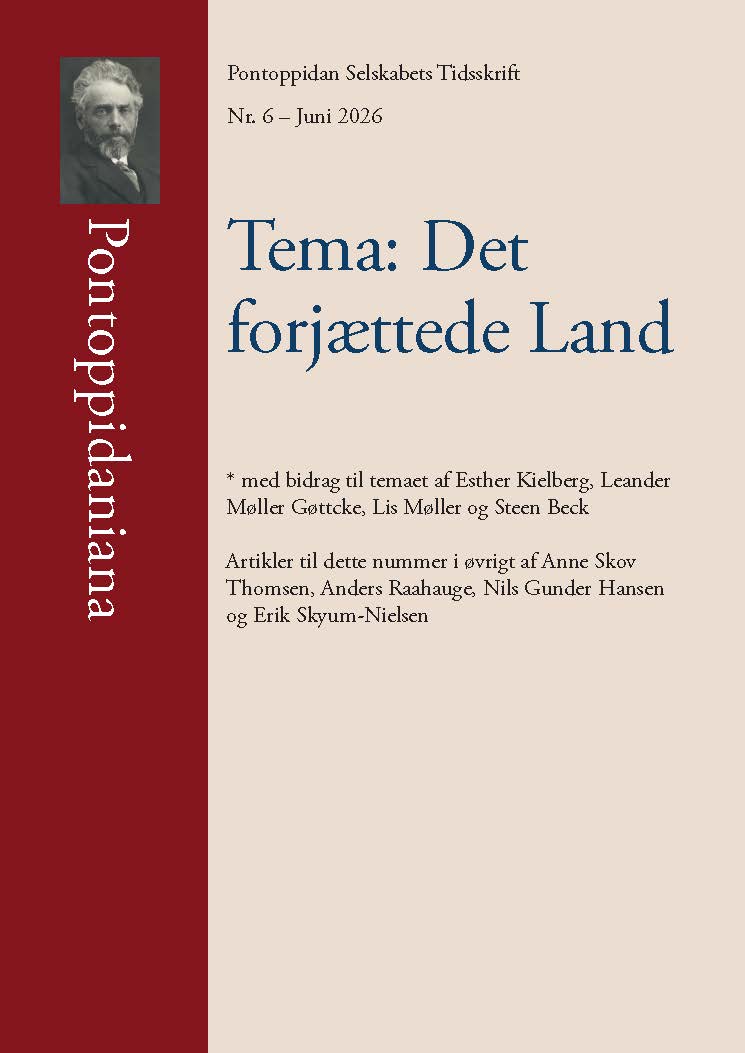
Pontoppidans tvesyn som demokratisk forestillingsevne
Udkast til en læsning af Det forjættede Land
Resumé
Abstract
This article analyses Henrik Pontoppidan’s tvesyn (‘double vision’) as a form of democratic imagination, a term borrowed from the literary theorist Isobel Armstrong. Through a reading of Det forjættede Land (1898), it argues that Pontoppidan’s realism does not consist in advocating a fixed political position, but in staging conflicts between competing social and political perspectives without granting any character a monopoly on truth. In so doing, the article intervenes in recent debates within Pontoppidan scholarship. While some critics have described Pontoppidan’s novels as polyphonic in a Bakhtinian sense, this comparison is misleading. Instead, tvesyn remains a more precise concept for describing Pontoppidan’s narrative technique. The article further develops tvesyn as a form of democratic imagination by drawing on the democracy scholar Robert A. Dahl’s account of the democratic principle of equality.