
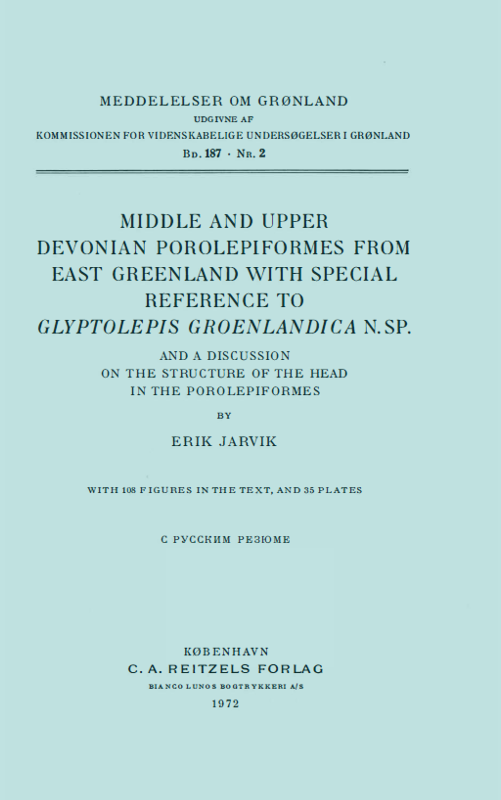
Middle and Upper Devonian Porolepiformes from East Greenland with Special Reference to Glyptolepis Groenlandica . sp.
Abstract
On the basis of a large fossil material, including a grinding series of Glyptolepis groenlandica n. sp., the dermal bones and sensory lines of the head and shouldergirdle, together with the main parts of the braincase and the visceral endoskeleton, have been described in the principal group of Devonian fishes since 1942 known as the Porolepiformes. All the known porolepiforms are very similar in structure and the group is characterised by a great number of specific structural features not found in any other fish es. Detailed comparisons with the Osteolepiformes and the Urodela have shown that porolepiforms agree with urodeles but differ from osteolepiforms not only in the structure of the snout and the intermandibular divison (JARVIK, 1942,1963a, 1966) but also in the epiphysial complex, the hypophysis, the auditory apparatus, the sensory line system, etc. Because the close relationship that demonstrably exists the Porolepiformes have to be classified together with the Urodela. Consequently taxonomic units such as Sarcopterygii, Crossopterygii, Rhipidistia and Lissamphibia are to be rejected. The renaming of the dermal bones of the skull-roof of osteolepiforms and porolepiforms proposed by WESTOLL has also been rejected and the homologisation of the osteolepiform lateral rostral with the porolepiform nariodal has been disputed. The parapineal organ is retained in larvae of primitive urodeles. The hypophysis is probably paired in origin. The pars tuberalis of the adenohypophysis was well developed in porolepiforms and there were probably portal vessels and a median eminence. BJERRING's assumption (1967) that the paired subcranial muscle is homologous with the polar cartilage has been confirmed. As is now evident this muscle belongs to the 2nd cephalic metamere and is the foremost of a series of metameric basicranial muscles, backwards continuous with the myomeres of the trunk. On the basis of palaeontological and embryological data the cranial metamerism has been discussed and new interpretations of the chondrocranium in urodeles and of the median parts of the parasphenoid have been given. Also, it has been shown that the vertebral column originally continued in front of the hypophysis and that the basis cranii forwards about to the opticus canals is composed of intermetameric vertebrae separated by intrametameric vertebral joints, each spanned by a basicranial muscle. The original, regular metameric arrangement of the dorsal and ventral cranial nerves, of the derivatives of the myotomes and sclerotomes of the cephalic somites, and of the visceral arches is well shown especially in osteolepiforms, porolepiforms and larval urodeles, which groups probably include the most primitive vertebrates. Finally, it has been concluded that the common ancestor of the Acrania and the Craniata (Vertebrata) was a metameric aquatic animal in many res pects suggestive of larval "Amphioxus'",
Downloads
Published
How to Cite
Issue
Section
License
Coypyright by the authors and the Commision for Scientific Research in Greenland. No parts of the publications may be reproduced in any form without the written permission by the copyright owners.
