
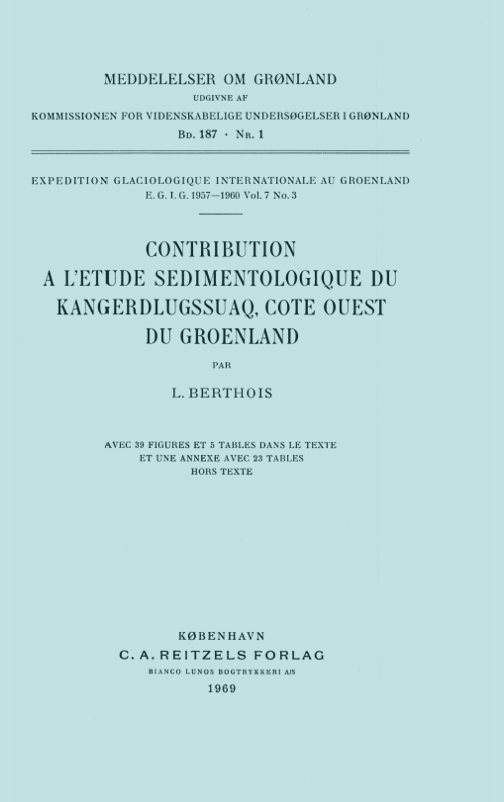
Contribution á l'étude sédimentologique du Kangerdlugssuaq, cóte ouest du Groenland.
Abstract
The study of pH distribution in Kangerdlugssuaq fjord waters, West Greenland, has shown that the pH is highest in the upper less saline water. In this upper water, however, the Calcium content is poorer than in the deep water. It is suggested that the biological activity related to photosyntesis reduces the free CO2 and bicarbonate content, thus increasing the pH in the water. An evidence for this is the examination under the microscope of the suspended particles, which shows that the biomass is more plentiful in the upper water than at depth. The study of the distribution of solved Calcium, Magnesium and Potassium and their relation to chlorinity, has shown that the decrease of the Mg/Cl ratio through water dilution is largely compensated by a supply from inland. This compensation is not so frequent for the K/Cl ratio, and no compensation at all occurs for the Ca/Cl ratio. This cornes from the fact that the rocks in the Kangerdlugssuaq glacier catchment area only include a very small amount of Calcium, while they are rich in minerais including Potassium and even more Magnesium. The distribution of solved Oxygen in fjord waters, studied in comparison with Fox curves, points to a large difference between the superficial supersaturated water, and the deep water in which the Oxygen content is markedly poorer. The supersaturation at the surface is a consequence of icebergs and floes which, when melting in the fjord, release a multitude of small air bubbles kept under pressure in the ice. The distribution of Deuterium concentration was studied as a function of chlorinity.
The ((D)/(H))/Cl ratio in the upper water is higher than the values commenly found in oceanic waters. In Kangerdlugssuaq fjord, the melting water from the glacier lowers the chlorinity but increases the (D)/(H) content. The study of the mineralogical and lithological constitution of the sediments collected by dredging and coring in the fjord shows that they generally include a fine and middle-sized fraction and a coarse fraction. The large disparities which occur in this respect between samples, even lying not far apart, result from differences in amount of coarse material, which is derived from melting icebergs and growlers drifting in the fjord. Talus land Elides operating over long slopes disturb the lateral deposits. Fine particles seem to settle comparatively slowly. Sandy varves are common and distributed in close recurrences in cores obtained near the glacier front. Downstream, however, they become more scattered. The rounding of the sedimentary particles goes on slowly, as shown by their morphological study. The morphoscopical curves of glacial sediments collected inland, to the North of Kangerdlugssuaq glacier and in ltivneq valley, point to processes including transportation by ice, crushing, action of running water and reworking by landslides in places. The morphoscopical curves of the sediments dredged in the middle of the fjord are rather regular, but those of the sediments collected near the shores are disturbed by slumping or by supply of sand by small ice tongues, or by still other factors.
The titration of cations, after they are dessorbed by microelectrodialysis, was made on the fine fraction, on which magnetic suceptibility measurements were also carried out. The shape of the particles was observed as they were falling in the water, and also the particularities in flake formation. The velocity of fall, in so far as it depends on the temperature, was studied with a Martin balance. The mineralogical constitution of the macroscopic fraction of the sediments is very uniform . A X-diffraction analysis of the microscopic fraction shows a general absence of carbonates, and a great quantity of quartz and feldspar, where as mica and ferriferous chlorite are not so abundant although present. Kaolinite and Montmorillonite were found only one time in ld analyses. Illite was never found. I t may be concluded that the fine fraction only cornes from the crushing of metamorphic rocks without appreciable weathering. The prevailing influence of acid rocks and their minerais in sedimentation was confirmed by complete chemical analyses. As regards to the relation between total Carbon and Nitrogen (C/N ratio), an outstanding difference exists between the fjord where the large values of the ratio result from plant remnants lignified on the bottom, and Umanak Fjord where the values are more usual, being not far from those found by J . DEBYSER (1961).
Downloads
Published
How to Cite
Issue
Section
License
Coypyright by the authors and the Commision for Scientific Research in Greenland. No parts of the publications may be reproduced in any form without the written permission by the copyright owners.
