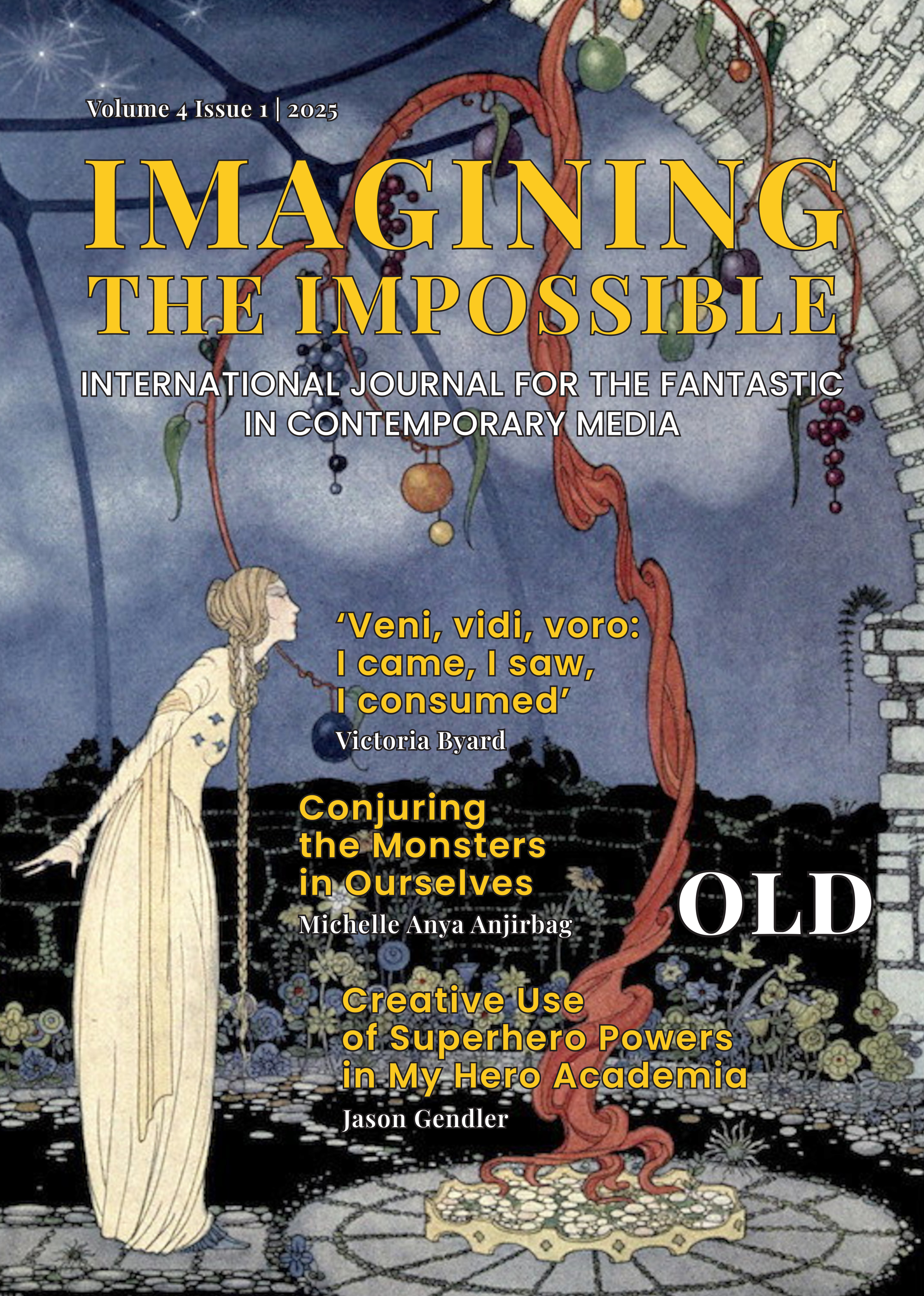
Conjuring the Monsters in Ourselves
Where the fantastic makes visible the inhumane and inhuman
DOI:
https://doi.org/10.7146/imaginingtheimpossible.145182Keywords:
monsters, history, retelling, adaptation, young adult, fantasyAbstract
Synopsis (500-800 words):
“Fantasy is the lie that speaks truth,” writes Brian Attebery in his 2022 Fantasy: How it Works, reflecting on how fantasy operates as a genre, and how it is understood. This paper looks at how fantasy as a genre can do more than “speak truth” in the abstract sense, and how it can make visible often-obscured, or deliberately avoided, historical truths. Literature has long been a medium that allows society to take a distanced look at itself, with contemporary fantasy containing within it a unique ability to reveal real-world truths through the construction of the imaginary. This paper uses three young adult contemporary fantasy novels, Cinderella is Dead by Kalynn Bayron, Legendborn by Tracy Deonn, and Skin of the Sea by Natasha Bowen, to examine how fantasy can make visible human-caused atrocities and violences in more stringent ways. In each of these novels, the evil depicted is not supernatural, but drawn from human violence historical and present. These novels deploy of depictions of misogynist and patriarchal violence and chattel slavery at the point of kidnappings as well as on US plantations. By incorporating banal cruelty of both under-discussed or deliberately obscured history, and that which is often ignored in the present, these authors each in their own way use the progressive potentials of the fantastic acknowledged by critics such as Daniel Baker, and Cristina Bacchilega and Pauline Greenhill to force the readers’ gaze not to linger moments of wonder but rather to acknowledge and see fully the trespasses of the past and their long-reaching aftereffects. Such works become anchors for dialogue between past and present, not correctives, but witnesses through the imaginary to that which should have been, by all rights, unimaginable. As such Deonn’s Legendborn, Bayron’s Cinderella is Dead, and Bowen’s Skin of the Sea all reposition how fantasy can intervene in how the story of history makes meaning in its retelling. They examine how these horrors are systemic as well as individual, and leave lasting impacts on the social fabric for generations. They also show the power of reimagining these stories in ways that unlock new potentials for new types and ways of heroism. As counternarratives, they each ultimately show that banal evil might be faced and defeated – patriarchal systems can be remade, lost histories can be uncovered and become roads into new imaginary spaces, the monsters of the past and present can be acknowledged. As such, fantasy becomes the vehicle for writing back; where nonfiction won’t accept the truth, the fantastic demands it be witnessed, unobscured and undisguised by the trappings of magic or an imaginary world.
Abstract (125-150 words):
“Fantasy is the lie that speaks truth,” writes Brian Attebery in his reflection on fantasy as a genre. This paper looks at how fantasy as a genre can do more than “speak truth” in the abstract sense, and how it can make visible often obscured historical truths. Literature has long been a medium that allows society to take a distanced look at itself, with contemporary fantasy containing within it a unique ability to reveal real-world truths through the construction of the imaginary. This paper uses Cinderella is Dead by Kalynn Bayron, Legendborn by Tracy Deonn, and Skin of the Sea by Natasha Bowen, to examine how fantasy can make visible human-caused atrocities in more stringent ways. As such, fantasy becomes the vehicle for writing back; where nonfiction won’t accept the truth, the fantastic demands it be witnessed, unobscured and undisguised by the trappings of magic or an imaginary world.
References
Attebery, Brian. 2024. “Affordances of Fantasy.” Genre 57 (1): 1-23.
---. 2022. Fantasy: How it Works. Oxford: Oxford University Press.
---. 2014. Stories About Stories: Fantasy & the Remaking of Myth. Oxford University
Press.
---. 1980. The Fantasy Tradition in American Literature: From Irving to Le Guin.
Indiana University Press.
Bacchilega, Cristina and Pauline Greenhill. 2022. “Fairytale Reanimation and Wonder Wanted
for a Better Future.” Imagining the Impossible: International Journal for the Fantastic in Contemporary Media 1 (1): 1-23.
Baker, Daniel. 2012. “Why We Need Dragons: The Progressive Potential of Fantasy.” Journal of
the Fantastic in the Arts 23 (3): 437-459.
Bayron, Kalynn. 2020. Cinderella is Dead. Bloomsbury.
Bowen, Natasha. 2021. Skin of the Sea. Penguin Books.
Coats, Karen. 2011. “Young Adult Literature: Growing Up, In Theory,” in Handbook of Research
on Children’s and Young Adult Literature, edited by Shelby a. Wolf, Karen Coats, Patricia Enciso, and Christine A. Jenkins, Taylor & Francis Group.
Connolly, Paula T. 2021. “Breaking the Surface: Mermaids and the Middle Passage.” Marvels &
Tales 35, (1): 79-93.
Coste, Jill. 2020. “New Heroines in Old Skins: Fairy Tale Revisions in Young Adult Dystopian
Literature.” In Beyond the Blockbusters: Themes and Trends in Contemporary Young Adult Fiction, edited by Rebekah Fitzsimmons and Casey Alane Wilson. University of Mississippi Press.
Deonn, Tracy. 2020. Legendborn. Simon & Schuster.
Elias, Amy J. 2001. Sublime Desires: History and Post-1960s Fiction, The Johns Hopkins University
Press.
Fitzsimmons, Rebekah and Casey Alane Wilson. 2020. “Introduction: Boom! Goes the
Hypercanon: On the Importance of the Overlooked and Understudied in Young Adult Literature.” In Beyond the Blockbusters: Themes and Trends in Contemporary Young Adult Fiction, edited by Rebekah Fitzsimmons and Casey Alane Wilson. University of Mississippi Press.
Heng, Geraldine. 2021. “An Arthurian Empire of Magic, and Its Discontents: An Afterword.”
Arthuriana 31 (2): 124-138.
Hutcheon, Linda. 1989. "Historiographic Metafiction: Parody and the Intertexts of History." in
Intertextuality and Contemporary American Fiction, edited by P. O'Donnell and Robert Con Davis. Johns Hopkins University Press, p. 3-32.
Hutcheon, Linda. 1988. A Poetics of Postmodernism: History, Theory, Fiction. Routledge.
James, Marlon. 2019. “Our Myths, Our Selves,” The seventh annual J.R.R Tolkien Lecture on
Fantasy Literature. Pembroke College, Oxford, February. Video, 49 min., 59 sec. https://www.youtube.com/watch?v=jV2bysurBds
Lawrence, Dana E. and Amy L. Montz. 2020. “‘Both Flesh and Monument’: The Immortal Life of
Literature through Adaptation,” in Adaptation in Young Adult Novels: Critically Engaging Past and Present, edited by Dana E. Lawarence and Any L. Montz. Bloomsbury Academic.
Le Guin, Ursula K. 1989[1979]. “Myth and Archetype in Science Fiction (1976),” in The Language
of the Night: essays on fantasy and science fiction (revised edition). The Women’s Press Ltd.
Lozada, Carlos. 2021. “The 1619 Project started as history. Now it’s also a political program,” The
Washington Post, November 19, https://www.washingtonpost.com/outlook/2021/11/19/1619-project-book-history/.
Mendlesohn, Farah. 2008. Rhetorics of Fantasy. Wesleyan University Press.
Montovani, Melissa. 2020. “Kalynn Bayron: Author of Cinderella is Dead (Interview),” Room
Magazine, November 3. https://roommagazine.com/kalynn-bayron-author-of-cinderella-is-dead/.
Neal, D’arcee Charington. 2023. “Who is Asking?: Afro-Arthurian Legend-making in N.K.
Jemisin’s Far Sector.” Arthuriana 33 (3): 86-103.
Phillips, Leah. 2023. Female Heroes in Young Adult Fantasy Fiction: Reframing Myths of
Adolescent Girlhood, Bloomsbury Academic.
Phillips, Leah. “Mythopoeic YA: Worlds of Possibility”, In Beyond the Blockbusters: Themes and
Trends in Contemporary Young Adult Fiction, edited by Rebekah Fitzsimmons and Casey Alane Wilson. University of Mississippi Press.
Quinn, Ben. 2024. “How the National Trust fought back against the culture warriors,” The
Guardian, October 27, https://www.theguardian.com/uk-news/2024/oct/27/how-the-national-trust-fought-back-against-the-culture-warriors
Sangster, Matthew. 2023. An Introduction to Fantasy. Cambridge University Press.
Sévère, Richard. 2023. “Why Can’t Mermaids Be Ethnically Diverse?: Legends and Legend-
Making in Arthurian Studies.” Arthuriana 33 (3): 3-9.
Thomas, Ebony Elizabeth. 2019. The Dark Fantastic: Race and the Imagination from Harry Potter
to the Hunger Games. New York University Press.
Waldstreicher, David. 2020. “The Hidden Stakes of the 1619 Controversy,” Boston Review,
January 24. https://www.bostonreview.net/articles/david-waldstreicher-hidden-stakes-1619-controversy/.
Downloads
Published
How to Cite
Issue
Section
License
Copyright (c) 2026 Michelle Anya Anjirbag

This work is licensed under a Creative Commons Attribution 4.0 International License.
Copyright author. CC by license 4.0.


