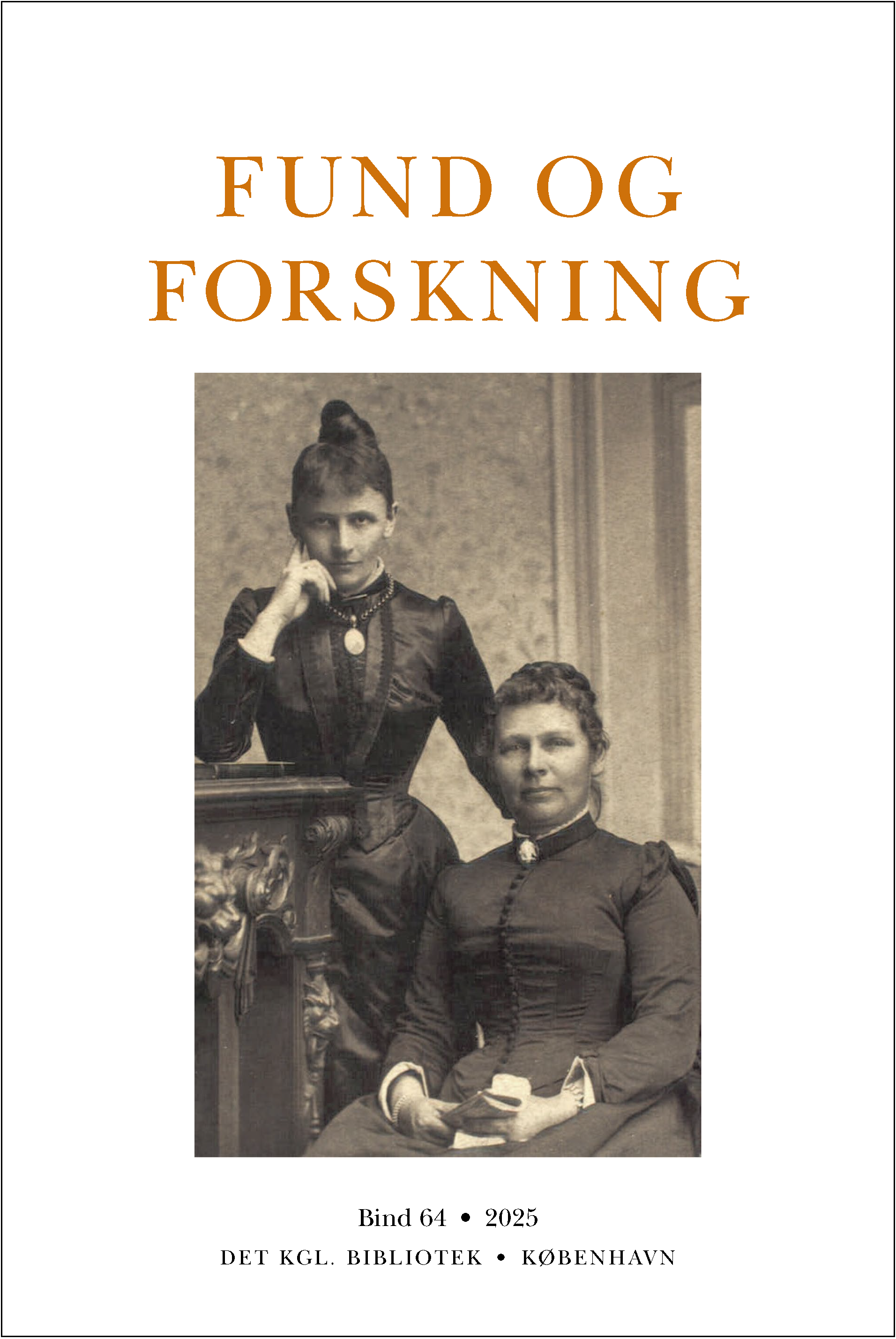
Vintage Vision
Brug af object detection-modeller i historiske fotografier med fokus på kvindepar
DOI:
https://doi.org/10.7146/fof.v64.169285Abstract
Artificial intelligence offers promising new possibilities for analyzing cultural heritage collections, yet applying automated visual recognition to historical photographs presents significant methodological challenges. This article examines these challenges, both in object detection and in addressing more complex research questions related to the interpretation of visual phenomena. Using a case study based on historian Nina Søndergaard’s thesis – that certain photographs of two women from around 1900 resemble wedding photographs and may thus indicate romantic relationships – we demonstrate how Søndergaard’s hypothesis can be tested empirically through the application of AI, contributing to methodology within LGBTQ+ visual culture studies and visual culture more broadly.
Our corpus comprises a large collection of dated photographs (1890‑1920), primarily drawn from the Royal Danish Library’s Digital Collections. We applied systematic pattern identification using AI models such as Florence-2 and RetinaNet to examine body positioning. The process, however, was not a straightforward application of a tool; it involved a dynamic interplay between manual selection and automated analysis. Furthermore, we created subsets of wedding photographs based on metadata and employed both manual and automated methods to investigate how individuals positioned themselves – whether standing or seated – in wedding photographs and in paired portraits more generally. Our analysis revealed minimal visual resemblance between Søndergaard’s examples and documented wedding photography conventions, highlighting the wide variety of poses employed in early twentieth-century portraiture.
These findings underscore the challenges of interpreting visual traits as direct indicators of specific emotions or life forms – an approach often adopted in cultural studies, driven by the desire to uncover what has been historically overlooked or underrepresented. Importantly, our study demonstrates how AI tools, developed through interdisciplinary collaboration between historical methodology and machine learning, can test subjective hypotheses and provide valuable analytical resources for visual culture research.