
Icelandic mittens from archaeological contexts
DOI:
https://doi.org/10.7146/atr.66.166420Keywords:
Viking age, nalbinding, Medieval, North Atlantic, weaving, wool, clothing, children's clothingAbstract
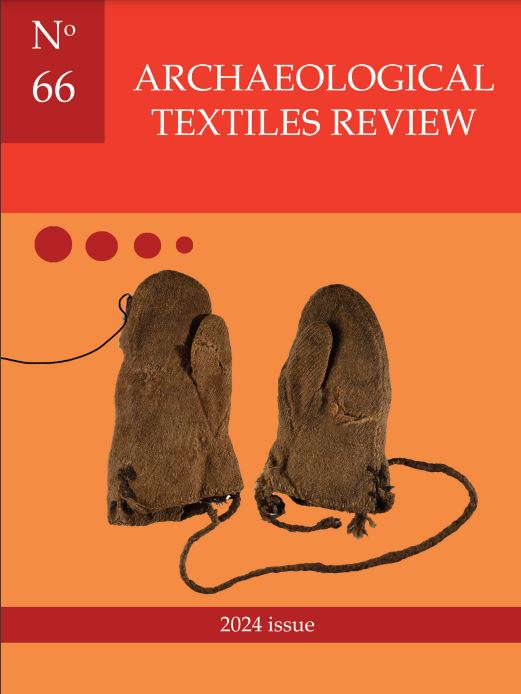
Protecting the hands from cold and damp conditions has been essential in northern Europe from prehistory to the present. Due to preservation, few examples of gloves and mittens have been recovered from archaeological contexts. Nonetheless, existing finds still reveal important information about everyday life in the past. Starting with three Icelandic finds we will discuss how mittens were produced with different techniques and how they were used and repaired from the 10th to the 17th centuries in the Nordic countries. A pair of well-preserved children’s mittens from Heynes (Þjms. 1960-77), located in Hvalfjörður in western Iceland, sewn from woven cloth was recently AMS radiocarbon dated to 925–1030 CE. Another woven mitten (Þjms. 1940) from Garðar, near Akranes in western Iceland, was dated to 1310–1388 CE, whereas a mitten in nalbinding from the site of Arnheiðarstaðir in Fljótsdalur in eastern Iceland (Þjms. 3405) was dated to 1480–1640 CE. Other finds from Scandinavia and northern Europe are included, all showing different ways of making hand protections in a time before knitting became the dominant technique used for handwear.
Downloads
Published
How to Cite
Issue
Section
License
Authors retain copyright to their articles.
From issue 68 and onwards, articles are published under the terms of the Creative Commons license CC BY-NC-ND 4.0, which allows others to freely share the material in unadapted form and for noncommercial purposes, as long as proper attribution is given.
In issues 54-67, all rights are reserved to the authors.
