
The largest known wintering concentration of Brent Geese Branta bernicla nigricans in East Asia along the coast of the Shandong Peninsula, China
Article Sidebar
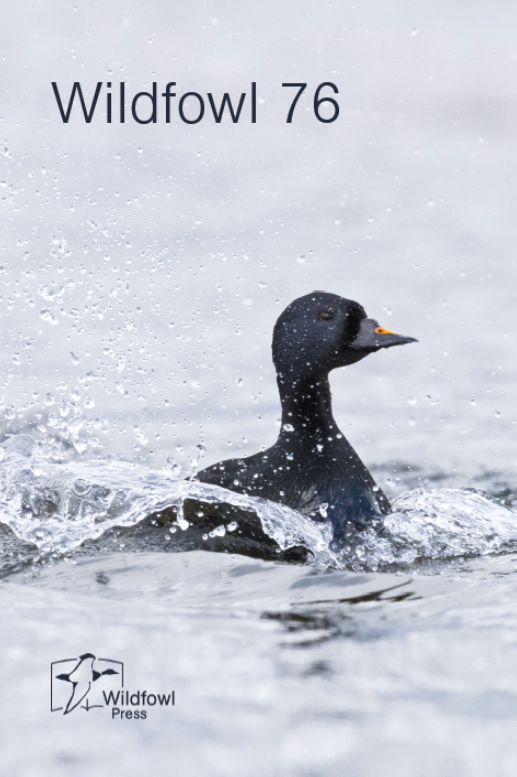
Main Article Content
Abstract
The number of Brent Geese Branta bernicla nigricans wintering in East Asia is small, and their winter distribution in China remains poorly known. Previous surveys have identified Sanggou Bay, Shandong Province, as an internationally important wintering site, with 124, 319 and 850 birds recorded in January 2023, 2024 and 2025, respectively. GPS tracking and field surveys were conducted along the coast of Shandong Peninsula in January 2026. One tagged Brent Goose migrated from Notsuke Bay, Japan, to coastal Shandong, where it utilised both Sanggou and Lidao Bays throughout the winter. Guided by real-time GPS data, a boat survey on 8 January recorded 1,496 Brent Geese in southern Sanggou Bay, followed by a shore-based survey on 9 January that identified 74 birds across Lidao and Ailian Bays. The minimum total count of 1,570 birds is equivalent to c. 18% of the estimated 8,700 Brent Geese wintering in East Asia, although considerable uncertainty remains regarding the actual numbers. This represents the largest known wintering concentration in the region. The discovery of this large offshore concentration also suggests that previous shore-based surveys may have underestimated the number of Brent Geese using offshore aquaculture areas. These results indicate that the aquaculture-dominated coastal waters from Lidao Bay to Sanggou Bay constitute a key wintering area for Brent Geese in East Asia; however, further systematic surveys are needed to assess annual variation and detectability.
Article Details
Articles in Wildfowl volumes 1-74 and in Wildfowl Special Issues 1-7 are not licensed under Creative Commons. In these volumes, all rights are reserved to the authors of the articles respectively.
The Wildfowl & Wetlands Trust (which published the journal from 1948–2020 inclusive) retains a royalty-free license in perpetuity to access and use pre-2021 issues for the purposes of research, which may involve sharing with research partners from time to time.
The copyright for this paper belongs to the Author(s). Papers published in Wildfowl 75 (in 2025) and subsequent issues are licensed under a Creative Commons Attribution-NonCommercial-ShareAlike 4.0 International License.
In the articles published in these volumes, all rights are reserved to the authors of the articles respectively. This implies that readers can download, read, and link to the articles, but they cannot republish the articles. Authors can upload their articles into an institutional repository.
References
Calenge, C. 2023. Home Range Estimation in R: the adehabitatHR Package. Office National de la Chasse et de la Faune Sauvage, Saint Benoist, Auffargis, France.
Cao, L., Meng, F., Zhang, J., Deng, X., Sawa, Y. & Fox, A.D. 2020. Moving forward: how best to use the results of waterbird monitoring and telemetry studies to safeguard the future of Far East Asian Anatidae species. Wildfowl (Special Issue No. 6): 293–319.
Conservation of Arctic Flora and Fauna (CAFF). 2019. Arctic Migratory Birds Initiative (AMBI): Workplan 2019–2023. CAFF Strategies Series No. 30. Conservation of Arctic Flora and Fauna, Arctic Council Secretariat, Akureyri, Iceland.
Derksen, D.V., Bollinger, K.S., Ward, D.H., Sedinger, J.S. & Miyabayashi, Y. 1996. Black brant from Alaska staging and wintering in Japan. Condor 98: 653–657.
Fu, Y., Deng, J., Wang, H., Comber, A., Yang, W., Wu, W., You, S., Lin, Y. & Wang, K. 2021. A new satellite-derived dataset for marine aquaculture areas in China’s coastal region. Earth System Science Data 13: 1829–1842.
Fujii, K. 2017. Population size and distribution of Brent Geese in Japan (2014 to 2017). Bird Research 13: 69–77. [In Japanese with English summary.]
Lensink, C.J. 1968. Neckbands as an inhibitor of reproduction in black brant. Journal of Wildlife Management 32: 418–420.
Li, Q., Jin, R., Ye, Z., Gu, J., Dan, L., He, J., Christakos, G., Agusti, S., Duarte, C.M. & Wu, J. 2022. Mapping seagrass meadows in coastal China using GEE. Geocarto International 37: 12602–12617.
Li, Z., Li, W., Yang, X., Zhang, Y. & Zhang, P. 2020. Distribution and ecological characteristics of seagrass beds in Rongcheng Sanggou Bay, Weihai. Marine Sciences 44: 52–59. [In Chinese with English summary.]
Liu, F., Li, J., Jin, S. & Liu, L. 2024. Molecular diversity and seasonal dynamics of Ostreococcus (Mamiellophyceae, Chlorophyta) in typical mariculture bays based on metabarcoding analysis. Marine Environmental Research 202: 106764.
Lv, X., Zhao, Q., Fei, M., Sawa, Y., Ikeuchi, T., Yu, G., Zhang, J., Meng, F., Zhang, J., Zhang, Y., Xie, Y., Cao, L. & Fox, A.D. 2024. First observations in 20 years of Brent Geese Branta bernicla wintering on the Shandong coast, China. Wildfowl 74: 84–98.
MacKinnon, J., Verkuil, Y.I. & Murray, N. 2012. IUCN situation analysis on East and Southeast Asian intertidal habitats, with particular reference to the Yellow Sea (including the Bohai Sea). Occasional Paper of the IUCN Species Survival Commission 47. IUCN, Gland, Switzerland and Cambridge, UK.
Meng, F., Zhao, Q., Sawa, Y., Ikeuchi, T., Zhang, J., Zhang, Y., Xie, Y., Zhang, L., Shi, A., Cao, L. & Fox, A.D. In press. Synanthropic commensal brant in China: exploitation of green algal food subsidies in long-line aquaculture areas. Ornithological Science 00: 000–000.
R Core Team. 2025. R: A Language and Environment for Statistical Computing. R Foundation for Statistical Computing, Vienna, Austria.
Sawa, Y., Tamura, C., Ikeuchi, T., Fujii, K., Ishioroshi, A., Shimada, T., Tatsuzawa, S., Deng, X., Cao, L. & Ward, D.H. 2020a. Migration routes and population status of the Brent Goose Branta bernicla nigricans wintering in East Asia. Wildfowl (Special Issue No. 6): 244–266.
Sawa, Y., Tamura, C., Ikeuchi, T., Shimada, T., Fujii, K., Ishioroshi, A., Tatsuzawa, S. & Ward, D.H. 2020b. Evidence of Brent Geese Branta bernicla moving between an autumn staging area in east Hokkaido and wintering sites in west Hokkaido and northern Honshu. Ornithological Science 19: 211–216.
Seaman, D.E. & Powell, R.A. 1996. An evaluation of the accuracy of kernel density estimators for home range analysis. Ecology 77: 2075–2085.
Sedinger, J.S., Ward, D.H., Schamber, J.L., Butler, W.I., Eldridge, W.D., Conant, B., Voelzer, J.F., Chelgren, N.D. & Herzog, M.P. 2006. Effects of El Niño on distribution and reproductive performance of black brant. Ecology 87: 151–159.
Sedinger, J.S., Schamber, J.L., Ward, D.H., Nicolai, C.A. & Conant, B. 2011. Carryover effects associated with winter location affect fitness, social status, and population dynamics in a long-distance migrant. American Naturalist 178: E110–E123.
Sedinger, J.S., Riecke, T.V., Leach, A.G. & Ward, D.H. 2019. The black brant population is declining based on mark recapture. Journal of Wildlife Management 83: 627–637.
Shimada, T., Hijikata, N., Tokita, K., Uchida, Y., Kurechi, M., Suginome, H. & Higuchi, H. 2017. Spring migration of Brent Geese wintering in Japan extends into Russian high arctic. Ornithological Science 16: 159–162.
Syroechkovskiy, E.E. 2006. Long-term declines in Arctic goose populations in eastern Asia. In G.C. Boere, C.A. Galbraith & D.A. Stroud (eds.), Waterbirds Around the World, pp. 649–662. The Stationery Office, Edinburgh, UK.
Wang, Y., Damba, I., Zhao, Q., Xie, Y., Deng, X., Ga, R., Liu, G., Xu, Z., Li, Y., Gao, D., Xu, W., Chen, G. & Cao, L. 2021. Organising a juvenile ratio monitoring programme for 10 key waterbird species in the Yangtze River floodplain: analysis and proposals. Avian Research 12: 72.
Ward, D.H., Amundson, C.L., Stehn, R.A. & Dau, C.P. 2018. Long-term trends in fall age ratios of black brant. Journal of Wildlife Management 82: 362–373.
Wetlands International. 2026. Waterbird Populations Portal. Wetlands International, Wageningen, the Netherlands. Available at https://wpp.wetlands.org/ (last accessed 29 May 2026).