
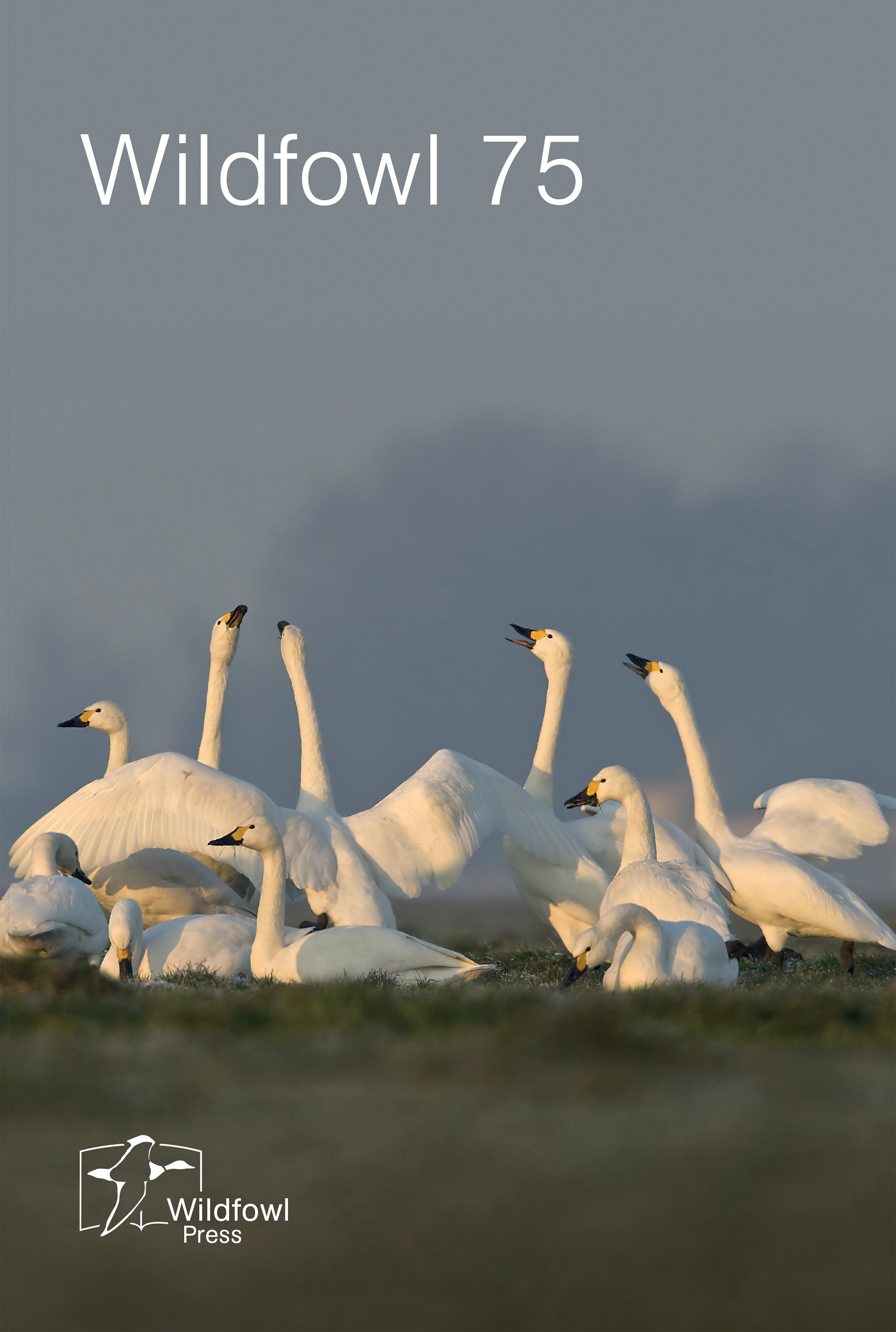
Decline of the Bewick’s Swan Cygnus columbianus bewickii population wintering in Northeast/Northwest Europe
Article Sidebar
Main Article Content
Abstract
The 39.4% decline in numbers in the Northeast/Northwest European population of Bewick’s Swan Cygnus columbianus bewickii between 1995 (29,780 birds) and 2010 (18,057 birds) was of major conservation concern, alleviated by a partial recovery to 20,149 recorded in the January 2015 census. The most recent census, in January 2020, however found that the recovery was not sustained. The results described in this paper found a further 29.7% decline between 2015 and 2020, with 12,702 individuals counted in 2020 and the population estimated at 12,930 birds. This represents a 56.7% decrease over the 25-year period from 1995–2020; an annual average decrease of 3.3% per year, with a higher rate of decline (8.5%/year) over the most recent 5-year period. Changes in the Bewick’s Swans distribution were evident, with a significant increase in the proportion of the population recorded in countries in the northeastern part of the wintering range compared with those further south and west. More sites of international importance for Bewick’s Swans in mid-winter (i.e. with ≥ 1% of the total population) consequently were found in Germany during the 2020 census than in previous censuses. Moreover, the swans were found to be more widely dispersed, rather than being concentrated at key sites, in 2015 and 2020. Annual productivity data, based on the percentage of cygnets (first-winter birds) recorded in wintering flocks, indicate that the recruitment to the population was consistently lower than estimated survival rates between 2010 and 2020, and moreover this has continued up to and including winter 2024/25. A population model predicts that a further reduction in population size to an estimated 11,068 Bewick’s Swans will be found during the next census scheduled for January 2026, unless the swans have a good breeding season in summer 2025, which would represent a decrease of 14.4% since 2020.
Article Details

This work is licensed under a Creative Commons Attribution-NonCommercial-ShareAlike 4.0 International License.
Articles in Wildfowl volumes 1-74 and in Wildfowl Special Issues 1-7 are not licensed under Creative Commons. In these volumes, all rights are reserved to the authors of the articles respectively.
The Wildfowl & Wetlands Trust (which published the journal from 1948–2020 inclusive) retains a royalty-free license in perpetuity to access and use pre-2021 issues for the purposes of research, which may involve sharing with research partners from time to time.
The copyright for this paper belongs to the Author(s). Papers published in Wildfowl 75 (in 2025) and subsequent issues are licensed under a Creative Commons Attribution-NonCommercial-ShareAlike 4.0 International License.
In the articles published in these volumes, all rights are reserved to the authors of the articles respectively. This implies that readers can download, read, and link to the articles, but they cannot republish the articles. Authors can upload their articles into an institutional repository.
References
American Ornithologists’ Union 1983. Check-list of North American Birds. 6th Edition. American Ornithologists’ Union, Lawrence, Kansas, USA.
Beekman, J.H., Dirksen, S. & Slagboom, T.H. 1985. Population size and breeding success of Bewick’s Swans wintering in Europe in 1983–4. Wildfowl 36: 5–12.
Beekman, J.H., Rees, E.C. & Bacon, P.J. 1994. Bewick’s Swan Cygnus columbianus bewickii. In: G.M. Tucker & M.F. Heath (eds.), Birds in Europe: their Conservation Status, pp. 108–109. Birdlife Conservation Series No. 3. Birdlife International, Cambridge, UK.
Beekman, J., Koffijberg, K., Hornman, M., Wahl, J., Kowallik, C., Hall, C, Devos, K., Clausen, P., Laubek, B., Luigujõe, L., Wieloch, M., Boland, H., Švažas, S., Nilsson, L., Stı¯pniece, A., Keller, V., Degen, A., Shimmings, P., Larsen, B.-H., Portolou, D., Langendoen, T., Wood, K. & Rees, E.C. 2019. Long-term population trends and shifts in distribution of Bewick’s Swans wintering in northwest Europe. Wildfowl (Special Issue No. 5): 73–102.
Brides, K., Wood, K.A., Hall, C., Burke, B., McElwaine, G., Einarsson, Ó., Calbrade, N., Hill, O. & Rees, E.C. 2021. The Icelandic Whooper Swan Cygnus cygnus population: current status and long-term (1986–2020) trends in its numbers and distribution. Wildfowl 71: 29–57.
Clausen, K.K., Madsen, J., Nolet, B.A. & Haugaard, L. 2018. Maize stubble as a wintering habitat for wintering geese and
swans in northern Europe. Agriculture, Ecosystems & Environment 259: 72–76.
Clausen, P., Petersen, I.K., Bregnballe, T. & Nielsen, R.D. 2019. Numbers of non-breeding birds in Special Protection Areas for birds in Denmark, 2004 to 2017. Danish Centre for The Environment and Energy Technical Report No. 148. Aarhus University, Rønde, Denmark. [In Danish with English summary.]
Cramp, S. & Simmons, K.E.L. 1977. Handbook of the Birds of Europe, the Middle East and North Africa. The Birds of the Western Palearctic. Volume I. Oxford University Press, Oxford, UK.
Dirksen, S. & Beekman, J.H. 1991. Population size, breeding success and distribution of Bewick’s Swans Cygnus columbianus bewickii wintering in Europe in 1986–87. In: J. Sears & P.J. Bacon (eds.), Proceedings of the Third IWRB International Swan Symposium, Oxford, 1989. Wildfowl (Supplement No. 1): 120–124.
Ebbinge, B.S., Bom, R.A., Broekhuizen, S., Cottaar, F., Kokorev, Y.I., Müskens, G. & Popov, I.Y. 2025. Breeding strategies of Dark-bellied Brent Geese Branta b. bernicla in a lemming-driven ecosystem in northern Siberia. Wildfowl 75: 32–62.
European Association of Sugar Manufacturers 2025. Fact sheet EU Beet Suger Sector, key statistics. https://cefs.org/factsheet-eu-beet-sugar-sector-key-statistics/ (last accessed 8 September 2025).
Fox, A.D. & Leafloor, J.O. (eds.) 2018. A Global Audit of the Status and Trends of Arctic and Northern Hemisphere Goose Populations. Conservation of Arctic Flora and Fauna International Secretariat, Akureyri, Iceland.
Fox, A.D., Ebbinge, B.S., Mitchell, C., Heinicke, T., Aarvak, T., Colhoun, K., Clausen, P., Dereliv, S., Farago, S., Koffijberg, K., Kruckenberg, H., Loonen, M.J.J.E., Madsen, J., Mooij, J., Musil, P., Nilsson, L., Pihl, S. & Van der Jeugd, H. 2010. Current estimates of goose population sizes in western Europe, a gap analysis and assessment of trends. Ornis Svecica 20: 115–127.
Fox, A.D., Dalby L., Christensen T.K., Nagy S., Balsby T.J.S., Crowe O., Clausen, P., Deceuninck, B., Devos, K., Holt, C.A., Hornman, M., Keller, V., Langendoen, T., Lehikoinen, A., Lorenten, S.-H., Molina, B., Nilsson, L., Stı¯pniece, A., Jens-Christian Svenning, J.-C. & Wahl, J. 2016. Seeking explanations for recent changes in abundance of wintering Eurasian Wigeon (Anas penelope) in northwest Europe. Ornis Fennica 93: 12– 25.
Fox, A.D., Walsh, A.J., Stroud, D.A., Francis, I.S., Norriss, D.W., Wilson, H.J., Kelly, S.B., Schindler, A.R., & Weegman, M.D. 2025. Can the Greenland White-fronted Goose be saved? British Birds 118: 431–445.
Heldbjerg, H., Clausen, K.K., Cao, L. & Fox, A.D. (2024). GPS-tracking reveals winter short-stopping and large differences in individual migratory distance among Greylag Geese (Anser anser) breeding in Denmark. Ornis Fennica 101: 101–115.
Jones, T., Martin, K., Barov, B., Nagy, S. (compilers). 2008. International Single Species Action Plan for the Conservation of the Western Palearctic Population of the Lesser White-fronted Goose Anser erythropus. AEWA Technical Series No. 36. African-Eurasian Migratory Waterbird Agreement, Bonn, Germany.
Kirby, J.S., Rees, E.C., Merne, O.J. & Gardarsson, A. 1992. International census of Whooper Swans Cygnus cygnus in Britain, Ireland and Iceland: January 1991. Wildfowl 43: 20–26.
KNMI. 2016. Royal Netherlands Meteorological Institute: Monthly and Yearly Mean Temperature, De Bilt Weather Station. Koninklijk Nederlands Meteorolgisch Instituut, Ministerie van Infrastructuur en Waterstaat, De Bilt, the Netherlands. Available online at https:// www.knmi.nl/nederland-nu/klimatologie/ maandgegevens (last accessed 19 August 2019).
Koffijberg, K. 2024. Results of the 42nd International Bewick’s Swan age count in 16/17 December 2023. Swan News 19: 8–9.
Limpert, R.J., Earnst, S.L., Carboneras, C. & Kirwan, G.M. 2020. Tundra Swan (Cygnus columbianus), version 1.0. In: S.M. Billerman (ed.) Birds of the World. Cornell Lab of Ornithology, Ithaca, USA. Available at https://doi.org/10.2173/bow.tunswa.01 (last accessed 5 November 2025).
Linssen, H., van Loon, E.E., Shamoun-Baranes, J.Z., Nuijten, R.J.M. & Nolet, B.A. 2023. Migratory swans individually adjust their autumn migration and winter range to a warming climate. Global Change Biology 29: 6888–6899.
Litvin, K. & Vangeluwe, D. 2016. The Bewick’s Swan is a paradox. Swan News 12: 12.
Nagy, S., Petkov, N., Rees, E.C., Solokha, A., Hilton, G., Beekman, J. & Nolet, B. 2012. International Single Species Action Plan for the Conservation of the Northwest European Population of Bewick’s Swan (Cygnus columbianus bewickii). AEWA Technical Series No. 44. African-Eurasian Migratory Waterbird Agreement, Bonn, Germany.
Nielsen, R.D., Holm, T.E., Clausen, P., Bregnballe, T., Clausen, K.K., Petersen, I.K., Sterup, J., Balsby, T.J.S., Pedersen, C.L., Mikkelsen, P. & Bladt, J. 2019. Fugle 2012–2017. NOVANA. Scientific Report No. 314. Danish Centre for the Environment and Energy, Aarhus University, Rønde, Denmark. Available at https://novana.au.dk/fugle/ fugle-2012-2017 (last accessed 10 September 2025). [In Danish.]
Nielsen, R.D., Holm, T.E., Clausen, P., Sterup, J., Pedersen, C.L., Clausen, K.K., Bregnballe, T., Thomsen, H.M., Balsby, T.J.S., Petersen, I.K., Mikkelsen, P., Dalby, L. & Mellerup, K.A. 2024. Fugle 2018–2023. Scientific Report No. 633. Danish Centre for the Environment and Energy, Aarhus University, Rønde, Denmark. Available at https://novana.au.dk/fugle/ 2018-2023 (last accessed 10 September 2025). [In Danish.]
Nuijten, R.J.M., Vriend, S.J.G., Wood, K.A., Haitjema, T., Rees, E.C., Jongejans, E. & Nolet, B.A. 2020a. Apparent breeding success drives long-term population dynamics of a migratory swan. Journal Avian Biology 51: e02574.
Nuijten, R.J.M., Wood, K.A., Haitjema, T., Rees, E.C. & Nolet, B.A. 2020b. Concurrent shifts in wintering distribution and phenology in migratory swans: individual and generational effects. Global Change Biology 26: 4263–4275.
Podhrázský, M., Musil, P., Musilová, Z., Zouhar, J., Adam, M., Závora, J. & Hudec, K. 2017. Central European Greylag Geese Anser anser show a shortening of migration distance and earlier spring arrival over 60 years. Ibis 159: 352–365.
Prior, N., Koffijberg, K. & Tijsen, W. 2023. Results of the international age count of the Northwest European Bewick’s Swan, 17/18 December 2022. Swan News 18: 6–7.
QGIS Development Team 2024. QGIS Geographic Information System. Open Source Geospatial Foundation, Beaverton, USA. http://qgis.org.
R Core Team. 2024. R: A Language and Environment for Statistical Computing. Version 4.4.0. R Foundation for Statistical Computing, Vienna, Austria. https://www.r-project.org/.
Ramsar Convention. 2017. Strategic framework and guidelines for the future development of the list of Wetlands of International Importance of the Convention on Wetlands (Ramsar, Iran, 1971). The Ramsar Convention Secretariat, Gland, Switzerland. Available at https://www. ramsar.org/document/strategic-framework-and-guidelines-for-the-future-development-of-the-list-of-wetlands-of-1 (last accessed 8 September 2025).
Rees, E.C. & Clausen, P. 2024. Swan research and conservation: a synthesis of information presented at the 7th International Swan Symposium. Wildfowl (Special Issue No. 7): 1–26.
Rees, E.C., Kirby, J.S. & Gilburn, A. 1997. Site selection by swans wintering in Britain and Ireland: the importance of geographical location and habitat. Ibis 139: 337–352.
Rees, E.C., Rozenfeld, S., Vangeluwe, D., Ioannidis, P., Erciyas-Yavuz, K., Belousova, A., Rustamov, E., Solokha, A., Sultanov, E., Kowallik, C., Portolou, D., Khrokov, A., Šc´iban, M., Ajder, V., Zenatello, M., Koffijberg, K., Kirtaev, G., Rogova, N., Ghasabyan, M., Wood, K.A., Langendoen, T., Nagy, S., Clausen, P. & Fox, A.D. 2024. International census and population trends for Bewick’s Swans Cygnus columbianus bewickii wintering from the East Mediterranean to Central Asia. Wildfowl (Special Issue No. 7): 179–201.
Robinson, J.A., Colhoun, K., McElwaine, J.G. & Rees, E.C. 2004. Bewick’s Swan Cygnus columbianus bewickii (Northwest Europe population) in Britain and Ireland 1960/61 to 1999/2000. Waterbird Review Series, The Wildfowl & Wetlands Trust/Joint Nature Conservation Committee, Slimbridge, UK.
Rüger, A., Prentice, C. & Owen, M. 1986. Results of the IWRB International Census 1967– 1983. IWRB Special Publication No. 6. International Waterfowl and Wetlands Research Bureau (IWRB), Slimbridge, UK.
Scott, D.A. 1980. A Preliminary Inventory of Wetlands of International Importance for Waterfowl in Western Europe and North-west Africa. IWRB Special Publication No. 2, International Waterfowl Research Bureau, Slimbridge, UK.
Stroud, D.A., Fox, A.D., Urquhart, C. & Francis, I.S. (compilers). 2012. International Single Species Action Plan for the Conservation of the Greenland White-fronted Goose (Anser albifrons flavirostris). AEWA Technical Series No. 45. African-Eurasian Migratory Waterbird Agreement, Bonn, Germany.
Stroud, D.A., Pirot, J.-Y. & Smart, M. 2022. The International Waterfowl (and Wetlands) Research Bureau: c. 1945–1995. Wildfowl 72: 3–60.
Tijsen, W. & Koffijberg, K. 2015. Thirty years of goose and swan counts in the north of the province of Noord-Holland. Limosa 88: 83–95. [In Dutch with English summary.]
Tijsen, W & Koffijberg, K. 2019. Preliminary results of the international Bewick’s Swan age count: 15–16 December 2018. Swan News 15: 10–11.
Tijsen, W. & Koffijberg, K. 2022. Results of the 40th international brood count for NW European Bewick’s Swan population in winter, December 2021. Swan News 17: 18.
Tveite, H. 2016. The QGIS Standard Deviational Ellipse Plugin. http://plugins.qgis.org/plugins/ SDEllipse/.
Van den Berg, M.S., Coops, H., Meijer, M.L., Scheffer, M. & Simons, J. 1998. Clear water associated with a dense Chara vegetation in the shallow and turbid Lake Veluwemeer, the Netherlands. In: E. Jeppesen, M. Søndergaard & K. Christoffersen (eds.), The Structuring Role of Submerged Macrophytes in Lakes, pp. 339–352. Springer, New York, USA.
Vangeluwe, D., Rozenfeld, S. & Kazantzidis, S. 2016. The odyssey of the Bewick’s Swan – another route to Greece. Swan News 12: 10–12.
Vangeluwe, D., Rozenfeld, S.B., Volkov, S.V., Kazantzidis, S., Morozov, V.V., Zamyatin, D.O. & Kirtaev, G.V. 2018. Migrations of Bewick’s Swan (Cygnus bewickii): new data on tagging the migration routes, stopovers, and wintering sites. Biology Bulletin 45: 90–101
Wetlands International. 2025. Waterbird Populations Portal. Wetlands International, Wageningen, the Netherlands. Available at https://wpp. wetlands.org/explore/371/1613?conservation =1 (last accessed 10 September 2025).
Wilson, J.C., Wood, K.A., Griffin, L.R., Brides, K., Rees, E.C. & Ezard, T.H.G. 2025. Using satellite tracking to assess the use of protected areas and alternative roosts by Whooper and Bewick’s Swans. Ibis 167: 515–529.
Wood, K.A., Newth, J.L., Hilton, G.M., Nolet, B.A. & Rees, E.C. 2016. Inter-annual variability and long-term trends in breeding success in a declining population of migratory swans. Journal of Avian Biology 47: 597–609.
Wood, K.A., Nuijten, R.J.M., Newth, J.L., Haitjema, T., Vangeluwe, D., Ioannidis, P., Harrison, A.L., Mackenzie, C., Hilton, G.M., Nolet, B.A. & Rees, E.C. 2018. Apparent survival of an Arctic-breeding migratory bird over 44 years of fluctuating population size. Ibis 160: 413–430.
Yuill, R.S. 1971. The standard deviational ellipse; an updated tool for spatial description. Geografiska Annaler. Series B, Human Geography 53(1): 28–39.