
Thermal ecology of Trumpeter Swan Cygnus buccinator incubation
Article Sidebar
Main Article Content
Abstract
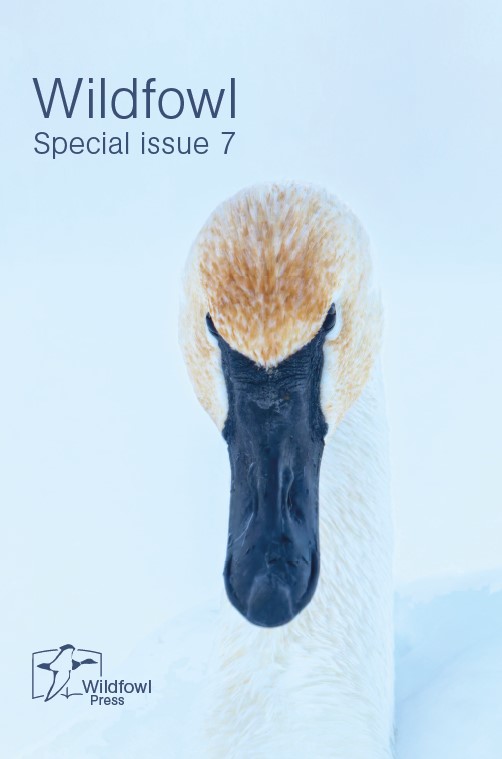
Trumpeter Swans Cygnus buccinator, North America’s largest waterfowl, breed at high latitudes where they construct unusually large nest mounds and incubate from the top of the mound while experiencing daily ambient temperature fluctuations of 25°C or more, as well as substantial exposure to solar radiation, high winds, rain and snow. This study investigates how incubating swans accommodate the thermal flux in their environment. Swan incubation dynamics were measured at Red Rock Lakes National Wildlife Refuge in southwestern Montana, USA, a federally protected high-elevation marsh complex where the last breeding population of Trumpeter Swans in the contiguous United States persisted during the early 20th century, a period when they neared extinction. Using around-the-clock digital video imaging, environmental monitoring devices and thermal recording devices, which were placed within clutches and also within and upon nest mound material, thermal dynamics were modelled in relation to swan incubation behaviour. Swans maintained a mean (± s.e.) egg temperature of 35.7 ± 0.27°C during active incubation. Linear mixed models of thermal covariates evaluated using AICc values and model weights (ω) revealed an interactive association between nest attendance and: (1) deviation of ambient environmental temperature from average egg incubation temperature, (2) solar radiation and (3) vapour density. Ambient temperature deviations above and below average egg incubation temperature, elevated solar radiation and declining vapour density were interactively associated with swan presence on the nest. Egg temperature per se was associated with both ambient temperature (positive) and vapour density (positive). Nest mound temperature was positively associated with ambient temperature, solar radiation and vapour density. The nest mound acted as a thermal mass, moderating thermal flux. Nesting success depended on swans shielding their eggs from excessive daytime warming and desiccation, and on contact incubation when ambient temperature was below the average egg incubation temperature.
Article Details
Articles in Wildfowl volumes 1-74 and in Wildfowl Special Issues 1-7 are not licensed under Creative Commons. In these volumes, all rights are reserved to the authors of the articles respectively.
The Wildfowl & Wetlands Trust (which published the journal from 1948–2020 inclusive) retains a royalty-free license in perpetuity to access and use pre-2021 issues for the purposes of research, which may involve sharing with research partners from time to time.
The copyright for this paper belongs to the Author(s). Papers published in Wildfowl 75 (in 2025) and subsequent issues are licensed under a Creative Commons Attribution-NonCommercial-ShareAlike 4.0 International License.
In the articles published in these volumes, all rights are reserved to the authors of the articles respectively. This implies that readers can download, read, and link to the articles, but they cannot republish the articles. Authors can upload their articles into an institutional repository.
References
Akaike, H. 1973. Information theory as an extension of the maximum likelihood principle, In B.N. Petrov & F. Csaksi, (eds.), Second International Symposium on Information Theory, pp. 267–281. Akademiai Kiado, Budapest, Hungary.
Anderson, D.R. 2008. Model Based Inferences in the Life Sciences. Springer Science, New York, USA.
Banko, W.E. 1960. The Trumpeter Swan: Its History, Habits, and Population in the United States. North American Fauna, 63. United States Fish and Wildlife Service, Washington, United States.
Bush, D.A. 2018. Incubation behavior and genetic attributes of Trumpeter Swans restored to Grays Lake National Wildlife Refuge. M.Sc. thesis, Idaho State University, Pocatello, USA.
Chabreck, R.H. 1973. Temperature variation in nests of the American Alligator. Herpetologica 29: 48–51.
Coates P.S. & Delehanty D.J. 2008. Effects of environmental factors on incubation patterns of Greater Sage-Grouse. Condor 110: 627–638.
Coates, P.S., Casazza, M.L., Brussee, B.E., Ricca, M.A., Gustafson, K.B., Overton, C.T., Sanchez-Chopitea, E., Kroger, T., Mauch, K., Niell, L., Howe, K, Gardner, S., Espinos, S. & Delehanty, D.J. 2014. Spatially explicit modeling of Greater Sage-grouse (Centrocercus Urophasianus) habitat in Nevada and northeastern California: a decision-support tool for management. U.S. Department of the Interior, U.S. Geological Survey, Reston, Virginia, USA.
Cooper, J.A. 1979. Trumpeter Swan nesting behaviour. Wildfowl 30: 55–71.
Conway, C.J. & Martin, T.E. 2000a. Evolution of passerine incubation behavior: influence of food, temperature, & nest predation. Evolution 54: 670–685.
Conway, C.J. & Martin, T.E. 2000b. Effects of ambient temperature on avian incubation behavior. Behavioral Ecology 11: 178–188.
Dahl, T.E. & Allord, G.J. 1996. History of Wetlands in the Conterminous United States. U.S. Geological Survey Water Supply Paper No. 2425. USGS, Reston, Virginia, USA. Available at https://water.usgs.gov/nwsum/WSP2425/history.html (last accessed 9 August 2024).
Deeming, D.C. 2002. Behaviour patterns during incubation. In D.C. Deeming (ed.), Avian Incubation: Behaviour, Environment, and Evolution, pp. 63–87. Oxford University Press, Oxford, UK.
Deeming, D.C. & Ferguson, M.J.W. 1991. Physiological effects of incubation temperature on embryonic development in reptiles and birds. In D.C. Deeming & M.J. Ferguson (eds.), Egg Incubation, pp. 147–172. Cambridge University Press, Cambridge, UK.
Deeming, D.C. & Mainwaring, M.C. 2015. Functional properties of nests. In D.C. Deeming & S.J. Reynolds (eds.), Nests, Eggs, and Incubation: New Ideas about Avian Reproduction, pp. 29–49. Oxford University Press, Oxford, UK.
Deeming, D.C. & Reynolds, S.J. (eds.). 2015. Nests, Eggs, and Incubation: New Ideas About Avian Reproduction. Oxford University Press, Oxford, UK.
De Vos, A. 1964. Observations on the behaviour of captive Trumpeter Swans during the breeding season. Ardea 52: 166–189.
Drent, R.H. 1973. The natural history of incubation. In D.S. Farner (ed.), Breeding Biology of Birds, pp. 262–311. National Academy of Sciences, Washington D.C., USA.
DuRant, S.E., Hopkins, W.A., Hawley, D.M. & Hepp, G.R. 2012. Incubation temperature affects multiple measures of immunocompetence in young wood ducks (Aix sponsa). Biology Letters 8: 108–111.
Fischer, H. 1976. Red Rocks Refuge, valley of the swans. Montana Outdoors (Jan/Feb): 35–41. Montana Fish, Wildlife & Parks, Montana, USA.
French, N.A. 1997. Modeling incubation temperature; the effects of incubator design, embryonic development, & egg size. Poultry Science 76: 124–133.
Frith, H.J. 1959. Breeding of the mallee-fowl, Leipoa ocellata Gould (Megapodiidae). CSIRO Wildlife Research 4: 31–60.
Gale, R.S., Garton, E.O. & Ball, I.J. 1987. The History, Ecology, and Management of the Rocky Mountain Population of Trumpeter Swans. U.S. Fish and Wildlife Service, Montana Cooperative Wildlife Research Unit, Missoula, USA.
Girvetz, E.H., Zganjar, C., Raber, G.T., Maurer, E.P., Kareiva, P. & Lawler, J.J. 2009. Applied climate-change analysis: the climate wizard tool. PLoS One 4: e8320.
Groves, D.J. 2017. The 2015 North American Swan Survey. A Cooperative North American Survey. U.S. Fish & Wildlife Service, Office of Migratory Bird Management, Juneau, Alaska, USA.
Haftorn, S. 1988. Incubating female passerines do not let the egg temperature fall below the ‘physiological zero temperature’ during their absences from the nest. Ornis Scandinavica 19: 97–110.
Hansen, H.A. 1973. Trumpeter Swan management. Wildfowl 24: 27–32.
Hansen, H.A., Shepard, P.E.K., King, J.G. & Troyer, W.A. 1971. The Trumpeter Swan in Alaska. Wildlife Monographs 26: 1–83.
Henson, P. & Cooper, J.A. 1993. Trumpeter Swan incubation in areas of differing food quality. Journal of Wildlife Management, 57: 709–716.
Henson, P. & Cooper, J.A. 1994. Nocturnal behavior of breeding Trumpeter Swans. The Auk 111: 1013–1018.
Henson, P. & Grant, T.A. 1992. Brown Bear, Ursus arctos middendorfi, predation on a Trumpeter Swan, Cygnus buccinator, nest. Canadian Field-Naturalist 106: 128–130.
Hepp, G.R., Kennamer, R.A. & Johnson, M.H. 2006. Maternal effects in Wood Ducks: incubation temperature influences incubation period and neonate phenotype. Functional Ecology 20: 308–314.
Huey, R.B. 1991. Physiological consequences of habitat selection. The American Naturalist 137: S91–S115.
LaBaugh, J.W., Rosenberry, D.O., Mushet, D.M., Neff, B.P., Nelson, R.D. & Euliss, Jr., N.H. 2018. Long-term changes in pond permanence, size, & salinity in Prairie Pothole Region wetlands: the role of groundwater-pond interaction. Journal of Hydrology: Regional Studies 17: 1–23.
Lumsden, H.G. 2002. Laying and incubation behavior of captive Trumpeter Swans. Waterbirds: 293–295.
Lundy, H. 1969. A review of the effects of temperature, humidity, turning and gaseous environment in the incubator on the hatchability of the hen’s egg. In T.C. Carter & B.M. Freeman (eds.), The Fertility and Hatchability of the Hen’s Egg, pp. 143–176. Oliver & Boyd, Edinburgh, Scotland.
Mainwaring, M.C. & Hartley, I.R. 2013. The energetic costs of nest building birds. Avian Biology Research 6: 12–7.
Martin, T.E., Scott, J. & Menge, C. 2000. Nest predation increases with parental activity: separating nest site and parental activity effects. Proceedings of the Royal Society of London. Series B: Biological Sciences, 267: 2287–2293.
Meijerhof, R. & Van Beek, G. 1993. Mathematical modelling of temperature & moisture loss of hatching eggs. Journal of Theoretical Biology 165: 27–41.
Miller, P.C. & Delehanty, D.J. 2021a. Active Trumpeter Swan nest on an active muskrat lodge. Western North American Naturalist 81: 462–465.
Miller, P.C. & Delehanty, D.J. 2021b. Egg retrieval by Trumpeter Swans. Western Birds 52: 266–286.
Mitchell, C.D. 2011. Trumpeter Swan (Cygnus buccinator) cygnet survivorship at Grays Lake National Wildlife Refuge, Idaho: pilot study report. U.S. Fish and Wildlife Service, Wayan, Idaho, USA.
Mitchell, C.D. & Eichholz, M.W. 2020. Trumpeter Swan (Cygnus buccinator), version 1.0. In S.M. Billerman, B.K. Keeney, P.G. Rodewald & T.S. Schulenberg (eds.), Birds of the World. Cornell Lab of Ornithology, Ithaca, New York, USA.
Moreno, J. & Carlson, A. 1989. Clutch size and the costs of incubation in the Pied Flycatcher Ficedula hypoleuca. Ornis Scandinavia 20: 123–128.
Mowbray, T.B., Ely, C.R., Sedinger, J.S. & Trost, R.E. 2020. Canada Goose (Branta canadensis), version 1.0. In P.G. Rodewald (ed.), Birds of the World. Cornell Lab of Ornithology, Ithaca, New York, USA.
Rahn, H.E. 1991. Why birds lay eggs. In D.C. Deeming & M.W.J. Ferguson (eds.), Egg Incubation: Its Effects on Embryonic Development in Birds and Reptiles, pp. 345–360. Cambridge University Press, Cambridge, UK.
Reid, J.M., Monaghan, P. & Ruxton, G.D. 2002. Males matter: the occurrence and consequences of male incubation in starlings (Sturnus vulgaris). Behavioral Ecology and Sociobiology 51: 255–261.
Richardson, T.W., Gardali, T. & Jenkins, S.H. 2009. Review and metaanalysis of camera effects on avian nest success. Journal of Wildlife Management 73: 287–293.
Roznik, E.A. & Alford, R.A. 2012. Does waterproofing Thermochron iButton dataloggers influence temperature readings? Journal of Thermal Biology 37: 260–264.
R Core Team 2023. R: A Language and Environment for Statistical Computing. R Foundation for Statistical Computing, Vienna, Austria
Scholander, P.F., Hock, R., Walters, V. & Irving, L. 1950. Adaptation to cold in arctic and tropical mammals in relation to body temperature, insulation, and basal metabolic rate. Biological Bulletin 99: 259–271.
Shea, R.E. 1979. The ecology of Trumpeter Swans in Yellowstone National Park and vicinity. M.Sc. thesis, University of Montana, Missoula, USA.
Skutch, A.F. 1962. The constancy of incubation. Wilson Bulletin 74: 115–152.
Smith, H.G. & Montgomerie, R.D. 1992. Male incubation in barn swallows: the influence of nest temperature and sexual selection. Condor 94: 750–759.
Staton, M.A. & Dixon, J.R. 1977. Breeding biology of the Spectacled Caiman, Caiman crocodilus crocodilus in the Venezuelan Llanos. U.S. Fish & Wildlife Service, Wildlife Research Report No. 5. U.S. Fish & Wildlife Service, Washington DC, USA.
Tinbergen, J.M. & Williams, J.B. 2002. Energetics of incubation. In D.C. Deeming (ed.), Avian Incubation: Behaviour, Environment, and Evolution, pp. 299–313. Oxford University Press, Oxford, UK.
Turner, J.S. 1994. Time and energy in the intermittent incubation of birds’ eggs. Israel Journal of Ecology and Evolution 40: 519–540.
Turner, J.S. 2002. Maintenance of egg temperature. In D.C. Deeming (ed.), Avian Incubation: Behaviour, Environment, and Evolution, pp. 119–142. Oxford University Press, Oxford, UK.
Webb, D.R. 1987. Thermal tolerance of avian embryos: a review. Condor 89: 874–898.
Webb, G.J., Messel, W.H. & Magnusson, W.E. 1977. The nesting of Crocodylus porosus in Arnhem Land, northern Australia. Copeia (1977): 238–250.
Wiebe K.L. & Martin K. 1997. Effects of predation, body condition and temperature on incubation rhythms of white-tailed ptarmigan Lagopus leucurus. Wildlife Biology 3: 219–227.
Winkler, D.W., Billerman, S.M. & Lovette, I.J. 2020. Ducks, geese, and waterfowl (Anatidae), version 1.0. In S.M. Billerman, B.K. Keeney, P.G. Rodewald & T.S. Schulenberg (eds.), Birds of the World. Cornell Lab of Ornithology, Ithaca, New York, USA.