
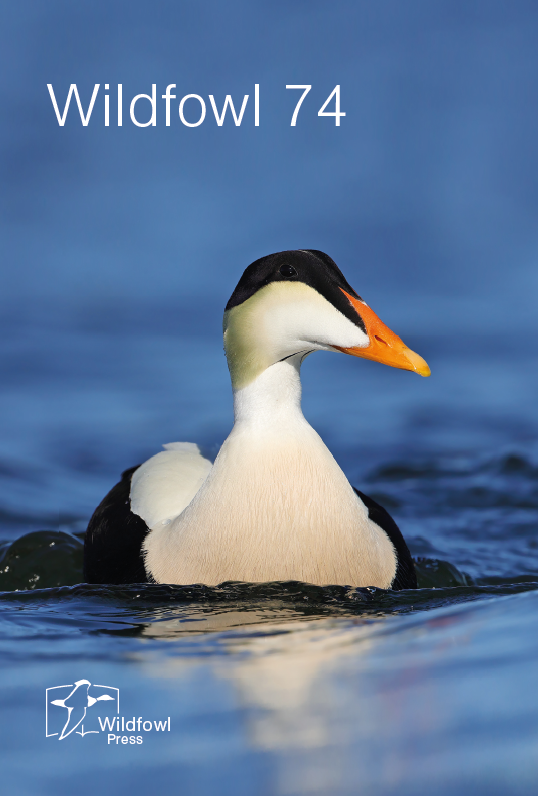
Severe declines in numbers of male American Common Eiders Somateria mollissima dresseri during spring counts over the past two decades in the southwestern Bay of Fundy, Canada
Article Sidebar
Main Article Content
Abstract
Article Details
Articles in Wildfowl volumes 1-74 and in Wildfowl Special Issues 1-7 are not licensed under Creative Commons. In these volumes, all rights are reserved to the authors of the articles respectively.
The Wildfowl & Wetlands Trust (which published the journal from 1948–2020 inclusive) retains a royalty-free license in perpetuity to access and use pre-2021 issues for the purposes of research, which may involve sharing with research partners from time to time.
The copyright for this paper belongs to the Author(s). Papers published in Wildfowl 75 (in 2025) and subsequent issues are licensed under a Creative Commons Attribution-NonCommercial-ShareAlike 4.0 International License.
In the articles published in these volumes, all rights are reserved to the authors of the articles respectively. This implies that readers can download, read, and link to the articles, but they cannot republish the articles. Authors can upload their articles into an institutional repository.
References
Allen, R.B., McAuley, D.G. & Zimmerman, G.S. 2019. Adult survival of Common Eiders in Maine. Northeastern Naturalist 26: 656.
Ballard, J.R., Mickley, R., Gibbs, S.E.J., Dwyer, C., Soos, C., Harms, N.J., Gilchrist, H.G., Hall, J.S., Franson, J.C., Milton, G.R., Parsons, G., Allen, B., Giroux, J.-F., Lair S., Mead, D.G. & Fischer, J.R. 2017. Prevalence and distribution of Wellfleet Bay Virus exposure in the common eider (Somateria mollissima). Journal of Wildlife Diseases 53: 81–90.
Bowman, T.D., Silverman, E., Gilliland, S.G. & Leirness, J. 2015. Status and trends of North American sea ducks: reinforcing the need for better monitoring. In J.-P.L. Savard, D.V. Derksen, D. Esler & J.M. Eadie (eds.), Ecology and Conservation of North American Sea Ducks, pp. 1–27. CRC Press, New York, USA.
Bowman, T., Churchill, J., Lepage, C., Badzinski, S., Gilliland, S.G., McLellan, N. & Silverman, E. 2022. Atlas of Sea Duck Key Habitat Sites in North America. Sea Duck Joint Venture, U.S. Fish and Wildlife Service, Anchorage, Alaska, USA. Available at https://seaduckjv.org/atlas/pdf/Sea%20Duck%20Atlas%20all%20lowres%203-21-22.pdf (last accessed 1 June 2024).
Canadian Wildlife Service Waterfowl Committee 2017. Population Status of Migratory Game Birds in Canada: November 2017. CWS Migratory Birds Regulatory Report No. 49. Canadian Wildlife Service, Gatineau, Quebec, Canada.
Chaulk, K.G. 2009. Suspected long-term population increases in Common Eiders, Somateria mollissima, on the mid-Labrador coast, 1980, 1994, and 2006. The Canadian Field-Naturalist 123: 304.
Chisholm, L., Talbot, T., Appleby, W., Tam, B. & Rong, R. 2021. Projected changes to air temperature, sea-level rise, and storms for the Gulf of Maine region in 2050. Elementa: Science of the Anthropocene 9: 00059. Available at https://doi.org/10.1525/elementa.2021. 00059 (last accessed 2 July 2024).
Erskine, A. & Smith, A. 1986. Status and movements of Common Eiders in the Maritime Provinces, Canadian Wildlife Service Report Series 47: 20–29.
Gilliland, S.G. & Lepage, C. 2013. Sea Duck Research and Monitoring in the Atlantic Flyway: Development of a Monitoring Program for the American Common Eider. An Assessment of Repeatability and Accuracy of Aerial Counts of Males (SDJV Project #135). Sea Duck Joint Venture, U.S. Fish and Wildlife Service, Anchorage, Alaska, USA. Available at: https://seaduckjv.org/science-resources/previous-and-ongoing-studies/ (last accessed 1 June 2024)
Giroux, J., PatenaudeMonette, M., Gilliland, S.G., Milton, G.R., Parsons, G.J., Gloutney, M.L., Mehl, K.R., Allen, R.B., McAuley, D.G., Reed, E.T. & McLellan, N.R. 2021. Estimating population growth and recruitment rates across the range of American Common Eiders. The Journal of Wildlife Management 85: 1646–1655.
Gonçalves Neto, A., Langan, J.A. & Palter, J.B. 2021. Changes in the Gulf Stream preceded rapid warming of the Northwest Atlantic Shelf. Communications Earth & Environment 2: 74.
Goudie, R.I., Roberston, G.J. & Reed, A. 2020. Common Eider (Somateria mollissima), version 1.0. In S.M. Billerman (ed.) Birds of the World. Cornell Lab of Ornithology, Ithaca, USA. Available at https://doi.org/10.2173/bow.comeid.01 (last accessed 1 June 2024).
Gutowsky, S., Robertson, G., Mallory, M., McLellan, N. & Gilliland, S. 2023. Redistribution of wintering American Common Eiders (Somateria mollissima dresseri). Avian Conservation and Ecology 18: art8. https:// doi.org/10.5751/ACE-02510-180208
Hamilton, D.J. 2000. Direct and indirect effects of predation by common eiders and abiotic disturbance in an intertidal community. Ecological Monographs 70: 21–43.
Koneff, M.D., Zimmerman, G.S., Dwyer, C.P., Fleming, K.K., Padding, P.I., Devers, P.K., Johnson, F.A., Runge, M.C. & Roberts, A.J. 2017. Evaluation of harvest and information needs for North American sea ducks. PLOS ONE 12: e0175411.
Lock, A. 1986. A census of Common Eiders breeding in Labrador and the Maritime Provinces. In A. Reed (ed.), Eider Ducks in Canada, pp. 30–38. Canadian Wildlife Service Report Series No. 47. CWS, Quebec City, Canada.
Mawhinney, K., Diamond, A.W., Kehoe, P. & Benjamin, N. 1999. Status and productivity of Common Eiders in relation to Great Black-Backed Gulls and Herring Gulls in the southern Bay of Fundy and the northern Gulf of Maine. Waterbirds 22: 253.
Meyer-Gutbrod, E., Greene, C., Davies, K. & Johns, D. 2021. Ocean regime shift is driving collapse of the North Atlantic Right Whale population. Oceanography 34: 22–31.
Milton, G.R., Iverson, S.A., Smith, P.A., Tomlik, M.D., Parsons, G.J. & Mallory, M.L. 2016. Sex-specific survival of adult common eiders in Nova Scotia, Canada: Common Eider survival in Nova Scotia. The Journal of Wildlife Management 80: 1427–1436.
Morse, R.E., Friedland, K.D., Tommasi, D., Stock, C. & Nye, J. 2017. Distinct zooplankton regime shift patterns across ecoregions of the U.S. Northeast continental shelf Large Marine Ecosystem. Journal of Marine Systems 165: 77–91.
Noel, K., McLellan, N., Gilliland, S., Allard, K.A., Allen, B., Craik, S., Demagny, A., English, M.D., Diamond, A., Giroux, J.-F., Hanson, A., Heusmann, H.W., King, L.E., Lepage, C., Major, H., McAuley, D., Meattey, D.E., Milton, G.R., Osenkowski, J., Roberts, A., Robertson, G.J., Roy, M.-C., Savoy, L., Sullivan, K. & Mallory, M.L. 2021. Expert opinion on American common eiders in eastern North America: international information needs for future conservation. Socio-Ecological Practice Research 3: 153–166.
Pershing, A.J., Alexander, M.A., Hernandez, C.M., Kerr, L.A., Le Bris, A., Mills, K.E., Nye, J.A., Record, N.R., Scannell, H.A., Scott, J.D., Sherwood, G.D. & Thomas, A.C. 2015. Slow adaptation in the face of rapid warming leads to collapse of the Gulf of Maine cod fishery. Science 350: 809–812.
Pershing, A.J., Mills, K.E., Dayton, A., Franklin, B. & Kennedy, B. 2018. Evidence for adaptation from the 2016 marine heatwave in the northwest Atlantic Ocean. Oceanography 31: 151–162.
Pershing, A.J., Alexander, M.A., Brady, D.C., Brickman, D., Curchitser, E.N., Diamond, A.W., McClenachan, L., Mills, K.E., Nichols, O.C., Pendleton, D.E., Record, N.R., Scott, J.D., Staudinger, M.D. & Wang, Y. 2021. Climate impacts on the Gulf of Maine ecosystem. Elementa: Science of the Anthropocene 9: 00076.
Pinsky, M.L., Worm, B., Fogarty, M.J., Sarmiento, J.L. & Levin, S.A. 2013. Marine taxa track local climate velocities. Science 341: 1239–1242.
R Core Team 2023. R: A Language and Environment for Statistical Computing. R Foundation for Statistical Computing, Vienna, Austria.
Robertson, G.J., Wong, S.N.P., Tomlik, M.D., Milton, G.R., Parsons, G.J. & Mallory, M.L. 2021. Common Eider wintering trends in Nova Scotia, 1970–2019. Journal of Fish and Wildlife Management 12: 565–571.
Ronconi, R.A. & Wong, S.N.P. 2003. Estimates of changes in seabird numbers in the Grand Manan Archipelago, New Brunswick, Canada. Waterbirds 26: 462–472.
Rothe, T.C., Padding, P.I., Naves, L.C. & Roberston, G.J. 2015. Harvest of sea ducks in North America: a contemporary summary. In J.-P.-L. Savard, D.V. Derksen, D. Esler & J.M. Eadie (eds.), Ecology and Conservation of North American Sea Ducks, pp. 417–467. CRC Press, New York, USA.
Seidov, D., Mishonov, A. & Parsons, R. 2021. Recent warming and decadal variability of Gulf of Maine and Slope Water. Limnology and Oceanography 66: 3472–3488.
Sorte, C.J.B., Davidson, V.E., Franklin, M.C., Benes, K.M., Doellman, M.M., Etter, R.J., Hannigan, R.E., Lubchenco, J. & Menge, B.A. 2017. Long-term declines in an intertidal foundation species parallel shifts in community composition. Global Change Biology 23: 341–352.
Tomlik, M.D., Milton, G.R., Parsons, G.J. & Mallory, M.L. 2023. Dynamic vegetation cover and decline in common eider breeding numbers in Nova Scotia, Canada. FACETS 8: 1–12.
Tjørnløv, R.S., Pradel, R., Choquet, R., Christensen, T.K. & Frederiksen, M. 2019. Consequences of past and present harvest management in a declining flyway population of common eiders Somateria mollissima. Ecology and Evolution 9: 12515–12530.
Venables, W.N. & Ripley, B.D. 2002. Modern Applied Statistics with R. Springer, New York, USA.
Wood, S.N., Pya, N. & Säfken, B. 2016. Smoothing parameter and model selection for General Smooth Models. Journal of the American Statistical Association 111: 1548–1563.
Wood, S. 2006. Generalized Additive Models: An Introduction With R. Chapman and Hall/CRC Press, Boca Raton, Florida, USA.
Zuur, A., Ieno, E., Walker, N., Saveliev, A. & Smith, G. 2009. Mixed Effects Models and Extensions in Ecology with R. Springer, New York, USA.