
Defining flyways, discerning population trends and assessing conservation challenges of key East Asian Anatidae species: an introduction
Article Sidebar
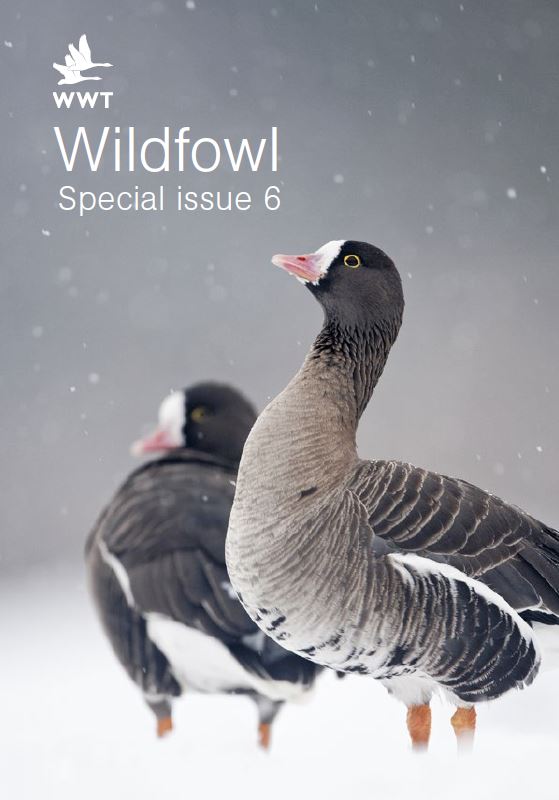
Main Article Content
Abstract
Long-distance migratory waterbirds contribute many ecosystem functions and services, not least as important huntable quarry species, as well as posing challenges to human societies, through agricultural crop damage, threats to flight safety and pathogen transmission. As a result, throughout much of the Northern Hemisphere, they have received considerable research attention to identify discrete population flyways upon which to build monitoring programmes, a basis for their effective internationally-coordinated conservation management, especially in North America and Europe. However, until recently, we lacked comparable information about migratory Anatidae populations in Far East Asia, despite long-term monitoring programmes and some knowledge of migration routes based on Japanese satellite tracking. In this article, we set the scene for the presentation of the species accounts for 10 large-bodied Anatidae species, which follow in this Special Issue of Wildfowl, and which attempt to fill some of the gaps in knowledge about these important species in Far East Asia. Papers in the Special Issue combine new telemetry data, winter counts and expert knowledge on the 10 species, to update maps of the extent of breeding and wintering areas, and to define the flyways that connect them. Critical stopover sites and the remotely-sensed habitats that these waterbird populations exploit along the way are also described, to provide a basis for their more effective future conservation.
Article Details
Articles in Wildfowl volumes 1-74 and in Wildfowl Special Issues 1-7 are not licensed under Creative Commons. In these volumes, all rights are reserved to the authors of the articles respectively.
The Wildfowl & Wetlands Trust (which published the journal from 1948–2020 inclusive) retains a royalty-free license in perpetuity to access and use pre-2021 issues for the purposes of research, which may involve sharing with research partners from time to time.
The copyright for this paper belongs to the Author(s). Papers published in Wildfowl 75 (in 2025) and subsequent issues are licensed under a Creative Commons Attribution-NonCommercial-ShareAlike 4.0 International License.
In the articles published in these volumes, all rights are reserved to the authors of the articles respectively. This implies that readers can download, read, and link to the articles, but they cannot republish the articles. Authors can upload their articles into an institutional repository.