
Contrasting trends in two East Asian populations of the Greater White-fronted Goose Anser albifrons
Article Sidebar
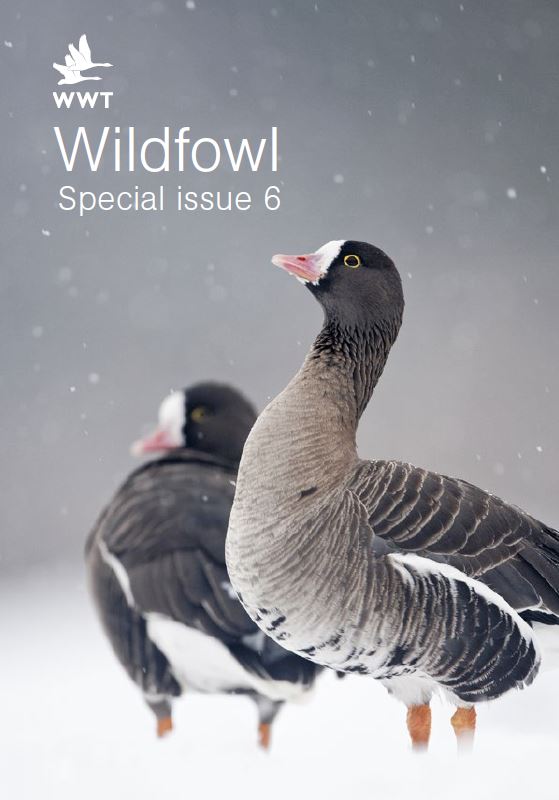
Main Article Content
Abstract
East Asian Greater White-fronted Goose Anser albifrons populations are less well defined and monitored than those in Europe and North America. Here, we combine historical and newly-reported telemetry data, wintering waterbirds surveys and expert advice to synthesis and update our knowledge of movements between the breeding and wintering distributions for Greater White-fronted Geese in East Asia. These sources suggest the existence of two biological flyway populations with contrasting population trends. The first consists of birds breeding on the Russian arctic, extending from the Khatanga River to east of Svyatoy Nos Cape (near Yana Bay, Yakutia), which migrates to winter in China where it is now almost totally confined to the Yangtze River floodplain. In recent years, this population has numbered between 30,000–55,000 individuals (compared to 140,000 in the 1990s), with > 70% concentrated at Poyang Lake in winter. The number of key sites identified for the species in China has increased with improved survey coverage since 2004. Birds from the second population also breed in arctic Russia, from east of Svyatoy Nos Cape to the Anadyr River, and winter in Japan and South Korea where 224,000–242,000 (in 2017/18 and 2018/19) and 178,000–182,000 (2018/19 and 2019/20) occur respectively, compared to a total population size of 60,000 reported in the late 1990s. Although the telemetry studies provide single examples of tracked birds moving between the two populations, suggesting some permeability, we contend that the populations are relatively discrete, but recommend retaining three management units (for China-, Japan- and Korea-wintering birds) because of the count, management and legislative logic of doing so. The results given here provide a robust assessment of the current status of these populations, but between-year differences in count totals underline the need for continued improvement of the count system in China. They also build a stronger basis for the effective conservation for this species in the region, highlighting the need for improved monitoring and management for the declining numbers wintering in China.
Article Details
Articles in Wildfowl volumes 1-74 and in Wildfowl Special Issues 1-7 are not licensed under Creative Commons. In these volumes, all rights are reserved to the authors of the articles respectively.
The Wildfowl & Wetlands Trust (which published the journal from 1948–2020 inclusive) retains a royalty-free license in perpetuity to access and use pre-2021 issues for the purposes of research, which may involve sharing with research partners from time to time.
The copyright for this paper belongs to the Author(s). Papers published in Wildfowl 75 (in 2025) and subsequent issues are licensed under a Creative Commons Attribution-NonCommercial-ShareAlike 4.0 International License.
In the articles published in these volumes, all rights are reserved to the authors of the articles respectively. This implies that readers can download, read, and link to the articles, but they cannot republish the articles. Authors can upload their articles into an institutional repository.