
Abundance of Tule Geese Anser albifrons elgasi in the Pacific Flyway 2003-2019
Article Sidebar
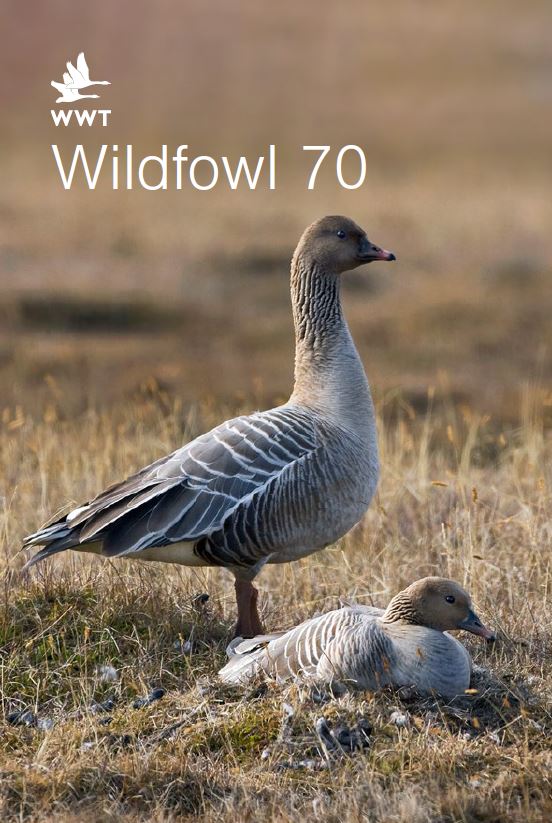
Main Article Content
Abstract
Tule Greater White-fronted Geese Anser albifrons elgasi (Tule Geese) may be the least abundant of North American goose subspecies and thus are a conservation concern. However, existing Tule Goose abundance estimates are either outdated, unpublished or lack estimates of precision. Annual estimates of Tule Goose abundance were derived by expanding estimates of radio-marked goose abundance by the ratio of total to radio-marked geese from mark-resight data. Tule Geese (n = 1,160) were captured and ringed during 2003–2019 primarily at an autumn migration stopover area in eastern Oregon, and 505 were also marked with plastic collars with unique codes and VHF radios. About 19,900 resightings (live encounter by radio telemetry or visual sightings) of radio-marked Tule Geese were made, primarily during autumn and winter in Oregon and California. The mean (± s.e.) annual abundance of Tule Geese in the autumn was 14,703 ± 1,455 (95% CI = 11,852–17,555, n = 17). There was no evidence of a trend in Tule Goose abundance during this period; the annual growth rate was -1.89 ± 1.84% (95% CI = -5.63–2.0, t16 = 1.05, P = 0.311, n.s.). Point estimates of annual abundance were variable (range = 6,992–33,342) and lacked precision (mean CV = 26%, range = 19–41%). The uncertainty was primarily associated with the variance of total to marked goose ratio estimates compared to estimates of radio-marked goose abundance. Winter distribution of Tule Geese generally appears to be unchanged from information from the 1980s and 1990s. Mean annual survival probability was lower for female (0.724 ± 0.038, 95% CI = 0.643-0.792) than for male (0.823 ± 0.029, 95% CI = 0.758–0.874) leg-ringed only geese, and for radio-marked geese (0.610 ± 0.028, 95% CI = 0.553–0.664) compared to leg-ringed only geese (0.786 ± 0.027, 95% CI = 0.727–0.834). The mark-resight method provides a means to monitor abundance of Tule Geese; however, improvements are needed to increase the precision of estimates, particularly regarding estimation of the ratio of total to marked geese. The stable trend in abundance and the moderate survival rates suggest that managers may need to assess current management strategies carefully if Tule Geese abundance is to be maintained or increased.
Article Details
Articles in Wildfowl volumes 1-74 and in Wildfowl Special Issues 1-7 are not licensed under Creative Commons. In these volumes, all rights are reserved to the authors of the articles respectively.
The Wildfowl & Wetlands Trust (which published the journal from 1948–2020 inclusive) retains a royalty-free license in perpetuity to access and use pre-2021 issues for the purposes of research, which may involve sharing with research partners from time to time.
The copyright for this paper belongs to the Author(s). Papers published in Wildfowl 75 (in 2025) and subsequent issues are licensed under a Creative Commons Attribution-NonCommercial-ShareAlike 4.0 International License.
In the articles published in these volumes, all rights are reserved to the authors of the articles respectively. This implies that readers can download, read, and link to the articles, but they cannot republish the articles. Authors can upload their articles into an institutional repository.