
From stopover to wintering: Bewick`s Swans Cygnus columbianus bewickii in Schleswig-Holstein, northern Germany in winters 2016/2017 and 2017/2018
Article Sidebar
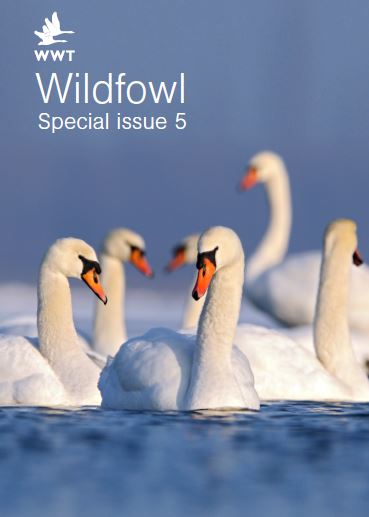
Main Article Content
Abstract
In recent years, Schleswig-Holstein in northwest Germany has held up to a third of the Northwest European population of Bewick’s Swans Cygnus columbianus bewickii for several weeks, especially in March, as the birds staged in the region before continuing northeast to spring migratory sites in the Baltic Countries. Maximum numbers counted in Schleswig-Holstein during 2017 (5,591 birds) were recorded 10 days earlier (on 25 February) than the mean date of the peak count (7 March) recorded for nine previous winters for which the dates of the peak counts were known. Winter 2017/2018 started and ended with even higher numbers, including a new record count of 8,364 individuals on 24 February, perhaps reflecting warmer winter temperatures. Sightings of > 116 individual swans fitted with neck-collars or leg-rings gave detailed insight into their migration phenology. These ringed birds were recorded at sites south or southwest of the River Elbe especially in autumn before flying to Schleswig-Holstein, where they stayed for up to four months, albeit making short flights south or west during this period to cope with periods of snow. During these two winters, Bewick’s Swans appeared at several new sites where they had not previously been recorded by observers, and the survey areas therefore were enlarged. Three trends in the swans’ staging patterns are discussed: 1) an increase in numbers, 2) earlier arrival, and 3) longer staying by the swans in Schleswig-Holstein as a consequence of 1) and 2).
Article Details
Articles in Wildfowl volumes 1-74 and in Wildfowl Special Issues 1-7 are not licensed under Creative Commons. In these volumes, all rights are reserved to the authors of the articles respectively.
The Wildfowl & Wetlands Trust (which published the journal from 1948–2020 inclusive) retains a royalty-free license in perpetuity to access and use pre-2021 issues for the purposes of research, which may involve sharing with research partners from time to time.
The copyright for this paper belongs to the Author(s). Papers published in Wildfowl 75 (in 2025) and subsequent issues are licensed under a Creative Commons Attribution-NonCommercial-ShareAlike 4.0 International License.
In the articles published in these volumes, all rights are reserved to the authors of the articles respectively. This implies that readers can download, read, and link to the articles, but they cannot republish the articles. Authors can upload their articles into an institutional repository.