
Estimating habitat carrying capacity for migrating and wintering waterfowl: considerations, pitfalls and improvements
Article Sidebar
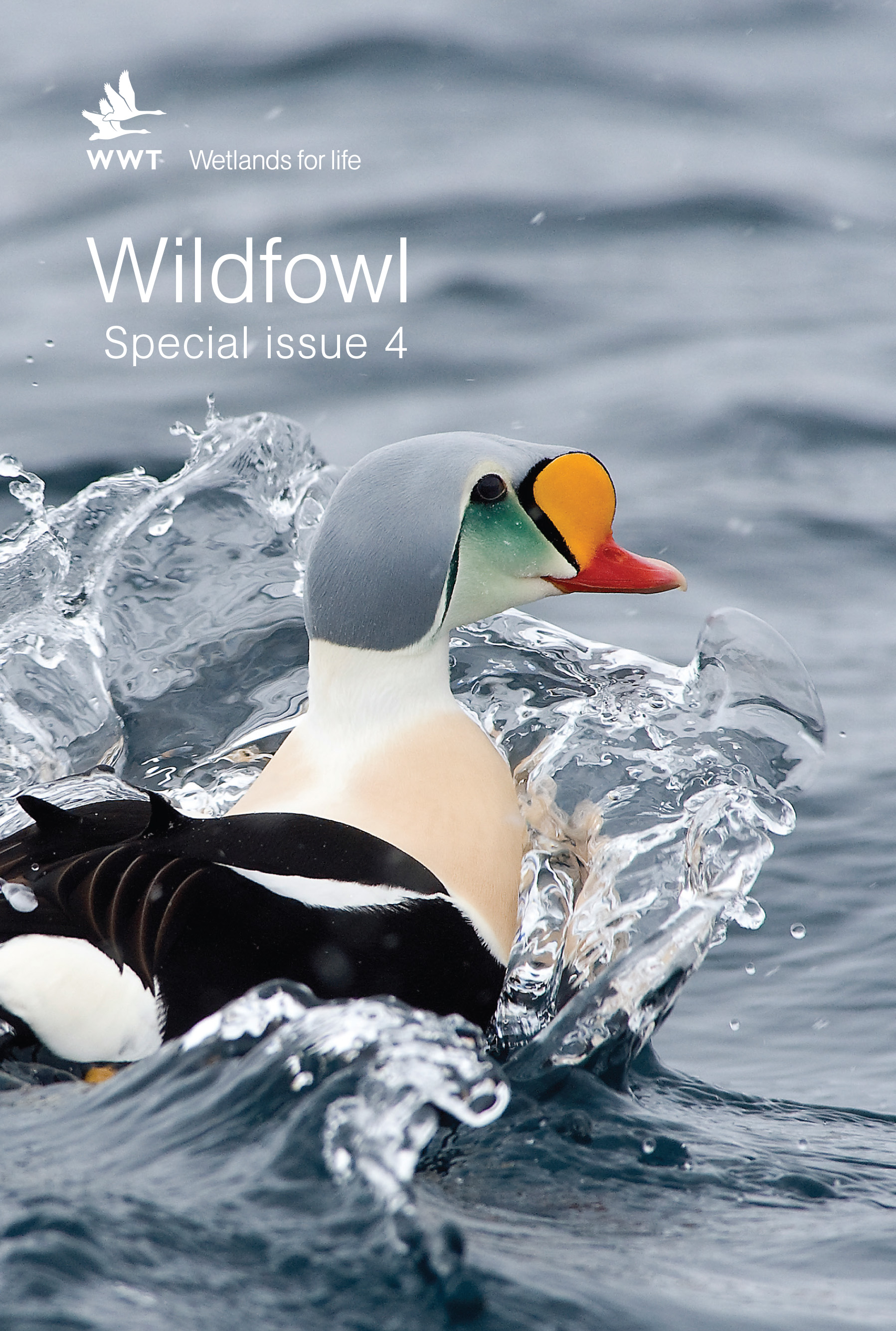
Main Article Content
Abstract
Population-based habitat conservation planning for migrating and wintering waterfowl in North America is carried out by habitat Joint Venture (JV) initiatives and is based on the premise that food can limit demography (i.e. food limitation hypothesis). Consequently, planners use bioenergetic models to estimate food (energy) availability and population-level energy demands at appropriate spatial and temporal scales, and translate these values into regional habitat objectives. While simple in principle, there are both empirical and theoretical challenges associated with calculating energy supply and demand including: 1) estimating food availability, 2) estimating the energy content of specific foods, 3) extrapolating site-specific estimates of food availability to landscapes for focal species, 4) applicability of estimates from a single species to other species, 5) estimating resting metabolic rate, 6) estimating cost of daily behaviours, and 7) estimating costs of thermoregulation or tissue synthesis. Most models being used are daily ration models (DRMs) whose set of simplifying assumptions are well established and whose use is widely accepted and feasible given the empirical data available to populate such models. However, DRMs do not link habitat objectives to metrics of ultimate ecological importance such as individual body condition or survival, and largely only consider food-producing habitats. Agent-based models (ABMs) provide a possible alternative for creating more biologically realistic models under some conditions; however, ABMs require different types of empirical inputs, many of which have yet to be estimated for key North American waterfowl. Decisions about how JVs can best proceed with habitat conservation would benefit from the use of sensitivity analyses that could identify the empirical and theoretical uncertainties that have the greatest influence on efforts to estimate habitat carrying capacity. Development of ABMs at restricted, yet biologically relevant spatial scales, followed by comparisons of their outputs to those generated from more simplistic, deterministic models can provide a means of assessing degrees of dissimilarity in how alternative models describe desired landscape conditions for migrating and wintering waterfowl.
Article Details
Articles in Wildfowl volumes 1-74 and in Wildfowl Special Issues 1-7 are not licensed under Creative Commons. In these volumes, all rights are reserved to the authors of the articles respectively.
The Wildfowl & Wetlands Trust (which published the journal from 1948–2020 inclusive) retains a royalty-free license in perpetuity to access and use pre-2021 issues for the purposes of research, which may involve sharing with research partners from time to time.
The copyright for this paper belongs to the Author(s). Papers published in Wildfowl 75 (in 2025) and subsequent issues are licensed under a Creative Commons Attribution-NonCommercial-ShareAlike 4.0 International License.
In the articles published in these volumes, all rights are reserved to the authors of the articles respectively. This implies that readers can download, read, and link to the articles, but they cannot republish the articles. Authors can upload their articles into an institutional repository.