
Variability in remigial moult chronology and nutrient dynamics of Surf Scoters Melanita perspicillata
Article Sidebar
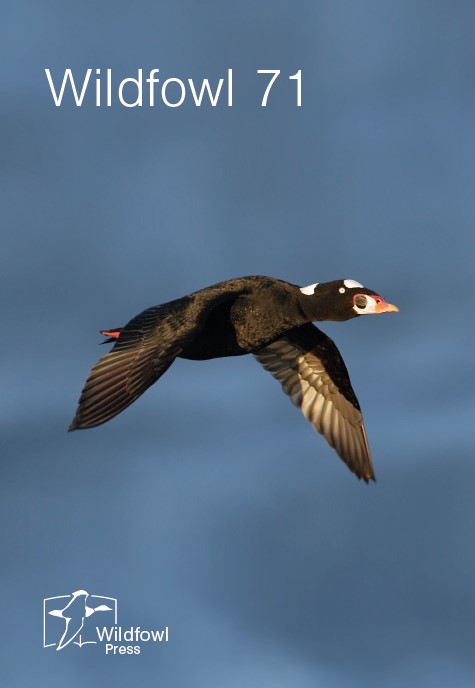
Main Article Content
Abstract
Little is known of the moulting ecology of the Surf Scoter Melanita perspicillata. In this study, we quantify the age and sex composition of moulting flocks, determine moulting chronology and consistency between years, and assess the body condition of scoters moulting along the coast of Labrador, Canada, during 2004–2007. Flocks of moulting scoters were comprised mainly of adult male Surf Scoters and the proportion of adults and sub-adults varied among years. Adult and sub-adult males had similar structural size and body mass but differed in bill morphology. The forecrown patch was a good indicator of age in males during moult, being fully developed in adult males and partially developed in sub-adults. Female Surf Scoters moulted later than males and adult males moulted slightly earlier than sub-adult males. We estimated that Surf Scoters were able to fly when their primaries reached 80% of their full growth, which yielded a flightless period of at least 35 days. We did not find any changes in leg, breast and liver lipid and proteins, but did observe a slight increase in total lipid levels as moult progressed.
Article Details
Articles in Wildfowl volumes 1-74 and in Wildfowl Special Issues 1-7 are not licensed under Creative Commons. In these volumes, all rights are reserved to the authors of the articles respectively.
The Wildfowl & Wetlands Trust (which published the journal from 1948–2020 inclusive) retains a royalty-free license in perpetuity to access and use pre-2021 issues for the purposes of research, which may involve sharing with research partners from time to time.
The copyright for this paper belongs to the Author(s). Papers published in Wildfowl 75 (in 2025) and subsequent issues are licensed under a Creative Commons Attribution-NonCommercial-ShareAlike 4.0 International License.
In the articles published in these volumes, all rights are reserved to the authors of the articles respectively. This implies that readers can download, read, and link to the articles, but they cannot republish the articles. Authors can upload their articles into an institutional repository.