
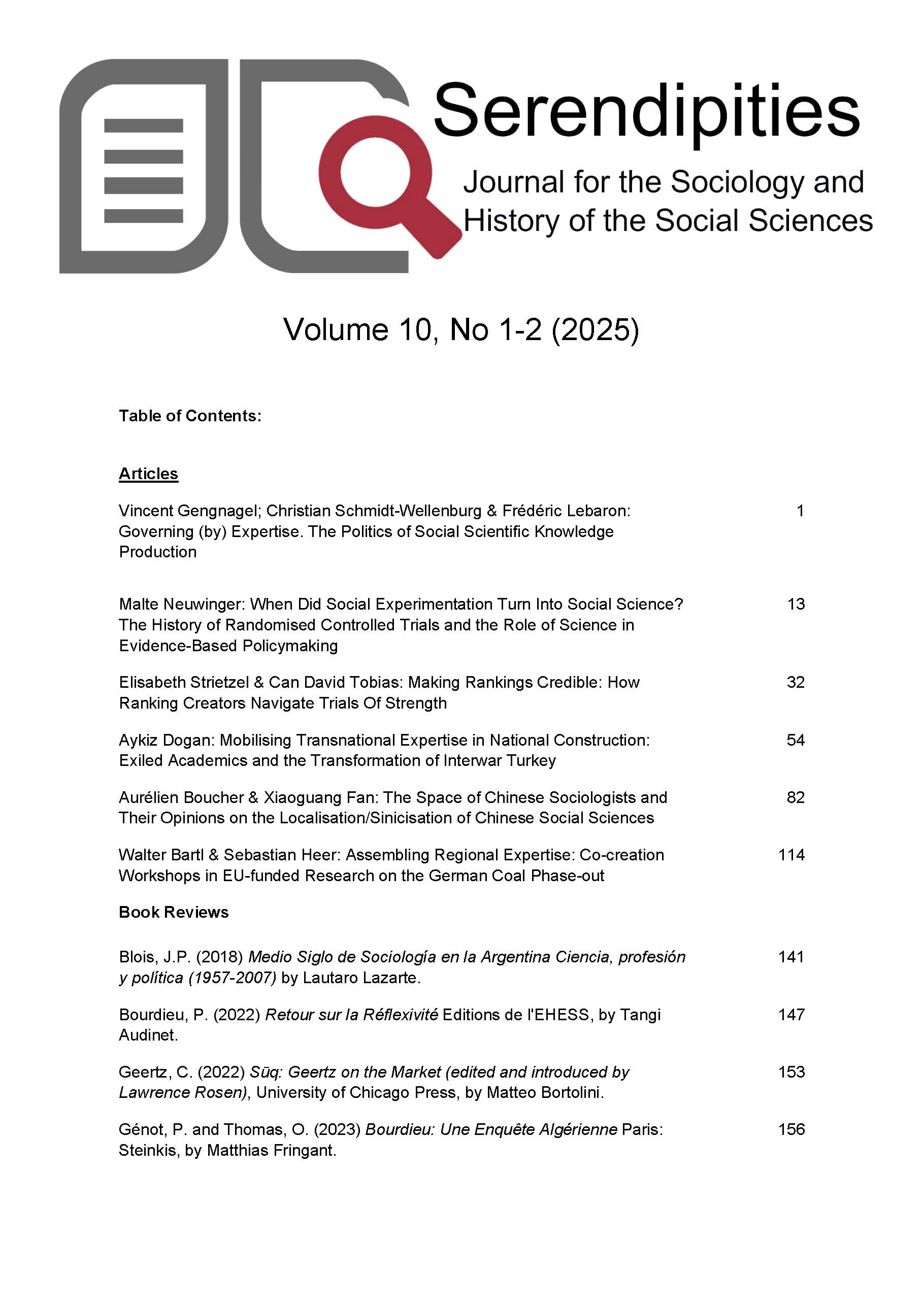
When Did Social Experimentation Turn Into Social Science? The History of Randomised Controlled Trials and the Role of Science in Evidence-Based Policymaking
DOI:
https://doi.org/10.7146/serendipities.v10i1-2.164196Keywords:
randomised controlled trial, social experiment, problem of demarcation, boundary work, history of social science, evidence-based policymakingAbstract
Supporters and critics of contemporary evidence-based policymaking (EBPM) widely view randomised controlled trials (RCTs) as an example of social science turned into an instrument of policymaking. Yet, historically, it is more adequate to say that policymaking turned RCTs into social science. Questioning standard views on the history of RCTs, this article argues that for most of the twentieth century, the scientific status of RCTs remained ambiguous—yet this did not stop them from gaining political credibility in social and medical applications. Until recently, experimental approaches were used not because they were regarded as the hallmark of science but because regulators and businesses felt that testing policies and drugs systematically was a sensible thing to do. Debates about the scientific status of RCTs became significant only in the 1980s when some leading social scientists opposed RCTs, viewing them as unscientific trial-and-error tinkering. RCTs eventually emerged as a generic instrument of evaluation in the 1990s, when they became regarded as politically credible and scientific. Judging from the history of its “gold standard”, present-day EBPM’s focus on social science instead of politics and business essentially reverses the direction in which it expects evidence to come to policy.
References
Angrist, Joshua D. and Jörn-Steffen Pischke (2010) The Credibility Revolution in Empirical Economics: How Better Research Design is Taking the Con out of Econometrics, Journal of Economic Perspectives 24(2): 3–30.
Backhouse, Roger E. and Philippe Fontaine (2010) Toward a History of the Social Sciences, in Roger E. Backhouse and Philippe Fontaine (Eds.), The History of the Social Sciences Since 1945, Cambridge, UK: Cambridge University Press, 184–233.
Baron, Jon (2018) A Brief History of Evidence-Based Policy, The ANNALS of the American Academy of Political and Social Science 678(1): 40–50. https://doi.org/10.1177/0002716218763128.
Bédécarrats, Florent, Isabelle Guérin, and François Roubaud (eds.) (2020) Randomized Control Trials in the Field of Development: A Critical Perspective, Oxford: Oxford University Press.
Berman, Elizabeth Popp (2022) Thinking Like an Economist: How Efficiency Replaced Equality in U.S. Public Policy, Princeton, N.J.: Princeton University Press.
Bothwell, Laura E., Wen-Hua Kuo, David S. Jones, and Scott H. Podolsky (2020) Social and Scientific History of Randomized Controlled Trials, in Steven Piantadosi and Curtis L. Meinert (Eds.), Principles and Practice of Clinical Trials, Cham: Springer International Publishing, 1–17.
Bourdieu, Pierre (1991) The peculiar history of scientific reason, Sociological Forum 6(1): 3–26. https://doi.org/10.1007/BF01112725.
Bourdieu, Pierre (2004) Science of Science and Reflexivity, Cambridge, UK: Polity Press.
Bourdieu, Pierre, Jean-Claude Chamboredon, and Jean-Claude Passeron (1991) The Craft of Sociology: Epistemological Preliminaries, Berlin: De Gruyter.
Breslau, Daniel (1997a) The Political Power of Research Methods: Knowledge Regimes in U. S. Labor-Market Policy, Theory and Society 26(6): 869–902.
Breslau, Daniel (1997b) Contract Shop Epistemology: Credibility and Problem Construction in Applied Social Science, Social Studies of Science 27: 363–394.
Breslau, Daniel (1998) In Search of the Unequivocal. The Political Economy of Measurement in U.S. Labor Market Policy, Westport, CT: Praeger.
Brown, Robert (1997) The delayed birth of social experiments, History of the Human Sciences 10(2): 1–21.
Brunner, Ronald D. (1982) The policy sciences as science, Policy Sciences 15(2): 115–135.
Bulmer, Martin (1991) National contexts for the development of social-policy research: British and American research on poverty and social welfare compared, in Social Sciences and Modern States. National Experiences and Theoretical Crossroads, Cambridge, UK: Cambridge University Press, 148–167.
Campbell, Donald T. and Julian C. Stanley (1967) Experimental and quasi-experimental designs for research, Boston: Houghton Mifflin Company.
Carpenter, Daniel (2014) Reputation and Power: Organizational Image and Pharmaceutical Regulation at the FDA, Princeton, N.J.: Princeton University Press.
Chupein, Thomas and Rachel Glennerster (2018) Evidence-Informed Policy from an International Perspective, The ANNALS of the American Academy of Political and Social Science 678(1): 62–70.
Daly, Jeanne (2005) Evidence-based medicine and the search for a science of clinical care, Berkeley: University of California Press.
Dehue, Trudy (2001) Establishing the Experimenting Society: The Historical Origin of Social Experimentation According to the Randomized Controlled Design, The American Journal of Psychology 114(2): 283–302.
deLeon, Peter (1991) Political events and the policy sciences, in Björn Wagner, Carol Hirschon Weiss, Björn Wittrock, and Hellmut Wollmann (Eds.), Social Sciences and Modern States. National Experiences and Theoretical Crossroads, Cambridge, UK: Cambridge University Press, 86–109.
Duflo, Esther and Michael Kremer (2005) Use of Randomization in the Evaluation of Development Effectiveness, in George Keith Pitman, Osvaldo N. Feinstein, and Gregory K. Ingram (Eds.), Evaluating Development Effectiveness, Piscataway, NJ: Transaction Publishers, 93–120.
Epstein, Steven (1996) Impure science: AIDS, activism, and the politics of knowledge, Berkeley: University of California Press.
Evidence-Based Medicine Working Group (1992) Evidence-Based Medicine: A New Approach to Teaching the Practice of Medicine, JAMA 268(17): 2420–2425.
Eyal, Gil (2019) The Crisis of Expertise, Cambridge, MA: Polity Press.
Fejerskov, Adam (2022) The Global Lab: Inequality, Technology, and the Experimental Movement, Oxford: Oxford University Press.
Fisher, Ronald (1935) The Design of Experiments. Edinburgh: Oliver & Boyd Ltd.
Fraker, Thomas and Rebecca Maynard (1987) The Adequacy of Comparison Group Designs for Evaluations of Employment-Related Programs, The Journal of Human Resources 22(2): 194–227.
Gieryn, Thomas F. (1983) Boundary-Work and the Demarcation of Science from Non-Science: Strains and Interests in Professional Ideologies of Scientists, American Sociological Review 48(6): 781–795.
Gueron, Judith M. and Howard Rolston (2013) Fighting for Reliable Evidence, New York: Russell Sage Foundation.
Guglielmo, Mark (2008) The Contribution of Economists to Military Intelligence During World War II, The Journal of Economic History 68(1): 109–150.
Hacking, Ian (1988) Telepathy: Origins of Randomization in Experimental Design, Isis 79(3): 427–451. https://doi.org/10.1086/354775.
Hadorn, Susanne, Fritz Sager, Céline Mavrot, Anna Malandrino, and Jörn Ege (2022) Evidence-Based Policymaking in Times of Acute Crisis: Comparing the Use of Scientific Knowledge in Germany, Switzerland, and Italy, Politische Vierteljahresschrift 63(2): 359–382. https://doi.org/10.1007/s11615-022-00382-x.
Hansson, Sven Ove (2015) Experiments Before Science. What Science Learned from Technological Experiments, in The Role of Technology in Science: Philosophical Perspectives, Dordrecht: Springer Netherlands, 81–112.
Harvey, Carol, Michael J. Camasso, and Radha Jagannathan (2000) Evaluating Welfare Reform Waivers Under Section 1115, Journal of Economic Perspectives 14(4): 165–188. https://doi.org/10.1257/jep.14.4.165.
Hausman, Jerry A. and David A. Wise (1985) Social Experimentation, Chicago: University of Chicago Press.
Heckman, James J. (1979) Sample Selection Bias as a Specification Error, Econometrica 47(1): 153–161.
Heckman, James J. (2020) Epilogue: Randomization and Social Policy Evaluation Revisited, in Florent Bédécarrats, Isabelle Guerin, and François Roubaud (Eds.), Randomized Control Trials in the Field of Development, Oxford: Oxford University Press, 304–330.
Hirvonen, Ilmari and Janne Karisto (2022) Demarcation without Dogmas, Theoria 88(3): 701–720. https://doi.org/10.1111/theo.12395.
Jamison, Julian C. (2019) The Entry of Randomized Assignment into the Social Sciences, Journal of Causal Inference 7(1): 1–16. https://doi.org/10.1515/jci-2017-0025.
Jann, Werner (1991) From policy analysis to political management? An outside look at public policy training in the United States, in Peter Wagner, Carol Hirschon Weiss, Björn Wittrock, Hellmut Wollman (Eds.), Social Sciences and Modern States: National Experiences and Theoretical Crossroads, Cambridge: Cambridge University Press, 110–130.
Jasanoff, Sheila (1987) Contested Boundaries in Policy-Relevant Science, Social Studies of Science 17(1): 195–230.
J-PAL (2024) The Abdul Latif Jameel Poverty Action Lab [online]. https://www.povertyactionlab.org/ [Last accessed: 22 January 2024].
Kuhn, Thomas S. (1970) The Structure of Scientific Revolutions, Chicago: University of Chicago Press.
LaLonde, Robert J. (1986) Evaluating the Econometric Evaluations of Training Programs with Experimental Data, The American Economic Review 76(4): 604–620.
Laudan, L. (1983) The demise of the demarcation problem, in R.S. Cohen and L. Laudan (Eds.), Physics, Philosophy and Psychoanalysis, Dordrecht: Springer Netherlands, 111–127.
Leigh, Andrew (2018) Randomistas: How Radical Researchers Are Changing Our World, New Haven: Yale University Press.
Levitt, Steven D. and John A. List (2009) Field Experiments in Economics: The Past, the Present, and the Future, European Economic Review 53(1): 1–18.
Manzi, Jim (2012) Uncontrolled: The surprising payoff of trial-and-error for business, politics, and society, New York: Basic Books.
Marks, Harry M. (2000) The Progress of Experiment: Science and Therapeutic Reform in the United States, 1900-1990, Cambridge, UK: Cambridge University Press.
Moffitt, Robert A. (2004) The Role of Randomized Field Trials in Social Science Research. A Perspective From Evaluations of Reforms of Social Welfare Programs, American Behavioral Scientist 47(5): 506–540.
Neuwinger, Malte (2024) What makes randomized controlled trials so successful—for now? Or, on the consonances, compromises, and contradictions of a global interstitial field, Theory and Society 53(5): 1213–1244.
Oakley, Ann (2000) A Historical Perspective on the Use of Randomized Trials in Social Science Settings, Crime & Delinquency 46(3): 315–329.
O’Connor, Alice (2001) Poverty Knowledge: Social Science, Social Policy, and the Poor in Twentieth-Century US History, Princeton, N.J: Princeton University Press.
Oliver, Kathryn, Theo Lorenc, and Simon Innvær (2014) New directions in evidence-based policy research: a critical analysis of the literature, Health Research Policy and Systems 12(1): 34.
Parkhurst, Justin O. (2017) The politics of evidence: from evidence-based policy to the good governance of evidence, London: Routledge.
Petryna, Adriana (2009) When Experiments Travel. Clinical Trials and the Global Search for Human Subjects, Princeton, N.J.: Princeton University Press.
Picciotto, Robert (2020) Are the ‘Randomistas’ Evaluators?, in Randomized Control Trials in the Field of Development, Oxford University Press, 256–279.
Porter, Theodore M. (1986) The Rise of Statistical Thinking, 1820–1900, Princeton, N.J.: Princeton University Press.
Ravallion, Martin (2020) Should the Randomistas (Continue to) Rule?, in Florent Bédécarrats, Isabelle Guerin, and Francois Roubaud (Eds.), Randomized Control Trials in the Field of Development, Oxford: Oxford University Press, 47–78.
Riecken, H.W. and R.F. Boruch (1978) Social Experiments, Annual Review of Sociology 4: 511–532.
Rossi, Peter H. (1987) The Iron Law of Evaluation and Other Metallic Rules, Research in Social Problems and Public Policy 4: 3–20.
Rossi, Peter H. and James D. Wright (1984) Evaluation Research: An Assessment, Annual Review of Sociology 10: 331–352.
Rossi, Peter H., James D. Wright, and Sonia R. Wright (1978) The Theory and Practice of Applied Social Research, Evaluation Quarterly 2(2): 171–191.
Sacket, David, William Rosenberg, Jamuir Gray, Robert Brian Haynes, and Scott Richardson (1996) Evidence based medicine: what it is and what it isn’t, British Journal of Medicine 312: 71–72.
Solomon, Miriam (2011) Just a paradigm: evidence-based medicine in epistemological context, European Journal for Philosophy of Science 1(3): 451–466.
de Souza Leão, Luciana and Gil Eyal (2019) The rise of randomized controlled trials (RCTs) in international development in historical perspective, Theory and Society 48(3): 383–418.
Steensland, Brian (2006) Cultural Categories and the American Welfare State: The Case of Guaranteed Income Policy, American Journal of Sociology 111(5): 1273–1326.
Stoker, Gerry and Mark Evans (2016) Evidence-Based Policy Making and Social Science, in Gerry Stoker and Mark Evans (Eds.), Evidence-Based Policy Making in the Social Sciences, Bristol: Policy Press, 15–28.
Swartz, David L. (2013) Metaprinciples for Sociological Research in a Bourdieusian Perspective, in Philip S. Gorski (Ed.), Bourdieu and Historical Analysis, Durham: Duke University Press, 19–35.
Turner, Stephen P. (2013) The Politics of Expertise, New York: Routledge.
Vedung, Evert (2010) Four Waves of Evaluation Diffusion, Evaluation 16(3): 263–277.
Wittrock, Björn, Peter Wagner, and Hellmut Wollmann (1991) Social science and the modern state: policy knowledge and political institutions in Western Europe and the United States, in Social Sciences and Modern States: National Experiences and Theoretical Crossroads, Cambridge, UK: Cambridge University Press, 28–85.
Downloads
Published
How to Cite
Issue
Section
License
Copyright (c) 2026 Malte Neuwinger

This work is licensed under a Creative Commons Attribution-NonCommercial-NoDerivatives 4.0 International License.
CC-BY-NC-ND


