Social Interaction
Video-Based Studies of Human Sociality
The Director's Ways of Seeing:
Embodied Participation in Japanese Theater Rehearsals
Minato Suzuki
Rikkyo University
Abstract
This study examines how participants' bodily orientations organize transitions from preparation to performance during rehearsals for a Japanese theater production. Drawing on video-based conversation analysis, it shows that actors' entry into performance as characters is collaboratively accomplished through embodied conduct involving both actors and the director. The director's shifts in posture and visual orientation make her directorial way of seeing publicly intelligible and contribute to reconfiguring the participation frame for performance. At the same time, the intelligibility of this directorial way of seeing depends on how these bodily shifts are situated within the unfolding interaction. Performance as a creative activity is interactionally made possible through the coordinated embodied conduct of multiple participants.
Keywords: theatrical rehearsals, conversation analysis, posture, creativity, Japanese
1. Introduction1
As Becker (1982) has argued, creative work is not accomplished by isolated individuals but within an "art world," an organized network of cooperative activities. Theater rehearsals are no exception. The creation of a theatrical performance proceeds through recurrent cycles in which actors perform a version of a scene, the director observes it and provides feedback, and participants then prepare to perform again. Transitions from one phase of this cycle to the next are not brought about by either the director or the actors alone but are interactionally accomplished through their coordinated conduct. Taking this recurrent organization as its point of departure, this paper examines how one recurrent part of creative work in rehearsals is interactionally organized: the transition from the director's feedback to the actors' renewed performance. By focusing on this transition, the paper demonstrates how bodily arrangements involving both the actors and the director organize the actors' entry into the performance phase, in which they participate as characters.
Previous conversation analysis studies have investigated how instructional and rehearsal settings are organized in the performing arts (e.g., Schmidt 2014, 2018, 2020; Krug 2022, 2023, 2025; Krug and Schmidt 2020; Löfgren 2023; Smart and Szczepek Reed 2025; Szczepek Reed et al. 2013; Broth and Keevallik 2014; Schmidt and Deppermann 2023; Lefebvre 2018, 2020; Lefebvre and Mondada 2023). The professional rehearsal examined in this study is oriented primarily toward the collaborative development of a particular theatrical production rather than toward developing the actors' general abilities through teaching2. Nevertheless, it shares an important organizational feature with instructional settings: in both settings, directions provided by a director or instructor are expected to inform the performers' subsequent embodied conduct. Research on instructional settings (e.g. Lindwall and Mondada 2025; Nishizaka and Okazawa 2026) therefore provides an important point of reference for examining the organization of professional rehearsals, including how participants move from instructions to embodied performance. For example, through their analysis of dance lessons, Broth and Keevallik (2014) provided valuable insight into how the transition from instruction to performance is interactionally organized in dance classes. They show that this transition is accomplished through three successive phases: 1) a verbal practice projector (e.g., "Let's try"), 2) a specification of where in the choreography to begin (structuring instructions), and 3) a rhythmic count-in that enables the students to begin dancing in synchrony. Although they differ in their primary aims, namely, producing a particular work or improving performers' abilities, instructional and rehearsal settings share certain organizational features insofar as performers are expected to follow directions specifying how they should move.
Turning more specifically to theatrical rehearsals, Schmidt (2014, 2018, 2020) offers a detailed analysis of rehearsal practices in contemporary theater. His research focuses on the preparatory processes that precede the onset of performance, particularly highlighting the multimodal organization of what he calls "projections-by-arrangement." These include verbal negotiations that anticipate aspects of the performance as well as bodily and material operations such as organizing spatial arrangements or manipulating props. One of Schmidt's key contributions is to show how participants collaboratively manage transitions between Spiel (play) and Realwelt (the real world). In doing so, he emphasizes the structural alternation between performance and non-performance phases. In particular, Schmidt (2020) focuses on moments in which ongoing acting is interrupted by the director's intervention and the activity shifts from Spiel (play) to Realwelt (the real world). Through this analysis, he demonstrates that directors' interventions are designed to minimize disruption and to preserve the progressivity of acting. Building on this line of analysis, the present study examines the interactional environment in which the transition from preparatory activities to a performance frame is accomplished, paying particular attention to the director's embodied conduct.
In Frame Analysis (1974), Goffman discusses the framing of theatrical performances and how they differ from everyday interactions. According to him, in a theatrical frame, actions are treated as depicting representations rather than as conducting real action. This framing is typically marked through constructional devices such as the opening and closing of a curtain. Such features stand in contrast to ordinary face-to-face interactions. While Goffman's analysis primarily addresses institutionally organized performances in which the theatrical frame can be treated as given, rehearsal settings differ in a crucial respect: the frame of "performance" cannot be presupposed. Rather, it is locally and interactionally accomplished through participants' embodied orientations, verbal and bodily actions, and engagements with the material environment. This raises an important empirical question: How is a performance frame interactionally constituted?
Within conversation analysis, several video-based studies have contributed to the development of empirically grounded approaches to framing that extend Goffman's notion of "frame" by foregrounding participants' embodied conduct (C. Goodwin 1981; M. H. Goodwin 1980, 1990, 2006; Heath 1986; Nishizaka 1992, 2009; Mondada 2009, 2013). Following and theoretically refining these lines of argument, Nishizaka (1992, 2009) emphasizes that transitions between activities are accomplished through the rearrangement of the participants' embodied orientations and that it is therefore necessary to analyze the spatial arrangement of multiple bodies as they orient to elucidate ongoing activity. Building on Goffman's (1974) concept of frame and Kendon's (1990) notion of F-formations, Nishizaka proposed the concept of a participation frame as a unit of social activity constituted through the participants' embodied orientations. Nishizaka's framework emphasizes how the participants display their participatory roles, such as "doctor" or "patient," through their bodily displays within an ongoing activity. Whereas Goffman's notion of the participation framework is primarily concerned with distinguishing participation statuses (e.g., speaker and hearer roles) on a per-utterance basis, Nishizaka's concept of the participation frame shifts the analytical focus to the participants' embodied orientations toward activity. This shift enables a description of the diverse roles on a per-activity basis. In this study, a change in the participation frame refers specifically to a reconfiguration of the participants' embodied orientations through which a shift in the ongoing activity and in their activity-relevant participatory roles is made publicly recognizable. The concept thus allows us to describe how participants accomplish the transition from feedback, in which the director provides comments to the actors, to performance, in which the actors participate as characters while the director participates as an observer.
Building on these perspectives, this paper analyzes a theatrical rehearsal through the concept of "participation frame." This concept enables us to examine rehearsal as a social activity constituted through the embodied orientations displayed by both the director and the actors in interaction. It also provides a way to investigate how the same performers come to participate in different participatory roles across participation frames: in the direction section, as actors receiving and responding to direction, and in the performance section, as actors performing as characters within an enacted scene. The analysis shows how the transition from the direction section to renewed performance is interactionally accomplished through the director's bodily conduct in coordination with the actors' embodied preparations.
2. Data and Method
2.1 Data
This study examines a rehearsal session from a contemporary theater production in Japan. Approximately 30 hours of video recordings were collected in 2019 during rehearsals held by several theater companies in the Kanto region. The excerpts analyzed in this paper are drawn from rehearsals involving professional theater practitioners preparing a Japanese-language stage performance. The director is responsible not only for directing the production but also for writing the play itself. The recordings were made during the early stages of a month-long rehearsal process, when the actors had not yet memorized their lines and therefore performed while holding scripts. Since neither the spatial positioning nor the timing of utterance onsets had yet been fully determined—matters that are typically the responsibility of the director—this early phase provides a perspicuous setting (Garfinkel 2002) for analyzing how the participation frame is organized moment by moment through interaction. To elucidate these shifts in participation frames, this paper adopts the methodological approach of conversation analysis (Sacks 1992; Schegloff 2007).
Figure 1. Rehearsal of a bus conversation scene
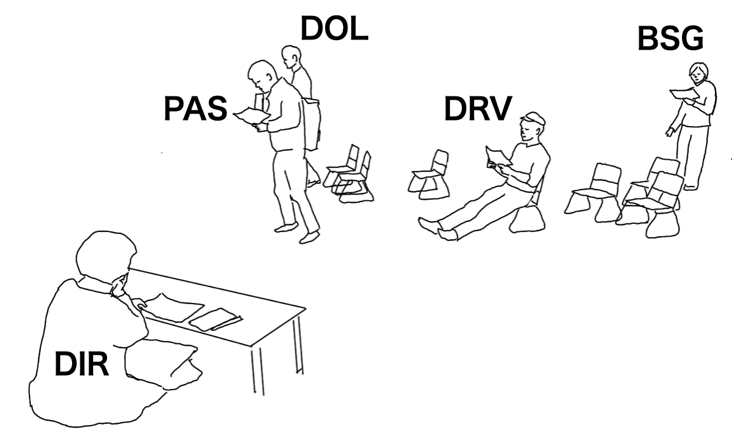
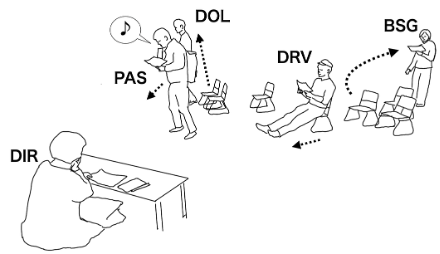
The rehearsal took place in a Japanese-style room, where sitting on the floor is typically expected. Four actors (BSG, PAS, DOL, and DRV) collaboratively rehearsed a bus conversation under the direction of the director (DIR) (see Figure 1). Apart from the four actors and the director, only the researcher was present during the rehearsal. All the excerpts examined in this paper are drawn from the second scene, which is labeled "②" in the script. Although the participants had rehearsed this scene prior to the day of recording, the script had been revised in the meantime, and this rehearsal was the first time they rehearsed the revised script. The scene begins with the tour guide's line, "Minasama, honjitsu wa ..." ("Ladies and gentlemen, today …") and features four characters: BSG as the bus tour guide, PAS as a passenger, DOL as a doll, and DRV as the bus driver. This scene is treated as a discrete rehearsal unit, explicitly referenced in the script. The director (DIR) observes the performance and provides feedback while seated directly on the floor.
2.2 Three sections in theatrical rehearsals
In general, rehearsals can be divided into two central sections (Krug and Schmidt 2020; Schmidt 2014, 2018, 2020; Broth and Keevallik 2014). The first is the performance section, during which the actors perform and the director observes. The second is the direction section, in which the director gives feedback or direction to the actors based on what was observed in the preceding performance section. This then leads back into another performance section.
Note that a new performance section does not begin immediately after the direction section ends. Rather, both the actors and the director progressively reorganize their participation roles through physical preparations, such as moving to their stage positions, arranging props, or preparing to observe the performance, before the scene can resume. Previous studies have pointed out that rehearsal sessions typically alternate between performance and reflection phases and have analyzed how participants mobilize multimodal resources to manage the gradual transition into the next performance segment (e.g., Krug and Schmidt 2020; Schmidt 2014, 2018; Broth and Keevallik 2014). In this study, I refer to the time span between the director's instruction to resume performing and the actual onset of the actors' lines as the preparation section (see Table 1).
Table 1. Phases of Rehearsals
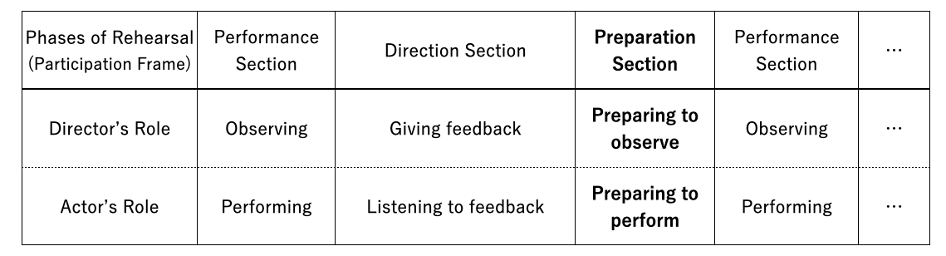
In the data analyzed in this study, performance sections and direction sections were typically organized in an alternating pattern, with a preparation section intervening between them. Performances were usually allowed to unfold without being interrupted by the director, with comments and instructions delivered after the completion of a performance section.3
What is crucial about this preparation section is that it provides a setting in which the participation frame is reorganized in anticipation of the upcoming performance. Accordingly, the following analysis focuses on the organization of this preparatory phase.
3. Analysis
3.1 The initiation of the preparation section
In the following analysis, I examine how the participation frame for performance is established and reorganized through the embodied rearrangements of the participants' bodies. In Excerpt 1, I show that the director's act of bodily reorientation is treated by the participants as a crucial resource for organizing the participation frame of the performance section. In Excerpt 2, I analyze a case in which a participation frame that was in the process of being established is temporarily interrupted by an inserted interaction—specifically, an exchange about adjusting the air-conditioning temperature—that is not directly related to the performance. By focusing on the shift in the director's embodied orientation during this inserted sequence, I demonstrate that participants treat her bodily conduct as a salient resource for managing transitions between rehearsal sections.
The following excerpt 1 captures a moment just after scene ② has been performed through to the end, followed by a direction section in which the director (DIR) gives feedback to the actors regarding their performances. The rehearsal is now about to transition into a new enactment of scene ②. At line 10, DIR says, "Mokkai yatte mo yoroshii deshou ka?" ("Shall we try it again?"), thereby instructing the actors to restart the performance section from scene ②.
Excerpt 1.
Open in a separate windowIn order to clarify how the participation frame is reorganized within the preparation section, I begin by examining how this section is initiated. What is crucial for the initiation of the preparation section is the utterance in line 10: "Mokkai yatte mo yoroshii deshou ka?" ("Once more, can we do it?") This utterance is a type of "practice projector," an interactional marker that initiates a shift into performance activity, and it takes the form of the first pair part of an adjacency pair (Broth and Keevallik 2014; Schegloff 2007). With this utterance, DIR proposes a restart of scene ②, which begins with the line "Minasama, honjitsu wa ..." ("Ladies and gentlemen, today ...") on line 16.
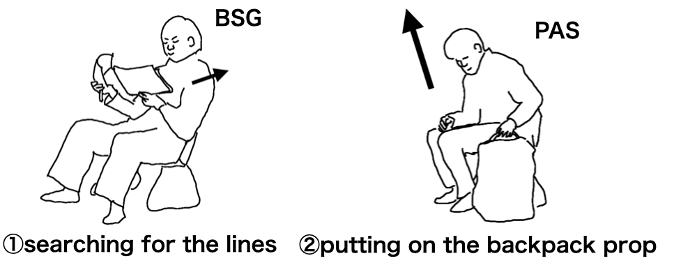
This proposal is accepted through BSG's utterance "un" ("Yes") in line 11, and the performers begin embodied preparations for the upcoming performance. For example, BSG leans back and flips through the pages of the script, adopting a posture that allows a broad view of the text, apparently searching for the lines of the scene to be performed (Figure 3-①). PAS also begins to prepare by standing up and putting on the backpack prop that needs to be worn at the start of the scene (Figure 3-②). In addition, DRV flips through the script on line 12, starting his preparation. (DOL's full body is unfortunately not visible in the video clips, but from his subtle movements, DOL also appears to be flipping through the script.) In this way, DIR's proposal in line 10 is accepted through the performers' verbal and embodied responses beginning from line 11, and the rehearsal transitions into the preparation section.
Figure 3. Preparations for the upcoming performance.
As shown above, DIR's utterance "Mokkai yatte mo yoroshii deshou ka?" ("Can we do it once more?") in line 10 is a crucial resource for the transition from the direction section to the preparation section. However, this utterance is not the only resource involved in the transition. Other multimodal resources that appear prior to the utterance also contribute to making the shift into the preparation section interactionally relevant. In the following analysis, I show how these resources are coordinated to establish the relevance of the transition to the preparation frame.
After DIR gives the final instruction to DRV in line 01 and DRV accepts it in lines 02–03, DIR looks at the script in front of her in line 06. This script contains direction notes that she wrote based on what she observed in the previous performance. While looking at the script, DIR repeats, "un un un un un" ("Yeah yeah yeah yeah yeah") and repeatedly nods. Through this repeated display of acceptance while referring to the annotated script, she visibly confirms that there are no further points to be directed. Given that the direction section is one in which the director is expected to provide directions to the performers, displaying that there is nothing more to add can be understood as projecting the completion of this section and a transition to the next.
Furthermore, in lines 08–09, DIR glances at both the wall clock and her wristwatch to check the time. In this context, where a transition to the next section has already become expectable, checking the time can be understood not merely as a way of confirming the current time, but rather as an action aimed at assessing whether there is still enough time to rehearse again. These behaviors by DIR make the shift to the preparation section relevant. Here, DIR orients toward a forthcoming activity by displaying both verbal and embodied resources. They make the transition to the preparation section projectable before her utterance in line 10.
This projectability is the reason why PAS can begin whistling the melody that is supposed to be playing at the end of scene "①," which is supposed to be sung at the beginning of the scene "②," even before the full content of DIR's utterance in line 10 becomes clear. Shifting to the preparation section is expectable before DIR's explicit verbal expression, "Mokkai yatte mo yoroshii deshou ka?" ("Can we do it once more?").
The key point here is that the transition into the preparation section is not accomplished solely through the verbal exchange between lines 10 and 11 (proposal and acceptance), but rather through the coordinated deployment of various multimodal resources such as showing satisfaction verbally and checking the watch and clock bodily. The shift to a new participation frame of preparing for performance is achieved multimodally.
3.2 The director's embodied orientation and transformation of the frame
From line 10 onward, the actors begin preparing for the next scene. First, PAS begins whistling and starts singing. According to the script, these actions belong to the closing of the preceding scene (scene ①). Scene ② is structured such that BSG's opening line, "Minasama, honjitsu wa ..." ("Ladies and gentlemen, today ..."), cuts into PAS's singing. Thus, PAS's whistling and singing are preparatory actions for launching scene ②.
Second, while PAS continues singing, BSG, who is supposed to deliver the first line of scene "②," briefly joins in by singing part of the same lyrics, pops up from her chair, and visibly begins moving toward her stage position. By both singing and popping up from her chair toward her position, BSG highlights her orientation to cutting into PAS's song and thereby launching scene ②. Through this display, she makes her active engagement in reorganizing the participation frame publicly observable to the other participants.
The other actors also begin to embody their characters (Figure 4): DRV, who plays the driver, extends his legs into a driving posture, as if pressing the accelerator pedal; PAS moves toward the front of the stage, where he is supposed to stand at the beginning of the scene while continuing to sing; and DOL, who plays a motionless doll, also stands up in line 15. Through the collective repositioning of their bodies into performance-ready stances, the participation frame for performance is actively being reconfigured.
Figure 4.
Excerpt 1-a. Selected lines from Excerpt 1
Open in a separate windowHere, the transformation of the participation frame from preparation to performance is not accomplished by the performers' actions alone. Rather, the director's embodied conduct also plays a crucial role in this transformation. In line 15, as the actors complete their preparations and take their positions onstage, DIR begins to shift from a cross-legged posture angled slightly away from the stage to a seiza position facing directly toward the stage (Figure 2). Seiza4 is a posture that brings the head, torso, waist, and knees into a coordinated forward-facing alignment and thereby strongly displays bodily orientation toward what lies ahead (Nishizaka 2010; Scheflen 1973; Kendon 1990). In this moment, the coordinated alignment of DIR's seiza posture clearly emphasizes her embodied visual orientation toward the stage. As Coulter and Parsons (1990) point out, visual orientation cannot be adequately characterized solely in terms of the direction of gaze. The concept of "seeing" encompasses a range of distinct actions, such as looking, gazing, watching, glancing, and observing. How a given visual orientation is understood is shaped within the practical situation. In Excerpt 1, the director's embodied posture is crucial to how her visual orientation becomes intelligible. By adopting the seiza posture, she makes her conduct recognizable as observing in the capacity of a director. In this way, DIR's visual orientation is not merely that of someone watching from the audience side; rather, it is a directorial way of seeing.
This bodily and visually orientational shift has important consequences for the participation frame of the rehearsal. Heath (1984) demonstrates that, through gaze and bodily orientation, recipients can display recipiency to a speaker in order to elicit speech from the speaker. In a medical consultation he analyzes, a patient orients both their body and gaze toward the doctor, and through this display of recipiency, elicits the doctor's opening utterance (e.g., "What can I do for you?"). Here, in a similar fashion, DIR's bodily orientation toward the stage can be seen as a display of recipiency to the actors' performance, thereby making the onset of performance relevant. Crucially, however, since DIR emphasizes her act of observing through the formal posture of seiza, this display of recipiency is not merely that of a listener, as in Heath's example, but a specifically directorial form of recipiency. Accordingly, the actors whom DIR observes are treated not merely as ordinary prospective speakers but as actors about to perform. Participation is not simply organized at the level of speaker/hearer roles in an utterance event, but at the level of actor/director participatory roles within the activity.
BSG's subsequent conduct provides evidence that DIR's shift in orientation contributes to the transition in the participation frame. BSG, who delivers the first line of the scene, looks toward DIR as DIR readjusts her posture. BSG then begins to form a gesture as if holding a microphone and delivers the opening line "Minasama, honjitsu wa ..." ("Ladies and gentlemen, today ...") in line 16. This shows that the participants themselves treat DIR's embodied visual orientation toward the stage as a resource for reconfiguring the participation frame. At this point, BSG begins participating in the scene as her character.
As shown above, the initiation of performance is not accomplished by the actors alone. Rather, it is a collaborative achievement that also depends on the director's bodily positioning and her embodied display of observing. The director's act of observing, accomplished through her seiza posture, serves as a crucial resource for shifting into the participation frame of performance. At the same time, DIR's conduct becomes recognizable as observing through the actors' bodily reconfiguration for starting the performance within the ongoing interaction. Through the collaborative configuration of multimodal resources by both the director and the actors, the transition from the preparation section to the performance section is interactionally accomplished. Thus, whether the actors can participate as characters depends not only on their individual conduct but also on how this collective bodily orientation is assembled. In rehearsal, acting as a character is an interactionally accomplished, collaborative achievement.
3.3 Temporary dissolution of the participation frame
Excerpt 2, which occurs shortly after Excerpt 1, presents a case in which the director's embodied act of observing as a director, previously established through her adoption of a seiza posture, does not immediately lead to the initiation of performance. Following the completion of DIR's instruction, the participants are preparing to resume the same scene, "②," as in the previous excerpt. During this preparation, however, a brief exchange concerning the room temperature is inserted, temporarily interrupting the progression toward performance and disrupting DIR's seiza posture. This section shows how the director's act of observing is organized in a manner sensitive to the unfolding interaction and, at the same time, is oriented to by the participants themselves as a resource for organizing that interaction.
Excerpt 2.
Open in a separate windowIn line 01, DIR begins her utterance "de" ("so"), thereby marking a boundary between activities (Keevallik 2010). She then continues with "mokkai basu yari::::: no" ("So, we do the bus ((scene)) again, and"), and in lines 04–06, adds: "de (.) chotto: (.) u:::::n soshitara atama kara yaru (tte no de) ii no kana" ("then, (.) you know: (.) uh:::: So, maybe starting from the top would be okay?"). Through these utterances, DIR proposes restarting scene "②," the bus scene, from the beginning. In response, all four actors (BSG, PAS, DOL, and DRV) display acceptance between lines 07 and 11 and begin moving toward their respective positions. Through DIR's proposal and the actors' response, the preparation section is collaboratively initiated.
What is especially important in this excerpt is DIR's marked shift in posture. As in the previous excerpt, she adopts a seiza posture in line 14 and turns her face from the script and toward the stage (Figure 5). In doing so, she makes it publicly recognizable that she is observing the stage. This bodily configuration serves as a key resource in constituting a participation frame appropriate for performance.
Excerpt 2-a. Selected lines from Excerpt 2
Open in a separate windowAs shown in the analysis of Excerpt 1, DIR's adoption of a seiza posture through which she directs her body and face toward the stage serves as a key resource for constituting a participation frame appropriate for performance. In Excerpt 2, when DIR takes a seiza posture, no actors have yet arrived at their positions by line 14; thus, the performance does not begin immediately. Nevertheless, the participants treat DIR's posture toward the stage as initiating the transition to a performance-relevant participation frame. Indeed, immediately after glimpsing DIR's bodily reorientation, BSG begins to move toward her designated position in preparation for performance. Through this movement, she begins to realign her spatial position toward the performance section in which she participates as a character. While in this case the performance does not begin immediately following DIR's postural shift, this embodied orientation nonetheless serves as a key resource for reconfiguring the participation frame, as in the previous excerpt.
In Excerpt 2, the constitution of the participation frame is delayed. While BSG begins moving toward her designated position, an intervening sequence concerning the air conditioning begins in line 15. As a result, BSG redirects her movement toward the control panel, and the reconfiguration of a participation frame for performance is suspended. What is particularly noteworthy here is the change in DIR's posture. At the moment she asks BSG to adjust the air conditioning in line 18, DIR breaks the seiza posture she had adopted in line 14 in preparation for performance and instead assumes a sonkyo posture, which is a crouched stance in which the body is slightly curled and both the hips and knees are lifted off the ground (Figures 6 and 7).
Figure 6.
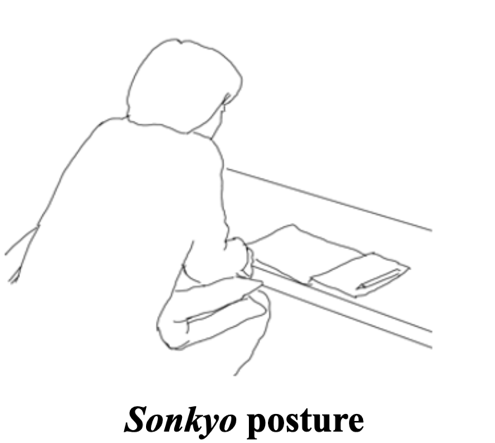
Figure 7.
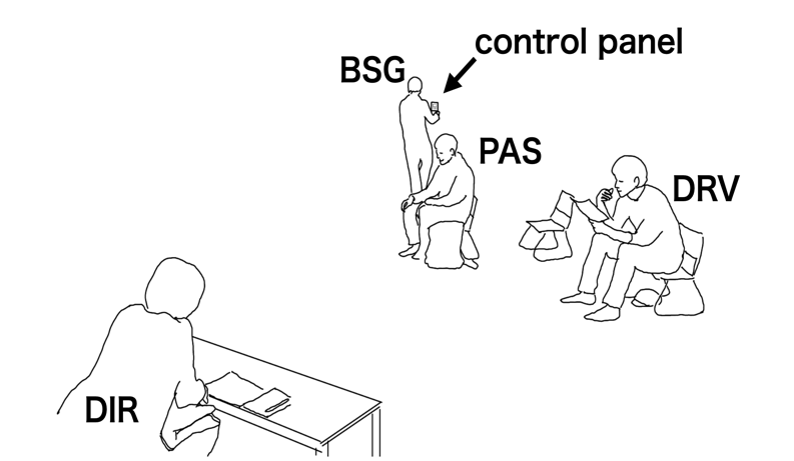
As the preceding analysis has shown, DIR's act of watching the stage from a seiza posture has been understood as a key resource for constituting a participation frame appropriate for performance. Accordingly, when this posture is dissolved, the ongoing reconfiguration of that participation frame may be interrupted.
In this excerpt, DIR responds to the intervening activity by breaking her seiza posture and shifting into a sonkyo position. Sonkyo5 is a posture that is physically unstable and difficult to maintain for an extended period. As Schegloff (1998) noted, certain body configurations, such as "body torque," in which the upper and lower body are oriented in different directions, visibly display the temporary nature of a participant's involvement in a given activity. While DIR's posture in this excerpt does not involve the twist of the body, sonkyo similarly highlights the transient feature of her engagement. Indeed, as soon as BSG finishes adjusting the air conditioning, DIR returns to the seiza posture in line 24. The timing of this return shows that DIR's sonkyo posture was specifically fitted to this intervening activity. At the same time, she also redirects her visual orientation toward the stage. Whereas her head and face had been oriented toward the stage while she was in seiza, from her production of "a sunmasen" ("Oh, thanks") in line 21 until she moves out of sonkyo, they remain directed downward toward the script on the table. Through this shift, DIR temporarily suspends her embodied display of stage-oriented observation until BSG has moved into an appropriate position.
Thus, Excerpt 2 illustrates how DIR temporarily suspends her embodied display of stage-oriented observation by moving out of seiza, adopting sonkyo, and redirecting her gaze toward the script. The timing of these changes displays her orientation to the ongoing delay in establishing the participation frame for performance. Overall, these findings demonstrate that her engagement in observing as a director, as evidenced by her body and visual orientation, is integral to the practical organization of the actors' participation as characters. At the same time, it also serves as a reflexively sensitive resource finely attuned to the unfolding organization of interaction.
3.4 Rearrangement of the participation frame for performance
Finally, I turn to the process by which the previously delayed participation frame is once again reconfigured from line 29 onward.
When DIR returns to a seiza posture in line 24, DOL, who should be standing at his designated position when the performance begins, is still offstage, removing his sweater. As a result, the start of the performance section is further delayed. At the moment when it becomes evident that the transition into performance will be further postponed, DIR shifts out of seiza and back into an agura (i.e., a cross-legged position). Her face also moves away from the stage and toward the script again. This coordinated shift confirms once again that the embodied visual orientation toward the stage, which is accomplished through seiza, is treated by the participants as a resource for constructing the participation frame for performance.
Figure 8.
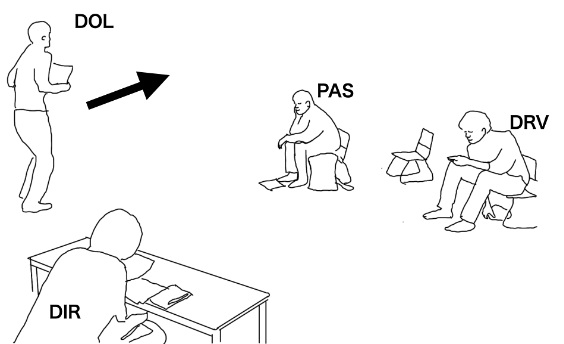
After removing his sweater in line 29, DOL begins to jog toward his designated position, script in hand (Figure 8). As soon as DOL reaches his position, DIR immediately reinitiates the transition into the performance section by saying, in line 30, "Jaa (.) utatteiru yo ( ) kara" ("All right, from where you're singing"). The discourse marker jaa ("All right") at the beginning of this utterance indicates that a necessary precondition has now been fulfilled.
Then, in line 32, DIR adjusts her posture again. What is particularly noteworthy here is this second bodily adjustment: By stretching her legs out in front of her (Figure 9), DIR completes the reconfiguration of the participation frame, thereby ratifying the performance section.
Excerpt 2-b. Selected lines from Excerpt 2
Open in a separate windowIn Excerpt 2, the initiation of the performance section is accomplished through DIR's extension of her legs forward into a chōza-like posture6 (Figure 9), in contrast to her adoption of seiza in Excerpt 1. This posture still aligns the head, gaze, torso, hips, and feet in a straight line oriented toward the stage (cf. Kendon 1990; Scheflen 1973). In doing so, it visually foregrounds DIR's attentional orientation and embodied engagement with the stage, just as in the earlier practices we have examined. In particular, this bodily emphasis on observing displays recipiency as a director (cf. Heath 1984), thereby making the actors' performance relevant, as in Excerpt 1. Thus, in this excerpt as well, the embodied display of observing as a director contributes to the participants' interactional constitution of performance. Immediately afterward, in line 33, BSG begins to deliver the opening line of scene ②, and the transition to the performance section is thereby accomplished.
To summarize, Excerpt 2 has shown that, as in Excerpt 1, variations in DIR's posture and seeing play a key role in constituting a participation frame appropriate for performance. That this embodied observing is treated as socially significant by the participants themselves is evident in the momentary dissolution of her posture during the inserted sequence, where she shifts her posture and visual orientation, and thereby suspends her display of observing. Later in the sequence, the start of the performance is further delayed as DOL removes his sweater, prompting DIR to shift once again into a cross-legged posture. Ultimately, in this excerpt, the transition into the performance section is achieved through DIR's adoption of a chōza-like posture, which physically emphasizes her orientation toward the stage and displays her recipiency, thereby making the onset of the actors' performance relevant. These shifts in her postures and in how she sees the stage demonstrate that the director's posture is used as a context-sensitive resource for managing the configuration of the participation frame.
As the analyses of Excerpts 1 and 2 have demonstrated, the director's embodied display of directorial observation serves as an important resource for enabling actors to participate as characters. At the same time, however, this embodied practice does not carry any fixed meaning independent of the surrounding interaction. Its intelligibility depends on how it is embedded within a broader configuration of resources, including the actors' spatial positioning, the material environment with the tatami floor, the spatial arrangement of the stage, and the placement of relevant tools (C. Goodwin 2000). Accordingly, the initiation of the performance section, in which the director observes as a director and the actors participate as characters, is not accomplished by either party in isolation. Rather, it is collaboratively accomplished and organized within the unfolding interaction. What this study has clarified is one of the bodily practices available to the director for reconfiguring a participation frame in which actors can participate as characters.
4. Conclusion
This paper has argued that the transition into performance in rehearsal is interactionally accomplished through the local reconfiguration of the participation frame (Nishizaka 2009). This reconfiguration is achieved through participants' embodied conduct, including the director's postural shifts and the actors' spatial positioning. The actors' participation as characters is also achieved in and through this dynamic reorganization of the participation frame.
Excerpts 1 and 2 show how the director's bodily posture, especially her shift into seiza, serves as a resource for constituting the participation frame for performance. In Excerpt 1, her adoption of seiza displays a directorial form of recipiency, thereby making the transition from preparation to performance relevant. In Excerpt 2, a similar shift is temporarily interrupted by an intervening exchange concerning the air conditioning, during which she assumes a sonkyo posture, temporarily suspending her embodied display of directorial observation. Once the interruption ends, she takes a chōza-like posture which emphasizes her orientation toward the stage. These cases demonstrate how the director's embodied orientations reflexively organize transitions from preparation to performance as a collaborative, multimodal achievement.
Based on its empirical account of how the participation frame for performance is reorganized, this paper offers two broader implications. The analysis shows that creative work in rehearsal has an interactional organization that extends beyond the conduct of those performing onstage. As the analysis has shown, in theatrical rehearsals, the transition into performance as part of the creative process is accomplished by both the actors and the director. In particular, the director's posture and the way she watches the actors are crucial to the interactional accomplishment of the transition into an activity in which the actors can engage in creative performance. Creative work in rehearsal is thus not an attribute residing within individual actors or directors but an interactional accomplishment. Through its empirical analysis, this paper respecifies the collaborative processes through which creative work is accomplished within an "art world" (Becker 1982).
Second, whereas Fischer-Lichte (2004/2009) argued that, during a performance, a reciprocal relationship unfolds between the performer and the audience, in which the responses of the spectators influence the performance and vice versa, the present study suggests that the initiation and recognizability of an activity as performance already depend on how both the performers and the spectator participate, even before any lines are spoken. In this sense, performance is not solely created by what happens on stage but is collaboratively constituted by multiple participants, including those positioned outside the stage. By demonstrating how the director's embodied conduct of observing contributes to the organization of the performance section, this study shows how creative activity is made possible through the coordinated embodied conduct of multiple participants in the unfolding interaction.
References
Becker, H. S. (1982). Art worlds. University of California Press.
Broth, M., & Keevallik, L. (2014). Getting ready to move as a couple: Accomplishing mobile formations in a dance class. Space and Culture, 17(2), 107–121. https://doi.org/10.1177/1206331213508483
Coulter, J., & Parsons, E. D. (1990). The praxiology of perception: Visual orientations and practical action. Inquiry, 33(3), 251–272.
Fischer-Lichte, E. (2009). Pafōmansu no Bigaku [Ästhetik des Performativen] (H. Nakajima, E. Hirata, I. Terao, R. Miwa, A. Yotsuya, & K. Hagiwara, Trans.). Ronsōsha. (Original work published 2004)
Fukuichi, A., & Sugamura, G. (2022). Sitting posture and moral impression formation: a focus on traditional Japanese sitting posture (Seiza). Journal of Physical Education and Sport, 22(2), 503–511.
Garfinkel, H. (2002). Ethnomethodology's program: Working out Durkheim's aphorism (A. W. Rawls, Ed.). Rowman & Littlefield.
Goodwin, C. (1981). Conversational organization: Interaction between speakers and hearers. Academic Press.
Goodwin, C. (2000). Action and embodiment within situated human interaction. Journal of Pragmatics, 32(10), 1489–1522.
Goodwin, M. H. (1980). He‐said‐she‐said: Formal cultural procedures for the construction of a gossip dispute activity. American Ethnologist, 7(4), 674–695.
Goodwin, M. H. (1990). He-said-she-said: Talk as Social Organization among Black Children. Indiana University Press.
Goodwin, M. H. (2006). Participation, affect, and trajectory in family directive/response sequences. Text & Talk, 26(4-5), 515–543. https://doi.org/10.1515/TEXT.2006.021
Goffman, E. (1974). Frame analysis: An essay on the organization of experience. Harvard University Press.
Heath, C. (1984). Talk and recipiency: Sequential organization in speech and body movement. In J. M. Atkinson & J. Heritage (Eds.), Structures of Social Action: Studies in Conversation Analysis (pp. 299–345). Cambridge University Press.
Heath, C. (1986). Body movement and speech in medical interaction. Cambridge University Press.
Jefferson, G. (2004). Glossary of transcript symbols with an introduction. In G. H. Lerner (Ed.), Conversation analysis: Studies from the first generation (pp. 13–31). John Benjamins. https://doi.org/10.1075/pbns.125.02jef
Kendon, A. (1990). Conducting Interaction: Patterns of Behavior in Focused Encounters. Cambridge University Press.
Keevallik, L. (2010). Pro-adverbs of manner as markers of activity transition. Studies in Language, 34(2), 350–381. https://doi.org/10.1075/sl.34.2.05kee
Krug, M. (2022). Temporal procedures of mutual alignment and synchronization in collaborative meaning-making activities in a dance rehearsal. Frontiers in Communication, 7, 957894. https://doi.org/10.3389/fcomm.2022.957894
Krug, M. (2023). Overcoming blanking: Verbal and visual features of prompting in theatre rehearsals. Human Studies, 46, 221–246. https://doi.org/10.1007/s10746-023-09670-w
Krug, M. (2025). Coordinating multiactivity transitions in dance rehearsals: Spatial configurations and instructional practices. Frontiers in Communication, 10, 1520005. https://doi.org/10.3389/fcomm.2025.1520005
Krug, M., & Schmidt, A. (2020). Zwischenfazit: Sukzessive und simultane Verzahnung von Spiel- und Besprechungsaktivitäten – Eine Instruktionsmatrix für Proben. Gesprächsforschung – Online-Zeitschrift zur verbalen Interaktion, 21, 264–277.
Lefebvre, A. (2018). Reading and embodying the script during the theatrical rehearsal. Language and Dialogue, 8(2), 261–288. https://doi.org/10.1075/ld.00015.lef
Lefebvre, A. (2020). Creating interactional bonds during theatrical rehearsals: An interactional approach of the documentary method of interpretation. In R. Ide & K. Hata (Eds.), Bonding through context (pp. 197–214). John Benjamins.
Lefebvre, A., & Mondada, L. (2023). Interactional contingencies in rehearsing a theater scene: The consequentiality of body arrangements as action unfolds. Human Studies, 46(2), 303–335. https://doi.org/10.1007/s10746-023-09669-3
Lindwall, O., & Mondada, L. (2025). Sequence organization in the instruction of embodied activities. Language & Communication, 100, 11–24. https://doi.org/10.1016/j.langcom.2024.11.003
Löfgren, A. (2023). Relocating to depict: Managing the interactional agenda at opera rehearsals. Research on Language and Social Interaction, 56(3), 209–230. https://doi.org/10.1080/08351813.2023.2235968
Mondada, L. (2009). Emergent focused interactions in public places: A systematic analysis of the multimodal achievement of a common interactional space. Journal of Pragmatics, 41(10), 1977–1997. https://doi.org/10.1016/j.pragma.2008.09.019
Mondada, L. (2013). Interactional space and the study of embodied talk-in-interaction. In P. Auer, M. Hilpert, A. Stukenbrock, & B. Szmrecsanyi (Eds.), Space in Language and Linguistics: Geographical, interactional and cognitive perspectives (pp. 247–275). De Gruyter.
Mondada, L. (2019). Conventions for multimodal transcription (Version 5.0.1). https://www.lorenzamondada.net/multimodal-transcription
Nakamura, T. (2011). Budo as a Required Subject at Junior High Schools: Bows in Budo. Research Journal of Budo, 43(2), 1–11. https://doi.org/10.11214/budo.43.2_1
Nishizaka, A. (1992). Sanka fure-mu no shintaiteki soshikika [Participation frame as an arrangement of bodies]. Shakaigaku Hyōron [Japanese Sociological Review], 43(1), 58–73.
Nishizaka, A. (2009). Katsudō no kūkanteki oyobi rensaiteki na soshikika: Hanashite to kikite no sōgo kōi saikō [The spatial and sequential organization of activity: Reconsidering the interaction between speakers and hearers]. Ninchikagaku [Cognitive Studies], 16(1), 65–77.
Nishizaka, A. (2010). Dōgu wo tsukau koto: shintai, kankyō, sōgokōi [Using tools: Body, environment, and interaction]. In S. Kushida & H. Yoshii (Eds.), Ethnomethodology wo manabu hito no tame ni [For Learners of Ethnomethodology] (pp. 36–57). Sekai Shisōsha.
Nishizaka, A. (2014). Sustained orientation to one activity in multiactivity during prenatal ultrasound examinations. In L. Mondada, J. Steensig, & J. Svennevig (Eds.), Multiactivity in social interaction (pp. 79–108). John Benjamins. https://doi.org/10.1075/z.187.03nis
Nishizaka, A., & Okazawa, R. (2026). The synchronized instantiation of an ordered pair of
instruction and
instructed action. Language & Communication, 108,
1–16
https://doi.org/10.1016/j.langcom.2026.02.005
Sacks, H. (1992). Lectures on conversation (Vols. 1–2; G. Jefferson, Ed.). Blackwell.
Schegloff, E. A. (1998). Body torque. Social Research, 65(3), 535–596.
Schegloff, E. A. (2007). Sequence organization in interaction: A primer in conversation analysis I. Cambridge University Press.
Scheflen, A. E. (1973). Communicational structure: Analysis of a psychotherapy transaction. Indiana University Press.
Schmidt, A. (2014). Spiel oder nicht Spiel? Zur interaktiven Organisation von Übergängen zwischen Spielwelt und Realwelt in Theaterproben. Verlag für Gesprächsforschung.
Schmidt, A. (2018). Prefiguring the future: Projections and preparations within theatrical rehearsals. In A. Deppermann & J. Streeck (Eds.), Time in Embodied Interaction: Synchronicity and Sequentiality of Multimodal Resources (pp. 231–260). John Benjamins Publishing Company.
Schmidt, A. (2020). Transitionspraktiken in Theaterproben mit Fokus auf Interventionen. Gesprächsforschung – Online-Zeitschrift zur verbalen Interaktion, Themenheft: Instruktionen in Theater- und Orchesterproben, 190–237.
Schmidt, A., & Deppermann, A. (2023). On the emergence of routines: An interactional micro-history of rehearsing a scene. Human Studies, 46(2), 273–302. https://doi.org/10.1007/s10746-022-09655-1
Smart, N., & Szczepek Reed, B. (2025). Co-creation of activity spaces in an amateur dance group: Interactional construction of the teaching space. Frontiers in Communication, 9, 1517858. https://doi.org/10.3389/fcomm.2024.1517858
Suzuki, M. (2023). Engeki no keiko bamen ni okeru engi no sōgokōiteki kōsei: Gendai engeki no kaiwa
bunseki
[The interactive construction of performances in contemporary theatrical rehearsal]. Nenpō
Shakaigaku
Ronshū, 36, 52–63.
https://doi.org/10.5690/kantoh.2023.52
Szczepek Reed, B., Reed, D., & Haddon, E. (2013). Now or not now: Coordinating restarts in the pursuit of learnables in vocal master classes. Research on Language and Social Interaction, 46(1), 22–46. https://doi.org/10.1080/08351813.2013.753714
Yagi, J. (2026). The Moral Organization of Postural Readjustments in Edo-Bayashi. Social Interaction. Video-Based Studies of Human Sociality, 9(3). https://doi.org/10.7146/si.v9i3.170737
Appendix: Transcript Conventions
Each verbal line in the excerpts presented in this study consists of one or two tiers. The first tier consists of the original utterances in Japanese, transcribed according to Jefferson's (2004) transcription system. The second tier provides an English translation, which preserves the original word order of the Japanese as much as possible. Some lines have a third tier about bodily and gaze movements. The symbols used in this tier are designed to make the temporal relationships among multiple forms of conduct visible. These are annotated based on the notation conventions developed by Nishizaka (cf. Nishizaka 2014) and Mondada (2019), as follows: Bodily movements are indicated using lowercase letters denoting the participants of the action (e.g., "dir:"), while gaze movements are indicated by appending "g" to the lowercase letter (e.g., "dir.g:"). The onset and offset of these movements are marked using symbols such as |, ┌, or └, and ongoing actions are indicated by -->. References to figures are indicated in an additional "Fig:" tier in the transcript, with the relevant moment marked by a # symbol. In the transcript, scripted dialogue is highlighted in grey to distinguish it from participants' ordinary talk.
1 This article draws on a previous Japanese-language publication entitled "The interactive construction of performances in contemporary theatrical rehearsal" (Suzuki 2023), and has been substantially revised and expanded with the permission of The Kantoh Sociological Society. The present paper extends its analytical scope by adding a focus on creativity to the introduction, the conclusion, and the latter part of the analysis of Excerpt 2, thereby contributing to current discussions on creativity, participation frames, and bodily shifts in rehearsal interaction.↩
2 The actors in professional rehearsals are expected not merely to follow the director's directions but also to shape the performance themselves. Indeed, unlike in lesson settings where a teacher first provides instructions on how to move, the rehearsal begins with the actors performing the scene.↩
3 Under this organizational arrangement, forms of interaction emphasized by Krug and Schmidt (2020)—particularly directors' "on-the-fly" interventions during ongoing performances—were rarely observed.↩
4 The formality of seiza may play an important role in this shift. Seiza is a posture associated with a formal stance toward an activity. In Japanese culture, seiza is conventionally associated with formality, politeness, attentiveness, and discipline. It is typically used in ceremonial or official settings. For example, participants in tea ceremonies sit in seiza to express respect and concentration, while in martial arts such as judo and kendo, the posture indicates readiness and self-discipline (cf. Nakamura 2011; Fukuichi and Sugamura 2022). With respect to the relationship between seiza and interaction, Yagi (2026/this issue) offers a fine-grained analysis of the interactional timing of postural readjustments within seiza in Edo-bayashi rehearsals.↩
5 In traditional Japanese culture, sonkyo is a posture commonly seen in some martial arts (e.g., sumo, kendo), typically assumed as a transient posture just before a match begins (Nakamura 2011). This conventional cultural association might be related to its use here, where the preparation frame is momentarily delayed before performance begins.↩
6 Chōza does not carry the same degree of cultural formality as Seiza. Nevertheless, it is a posture frequently adopted when watching something passively or attentively.↩