
Social Interaction
Video-Based Studies of Human Sociality
Between Fidelity and Innovation:
Multimodal Creativity in Orchestra Rehearsals
Monika Messner
University of Graz
Abstract
Orchestra rehearsals are complex environments where conductors and musicians collaboratively shape a public performance through dynamic, multimodal interaction. This study investigates how creativity emerges within these interactions, particularly focusing on the conductor's use of verbal and embodied corrections and instructions to interpret and transform the musical score. Drawing on the theoretical framework of Multimodal Conversation Analysis, the research analyses rehearsal data from professional symphonic orchestras in France, Italy, and Belgium. The study explores the tension between fidelity to the score and creative innovation, examining how conductors navigate this space by employing descriptive (verbal) and depictive (gestural, vocal) modes of instruction. Languages spoken during the rehearsals are French, Italian, English, and German.
Keywords: orchestra rehearsals, musical creativity, fidelity vs. innovation, multimodal instructions, verbal descriptions, embodied depictions
1. Introduction
Orchestra rehearsals are complex interactional settings in which conductors and musicians collaboratively elaborate a public musical performance. This process relies on a range of semiotic resources, such as speech, gestures, body movements, singing, facial expressions, and gaze, through which conductors correct, instruct, and guide the ensemble. At the same time, these activities are highly dependent on the score, i.e., the score is 'translated' into musical sound and becomes the object of interpretation and interaction between the participants in a rehearsal (Stöckl and Messner, 2021, p. 194). Creativity in orchestra rehearsals operates in the dynamic tension between the musical instructions in the score (fidelity) and the envisaged sound qualities instructed by the conductor (novelty). A useful point of departure for conceptualizing this tension is provided by Coessens (2013, p. 338), who situates musical creativity along two axes. Her framework, primarily developed for genres based on notated music, conceptualizes creative action in relation to both the temporal unfolding of musical practice and its orientation toward innovation and tradition:
Figure 1. Creative action in music in four major arenas (Coessens, 2013, p. 338)
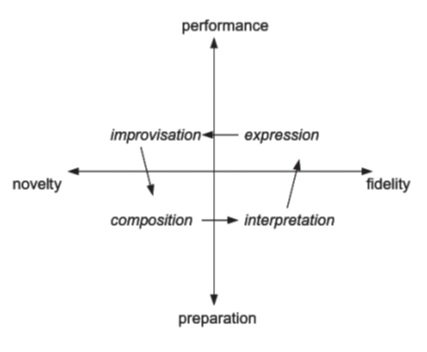
Coessens (2013, p. 338) identifies the y-axis as "the axis of music-praxis", which spans from preparation to performance and represents the temporal and procedural aspects of music-making. Preparation refers to the exploratory and developmental phases of music-making, in which a musical piece may be shaped with varying degrees of advance planning: composing unfolds within established cultural and symbolic frameworks while constituting an inherently novel act; interpretative work is oriented towards the realization of pre-existing material and thus aligns with the pole of fidelity. Performance, by contrast, designates the situated enactment of this preparatory work and may occur at different stages of the process, ranging from rehearsal performances to the final concert performance. Whether realized as the situated expression of a notated score in classical music or as the improvisational articulation of themes in jazz, performance draws on technical training as well as aesthetic and personal inquiry (Coessens, 2013, p. 340). These four manifestations of musical activity, which may mutually inform one another, are embedded in a gradual process of exploration that ultimately culminates in a unique, context-dependent concert performance. The x-axis, termed "the axis of music-context" (Coessens, 2013, p. 338), contrasts innovation (novelty) with adherence to tradition (fidelity). On one end, creativity and originality are emphasized, while on the other, established musical traditions, styles, and structures must be honoured.
Within this framework, orchestra rehearsals can be understood as a liminal form of performance situated between preparation and concert realization. In this context, the spatiotemporal unfolding of musical practice oscillates between fidelity to the written score and moments of creative agency. Composition here does not refer to the production of a new work, but to local compositional decisions (e.g., phrasing, balance, articulation) that emerge collectively in rehearsal. Interpretation denotes the concrete realization of the notated material through these decisions, while improvisation manifests in flexible, situated adjustments and exploratory trial-and-error processes that temporarily suspend fixity to explore expressive possibilities. Conductors play a central role in this process: in situ, they must give concrete expressive form (expression)to their interpretative ideas by continuously negotiating what aspects of the score or performance practice to relate to, to what extent, and where to place the ensemble's focus.
In the following example, the divergence between fidelity to the score and novelty, which is articulated in the conductor's explanations, is observable. The conductor first explicitly refers to what is written in the score (l. 01-03); then he switches to an explanation (l. 04-07) and a reformulation of his idea regarding the tempo (l. 08-09). The interaction unfolds within a multilingual communicative setting in which French, as the orchestra's working language, and English, as lingua franca, are interwoven:
Example 1. Exploiting the vagueness of the score1
Open in a separate window
In this example, the conductor exploits the score's vagueness by necessity (Schutz, 1951, p. 84) and its non-capability of completely determining the final performance (Sawyer, 2006, p. 237). His reference to what is written in the score is in a tense relationship with what he instructs about the tempo. He explains how the different tempos (exposition, development and reprise/recapitulation as parts of a sonata) of the first movement of Mahler's Symphony no. 10, are related to each other. At number fifteen in the score, as localized by the conductor (l. 01 and 04) and as indicated as being part of the development of the sonata, there is no tempo instruction. An instruction concerning the tempo can be found in the reprise with 'somewhat hesitant'. The conductor thus introduces an interpretative cue that is not explicitly encoded in the score, namely the idea that the Adagio theme gets faster in the development (l. 05-07). In doing so, he treats the work as a musical process whose internal logic unfolds in performance. This orientation is already foreshadowed in his invitation to "see what happens in this piece" (l. 02), which frames the score as something that unfolds through practical engagement rather than through notation alone. The example therefore makes visible a productive tension between fidelity to the written text and the interpretative elaboration required for its realization. The conductor articulates relationships that remain under-specified in the score and renders them relevant for performance. Interpretation, in this sense, allows the score to 'speak', demonstrating how musical meaning emerges through situated and performative engagement with the notated material.
This, in turn, fosters a scope for creativity, where language and other semiotic means translate the information given by the score and in this way open room for interpretations and musical ideas that were not previously possible. Among these semiotic resources, the conductor's gestures play a particularly salient role. They provide visual representations of temporal processes, such as increases or decreases in tempo along the sagittal axis (cf. fig. 1, where the conductor moves the right hand forwards, and fig. 2, where he moves it backwards), or depict structural relations, e.g., the convergence of two musical trajectories (cf. fig. 3, where the conductor moves the left hand upwards and the right hand downwards).
Building on this perspective, the present study examines how conductors' instructions relate to the musical score and how musical meaning is transformed in rehearsal interaction. More specifically, it asks to what extent conductors' instructions align with or diverge from the notated material, how the 'meaning' of the score is translated - or "transducted" (Kress, 2010, p. 124) - into other semiotic modes such as speech, embodiment, or singing, and how such transformations are rendered intelligible and legitimate within the rehearsal context. The theoretical framework for this study is Multimodal Conversation Analysis (Deppermann, 2013; Mondada, 2013); the data come from rehearsals in French, Italian and Belgian professional symphonic orchestras.
2. Creativity in Speech and Music
Creativity is a complex concept. Although it lacks a standardized definition and is used in different ways across disciplines, there are some core assumptions: creativity is often characterized by a high level of originality and, in many cases, aesthetic value, with words like 'remarkable', 'new', and 'original' frequently used to describe it (Coessens, 2013). Creativity is also regarded as the ability to produce something appropriate, useful and valuable (Boden, 1994; Sternberg, 1999; Herles, 2011) and involves recognizing two or more conflicting domains in an unstable relationship that requires a higher-level resolution and gains "social value" (Hidalgo-Downing, 2016, p. 109).
Creativity in speech can be understood as a context-dependent phenomenon arising from the complex interplay of linguistic, cognitive, and social processes. Drawing on Wittgenstein's (1953, §66) notion of language as a game that exploits family resemblances, creative language use involves the flexible recombination of linguistic resources, for instance through the blending of different registers and languages, or playful engagement with meaning (Carter, 2004). Such practices disrupt normative linguistic patterns and invite new interpretations, often through devices such as metaphor, metonymy, irony, opposition, and contradiction. These forms of linguistic play not only enrich discourse but also serve as tools for innovation and expression in social interaction. This perspective is relevant for the present study, as similar processes of recombination and reinterpretation also underpin creative practices in musical rehearsals.
In music, creativity can be understood through various lenses, including improvisation, composition, and performance (van der Schyff et al., 2018). Improvisation, as documented especially in jazz performance practices, represents spontaneous musical innovation, where musicians interact dynamically with their environment and fellow performers (Berliner, 1994; Monson, 1996; Duranti and Burrell, 2004). Composition, on the other hand, involves the structured yet inventive process of crafting new musical pieces, often drawing from existing traditions while pushing artistic boundaries (Coessens, 2013, p. 340; Veale et al., 2013, pp. 44-45). Performance itself is also a creative act, as musicians reinterpret and personalize existing compositions, infusing them with emotional and stylistic elements (Coessens, 2013).
In most of these approaches to musical creativity, the evaluation of something as 'original' plays a role. The problems associated with the assumption that "artistic creativity exploits conventional expressions and transforms them in order to generate new meaning" (Sambre, 2013, p. 315; cf. also Turner, 2006) are obvious: What should be considered new, what should be considered appropriate and to whom does this apply (Schiavio et al., 2021)? The present investigation takes a neutral stance, avoiding evaluative labels like 'valuable', 'appropriate', or 'original' from an external perspective. Instead, participants themselves determine the relevance and usefulness of emerging ideas by selecting, refining, stabilizing, or discarding them during rehearsals. This process of generating and shaping ideas is typically implicit, occurring naturally through interaction rather than through explicit discussions about the value of ideas (Schmidt and Deppermann, 2020).
3. Creativity in Orchestra Rehearsals
In this study, creativity in orchestra rehearsals is not treated as an inherent property of musical action, but examined along an overall cline that ranges from practices strongly oriented towards the prescriptions of the score to practices that increasingly open space for interpretative agency, transformation, and the introduction of new ideas. As the analysis will show, distinctions along this continuum - less, more, or highly creative - are not always straightforward. Crucially, this perspective does not frame creativity in opposition to fidelity; instead, it conceptualizes creativity as arising from situated ways of engaging with, elaborating, and extending the notated material within the rehearsal process.
Within this framework, the conductor plays a central role in guiding the interpretative process. By articulating an artistic vision that operates as a form of professional vision (Goodwin, 1994), conductors, for the sonic realm, selectively highlight musically relevant features of the score and the performance, thereby organizing and orienting creative development within the ensemble. Through verbal instructions, gestures, and vocal cues, they encourage musicians to experiment with phrasing, dynamics, articulation, and tempo. Beyond technical direction, conductors frequently also draw on metaphors, imagery, and historical or emotional references, that contribute to the shaping of the emerging performance.
Orchestra rehearsals thus constitute interactional environments in which social meaning is produced through the coordinated use of multiple semiotic resources. While the multimodal constitution of meaning is a general feature of interaction (e.g., Goodwin, 2000; Mondada, 2014), it takes on specific forms in musical practice, where sound, gesture, and embodied timing are integral to the activity itself. Previous research has shown that musical understanding and creativity are not only verbally articulated but also developed through vocalizations, gestures, and other embodied resources (Haviland, 2007, Cocker-Lockard, 2012; Tolins, 2013; Merlino, 2014; Veronesi, 2014; Ivaldi, 2016; Emerson et al., 2017; Messner, 2020, 2022, 2023, 2024; Hsu et al., 2021; Löfgren and Hofstetter, 2021; Stöckl and Messner, 2021; Pentimalli and Gobo, 2023). In particular, conductors make extensive use of depiction to convey feedback and shape performance (Messner, 2023, 2024; Meissl, 2024). They employ (iconic) gestures, facial expressions, (spoken) enactments, vocalizations, and full-scale demonstrations to render both undesired and desired musical realizations perceptually accessible. Following Clark's staging theory (2016, 2019), such depictions can be understood as performances that function as "physical analogs" (Clark, 2019, p. 239) of what they represent, showing what a referent "looks, sounds or feels like" (Clark, 2016, p. 342).
Against this background, the present study focuses on two fundamental modes of instructing: describing and depicting. According to Weeks (1996, pp. 262-263), descriptions are primarily realized through language and draw on shared linguistic categories to formulate musical ideas (e.g., "play softer", "more legato"). Depictions, by contrast, involve the use of visual, auditory, and proprioceptive resources, such as gestures, vocalizations, or embodied enactment. In line with Clark (2016), they can be understood as practices in which one perceptual scene is used to represent another.
Consider again ex. 1. The gestures used by the conductor in this example can be described as adjunct depictions, as they represent metaphorical analogues of what the conductor simultaneously utters. In gesture studies, such forms are commonly discussed as iconic gestures: they depict concrete entities, actions, or salient aspects of a referent through bodily movement (McNeill, 1992). A more specific subtype are metaphorical gestures, in which embodied spatial movement is mapped onto more abstract domains (Cienki and Müller, 2008; Mittelberg, 2008; Müller and Ladewig, 2013; Cienki, 2016). In musical interaction, such gestures make abstract musical parameters - e.g., tempo, dynamics, phrasing - perceptually accessible through embodied and spatial forms of representation. This can be observed in ex. 1: when the conductor speaks about the music becoming faster (l. 04), he simultaneously moves the right hand forwards, away from the body, whereas descriptions of slowing down (l. 07) are accompanied by a backward movement towards the chest. As shown by Meissl et al. (2022), conductors frequently use the body as a spatial reference point from which musical processes are projected outward or inward in space. In this way, temporal and dynamic aspects of music are transformed into embodied trajectories that can be visually perceived and enacted by the musicians. Such metaphorical depictions are particularly relevant for the present study because they illustrate how conductors translate notated musical meaning into multimodal communicative forms that shape interpretative orientation in rehearsals. More broadly, musical interaction relies heavily on metaphorical conceptualizations of sonic qualities and performance (Veronesi, 2014; Emerson et al., 2017; Opazo, 2018; Poggi and Ansani, 2022; Meissl, 2024), a phenomenon that will be further examined in the analytical part of the paper in relation to the creativity cline.
From a conversation-analytic perspective, both descriptive and depictive instructions can be understood as practices through which prior musical actions are rendered accountable as "trouble in performing" (Köhler, 2007) and are subsequently transformed. Following Weeks (1996), conductorial instruction may be oriented retrospectively, by correcting prior performance, or prospectively, by projecting new forms of musical action. Particularly relevant for the present study are practices such as contrast pairs (Weeks, 1985, 1996), in which a dispreferred version is juxtaposed with a preferred model, thereby guiding musicians toward specific interpretative realizations. Viewed from the perspective of the creativity cline, such instructional practices differ in the extent to which they reproduce, specify, or expand the interpretative possibilities afforded by the score.
4. Methodology and Data
The study draws on a video corpus of 55h of rehearsals of professional symphonic orchestras in Belgium, Italy and France. For the present paper, 4 representative examples (excluding ex. 1 in the introduction) were chosen to show how creativity emerges in the conductors' instructional activities. The selection was guided by multiple criteria relevant to the study of creativity: the examples vary in the degree of creative engagement with the score (less, more, high creativity) and illustrate different ways in which conductors negotiate tensions between the notated material and its interpretative realization.
As introduced above, the overall cline of creativity provides the analytical lens for this study. It does not describe fixed categories inherent in the data, but serves as a heuristic framework for examining how different instructional practices vary in the degree to which they open up or constrain interpretative possibilities with respect to the score. The cline is grounded in a set of interrelated sources and practices, including the conductor's artistic vision, musicians' performances as expressive acts, the inherent under-specification of musical notation, and the use of multimodal and discursive resources such as metaphor, stylistic reference, or depiction.
In the analytical section, the cline is examined in detail to show how it is informed by the data and how it traces shifts in creative orientation throughout rehearsal. Crucially, the analysis addresses two interconnected foci: (1) the emergence of creativity along the cline, and (2) the modes of instruction employed by conductors, ranging from descriptive (verbal explanations) to depictive (manual gestures, facial expressions, vocalizations, full-scale demonstrations). Examining these foci jointly allows to trace how different instructional strategies support, guide, or transform creative engagement and how conductors' communicative choices relate to musicians' interpretative contributions.
The analytical framework underpinning the study is Multimodal Conversation Analysis (Deppermann, 2013; Mondada, 2013; Hofstetter and Keevallik, 2020). Based on multimodal transcripts (Mondada, 2018), the multimodal strategies and resources participants use in interaction to produce creative outcomes are analysed. The transcripts include parts of the score for a better understanding of what is played by the musicians and sung/vocalized by the conductors. The focus is on how relatively stable cultural productions, such as orchestral performances, are shaped and maintained through interaction.
5. Analysis
The following example analyses are organized in two parts: first, the sequential unfolding of the conductors' instructional practices is delineated; second, the way how verbal and embodied instructions by the conductor, alongside the dual roles of conducting and performing undertaken by conductor and musicians, intersect with the concept of creativity, is examined.
5.1 Example 2. Negotiating dynamics: hedging, reformulation, and interpretative space in forte
In this excerpt, the conductor instructs the orchestra to play forte rather than fortissimo, recalibrating the dynamic level indicated in the score. The rehearsal is conducted in English, which serves as a lingua franca between a guest conductor from Germany and an Italian orchestra. The example demonstrates how a conductor's instruction, while seemingly a straightforward reference to a notated dynamic marking in the score, operates as a nuanced interpretive act. Through verbal hedges - i.e., mitigating expressions that soften or qualify an expression (e.g., "little", "perhaps", "easy") - and embodied gestures, the conductor negotiates the tension between fidelity to the score and expressive realization, aligning musicians with a refined musical concept.
Example 2. Negotiating dynamics: hedging, reformulation, and interpretative space in forte
Open in a separate window
The example starts with the orchestra playing and the conductor giving a prospective instruction ("forte", l. 01), right before "forte" is written in the score (cf. the extract of the score in l. 02). Produced immediately prior to the relevant passage, the instruction reflects the conductor's professional vision (Goodwin, 1994): as she intervenes at this moment, she anticipates a potential issue in the dynamics and pre-emptively guides the musicians' performance. By shaking her head (l. 01), she signals to the musicians that she is not satisfied with something. At the same time, she nods and laughs, and thus brings understanding to them. This embodied action is part of the interrupting activity by the conductor: by moving the left hand repeatedly upwards and looking at the score (l. 03), she marks a shift from the activity of music making to the activity of discussing (cf. also Weeks, 1985). She refers to the instruction she gave earlier by providing a hedge (l. 05, "it's easy to get carried away"), through which she conveys empathy and aligns herself with the musicians, and by repeating the instruction in the form of a correction (l. 07, "but please let's keep that only forte"), which she also illustrates by moving both hands repeatedly downwards. She adds an account (l. 09, "otherwise we have no place to go there anymore") and formulates an instruction (l. 10, "let's go back again", i.e., returning to forte), which is further specified by indicating the dynamic progression (l. 11, "it's fortissimo and then we go back (to a forte)"). This sequence emphasizes the relational shaping of dynamics, while an accompanying embodied movement (raising and lowering the hands and bending the knees) visually enacts and reinforces the verbal instruction.
In the context of an orchestral rehearsal, the conductor's instruction to play "only forte" (L 07) at a specific point in the score initially appears as a straightforward reference to a notated dynamic marking. As a technical term, forte carries no novel informational value for the musicians, since it is already present in the score and thus part of the shared professional knowledge. From this perspective, the instruction may appear devoid of creative potential. However, a closer analysis reveals that the conductor's formulation "only forte" functions as a reformulation - akin to a self-repair (cf. Schegloff et al., 1977) - of the earlier instruction "forte" (l. 01), prompted by the emerging 'trouble' of an overly loud realization of the passage. Against this background, the conductor's use of hedges (l. 05, l. 09) introduces a layer of interpretive nuance that opens a space between the seemingly fixed dynamic marking in the score, its actual realization in performance - i.e., between the written indication forte and the level of loudness that musicians associate with - and the conductor's musical concept. Here, room for manoeuvre arises: the conductor negotiates the tension between fidelity to the written dynamics, which are inherently vague and open to interpretation, and her own refined musical concept, considering the broader musical context (l. 09). By using hedges, she resists a trivial or overly forceful rendering, thereby guiding the musicians towards a more controlled and context-sensitive realization.
This interpretative latitude is further reinforced through the conductor's gestural demonstrations, which not only serve to focus the musicians' attention but also perform a particular musical attitude or affective stance (Meissl, 2024). In l. 07 (fig. 4), the conductor moves her hands downwards; in l. 10 (fig. 5), this downward trajectory is further intensified by a simultaneous bending of knees, thereby embodying the instructed change in dynamics through the whole body. These gestures elevate the instructed dynamics in terms of their relevance. However, they do not add any new information to the verbal instruction. Rather, sound volume is translated into a visual-spatial representation through metaphorical mapping, in which a decrease in volume is enacted as downward motion (cf. the downward movements of the conductor in l. 07, 09, 10 and 11; cf. also the metaphorical mapping SOFTER IS DOWN in Braem and Bräm, 2000; Opazo, 2018; Meissl et al., 2022).
5.2 Example 3. Upgrading musical instruction through multimodal demonstration
The following extract illustrates how the conductor integrates verbal instructions with embodied vocal and gestural demonstrations to guide musicians during the rehearsal. He instructs the orchestra to take more time on the quarter notes and to observe the crescendo indicated in the score. The rehearsal is conducted in French, serving as the orchestra's working language, with a guest conductor from the Netherlands leading the ensemble. By combining context-sensitive verbal explanations with multimodal depictions - including singing, gestures, and facial expressions - the conductor both clarifies and intensifies performance expectations, fostering a dynamic interplay between precise technical direction and interpretative freedom within the orchestra's ensemble framework.
Example 3. Upgrading musical instruction through multimodal demonstration
Open in a separate window
This example starts while the musicians play (l. 01) and the conductor conducts (l. 02). The score
in the transcript illustrates what the musicians interpret: it is the beginning of the rehearsed
piece. The conductor interrupts the music at the end of this first musical phrase by evaluating the
performance (l. 04, "c'est très bon"; 'it is very good'). Before switching to a verbal correction on
what has just been played (l. 07-08, "c'est possible de avoir un peu plus de temps dans le noir";
'is it possible to have a little bit more time in the black (notes)'), he sings the first three
notes of the musical motive (l. 06). The act of singing operates as a mechanism of relocation, in
that it shifts the musicians' attention to a specific segment of the just-played passage, thereby
making it available for scrutiny and correction. At the same time, it exhibits self-organizing
properties reminiscent of what Goffman (1978) termed a "response cry": a spontaneous,
non-propositional vocalization that emerges in direct response to an ongoing activity and serves to
register, highlight, or react to an event without requiring an immediate verbal uptake. The
vocalization is responsive to the previous musical performance and does not make relevant an
immediate action by the musicians. Rather, the function of the vocalization is to inform the
orchestra and to localize a problematic part of the score, i.e., the correctable (cf. Weeks, 1996).
By the time the conductor issues verbal instructions (l. 07-08), the musicians are already aware of
the context, thanks to the vocal cues provided in l. 06. In these verbal instructions, the conductor
directs attention to the duration of the notes, an aspect that was also already made perceptible in
the vocalization and in the accompanying gestures. He progressively makes the correctable explicit
by using elongated syllables ("ta::m ta::: ta:", l. 06), accompanied by a coordinated movement in
which his left hand descends while the left elbow moves outwards (fig. 6), thereby combining
auditory and visual cues into a unified expressive signal. Following his turn at lines 07-08, he
then again sings the first three notes of the musical phrase (l. 09) - by employing different
syllables and a different gesture (fig. 7) compared to l. 06 - and explains a second time (l. 10,
"utilisez le temps pour le crescendo"; 'take the/your time for the crescendo'). He then provides an
account for his instruction, which pertains to the deontic level (l. 11-12, "c'est un peu pénible
mais ça c'est la base de tout"; 'it is a bit meticulous but this is the basis for everything'), and
asks the musicians to play once more (l. 13, "encore!"; 'once again').
In the given example, the conductor initiates the correction sequence, which entails instructions on
how to play the quarter notes of a musical motive, by a vocal location of the trouble source (l. 06)
followed by an explicit verbal explanation (l. 07-08). Rather than creative per se, the verbal
instruction ('use more time for the black (quarter) notes') becomes relevant for creative
development insofar as it reconfigures the relationship between the notated material and its
expressive realization. The following embodied depiction (l. 09) marks a shift from language-based
instruction to a multimodal mode of communication. In this depiction, the conductor not only
reinforces the instruction to elongate the quarter notes, but also incorporates the crescendo
indicated in the score - an aspect not explicitly addressed in the verbal explanation. By
juxtaposing verbal instruction with vocal-gestural demonstration, significantly more information is
conveyed through embodied resources - such as singing, hand gestures, and facial expressions - than
could be captured through verbal means alone (cf. also Haviland, 2007; Tolins, 2013; Veronesi, 2014;
Emerson et al., 2017; Messner, 2020, 2024; Hsu et al., 2021; Keevallik, 2021). Notably, the frowning
observed in l. 09, which coincides with a moment of intensified musical expression, serves to
highlight the importance of the instruction, exemplifying how facial gestures can enhance its
affective salience (Poggi, 2017, p. 45) and contribute to the multimodal gestalt (Mondada, 2014) -
i.e., a dynamically organized configuration of multiple semiotic resources in interaction - of the
communicative act.
This form of demonstration functions as an 'upgrade' (Schmidt and Deppermann, 2023), wherein the
embodied depiction refines and intensifies the prior verbal instruction. While the verbal correction
implies a negative assessment of the previous performance ('the notes were too short'), the
subsequent depiction not only clarifies what the verbal instruction intended but enacts it through
embodied means - rendering the duration and expressive character of the notes visible and enhancing
their importance. This suggests a functional distinction between description and depiction.
Descriptions, being abstract, categorical and grounded in language, tend to maintain a degree of
vagueness and interpretive openness, particularly when the intended outcome is still under
negotiation. Depictions, in contrast, offer more concrete and readily imitable illustrations of the
desired performance; their specificity often leads them to be interpreted as normative, guiding
musicians towards a particular realization rather than leaving the outcome open to interpretation.
The depiction in l. 09 also raises the question of the interpretative openness of temporal
instructions: is the model provided by the conductor to be reproduced exactly, or is it instead a
stimulus for the musicians' own interpretative (and creative) engagement? This question can be
linked to Szczepek Reed's (2021) distinction between body-focused and concept-focused instruction.
In body-focused instruction, the embodiment is prescriptive, requiring musicians to perform specific
physical actions (e.g., the demonstration of an inhalation); in concept-focused instruction,
embodiment serves a representational function, communicating mental or sensory concepts that invite
interpretation (e.g., portraying a character as being mentally 'off balance'; Szczepek Reed, 2021).
In the example above, the conductor's embodied conduct - including singing, gestures, and facial
expressions - straddles both categories. It serves on the one hand as a medium for specifying
musical form through directly imitable vocalizations, and on the other hand as a source of more
interpretive, conceptual, and affective cues conveyed through gesture and facial expression. The
instruction thus targets not only the musicians' conceptual understanding of the musical structure
but also its embodied enactment - as is characteristic of implementing embodied musical
instructions. Crucially, even seemingly concrete depictions, especially singing, remain
concept-driven and require interpretive uptake by the musicians, so that both body-focused and
concept-focused instructions become sites of creative development.
In this example, the conductor employs a combination of verbal, vocal and gestural means to guide
musicians' interpretation, instructing them to play the upbeat of a musical motive more actively and
to apply a specific way of playing to a fortepiano marked in the score. Through nuanced verbal
descriptions, vocal demonstrations, and multimodal enactments, the conductor simultaneously anchors
instructions in the score and expands interpretive possibilities by referencing stylistic exemplars,
thereby balancing precision with creative openness in shaping the orchestra's performance. The
rehearsal takes place in the same setting as in the previous example: French is used as the
rehearsal language, and a Dutch guest conductor is working with a French orchestra.
Example 4. From upbeat to fortepiano: multimodal demonstration and stylistic framing
The example shows how conductors must realize in situ what they want to focus on and to what extent
they want to relate to it. The extract consists of two instructional parts: l. 03-06, where the
conductor instructs on how to play the upbeat of a musical theme; and l. 07-10, where he transfers a
specific way of playing to a dynamical indication in the score. The example starts with a verbal
address to the woodwind players (l. 02, "pour les vents"), i.e., the group of musicians to whom the
following instructions apply. The conductor verbally and vocally localizes the problematic part in
the score (l. 03-04, "à deux … pa pa di"; 'at two … pa pa di') and adds a verbal instruction
regarding the strength and clarity of upbeat execution (l. 05, "le levé plus actif"; 'the upbeat
more active'). He then uses a vocal-gestural demonstration (l. 06) to illustrate how the
implementation of his instruction sounds/should sound: he sings "pa pa di" while moving the right
hand upwards and forwards. In contrast to the earlier vocalization (l. 04), which primarily serves
to localize the relevant passage, this second demonstration makes the intended sound features more
explicit. While the 'active' quality is already implied in l. 04, it is here rendered perceptually
accessible through a more elaborated combination of vocal articulation and gesture, thereby refining
the initial instruction. In the second directive section, the conductor instructs on the dynamics of
the note following the upbeat, first on the verbal level (l. 07, "tous fortepiano stravinsky"; 'all
fortepiano stravinsky'), proceeding to two vocal-gestural demonstrations (l. 08-09, he sings "ta ta
di" and moves his hands upwards and forwards), which again clarify the intended sound for the
addressed musicians. He wraps up the instructional sequence by progressing through the score
maintaining his vocal line (l. 10, "di da da da ja da dim") and inviting the musicians to repeat the
passage (l. 11, "encore"; 'once again').
The conductor sets two different foci of attention in this extract. They apply to the same musical
motive (an upbeat followed by a longer note, cf. also the extracts of the score in the transcript)
but refer to different notes of the melodic fragment. First, he draws attention to the sound of the
upbeat by verbally describing its sonic character (l. 05) and by vocally and gesturally
demonstrating the instructed musical quality (l. 06). The conductor's utterance in l. 05 - "plus
actif" ('more active') - can be understood as a metaphorical expression, mapping a notion of bodily
or behavioral 'activity' onto the articulation of the upbeat. This formulation helps render the
intended sound quality perceptually and conceptually accessible. L. 06 introduces a vocal
demonstration, in which the conductor sings the respective passage in the score with an emphasized
articulation of plosives ("pa"). This form of vocalization operates iconically: it not only refers
to a musical quality but embodies it, thus functioning simultaneously as sign and sound. Such
demonstrations exemplify depictive practices in which salient features of a musical phenomenon are
selectively enacted through vocal and embodied means (cf. also Clark and Gerrig, 1990). Within the
orchestra rehearsal, this creative act of depiction transforms the verbal (and possible also more
abstract) musical instruction into an immediate, sensory referent. Moreover, singing in this context
does not occur arbitrarily: it is structured into discernible units that help to delimit the musical
material considered a 'correctable' (Weeks, 1996). Compared to the more general verbal instruction
offered in l. 03, the sung demonstration in l. 06 delineates a clear temporal and sonic boundary -
effectively identifying a segment of music that demands attention and revision. Of particular
interest here is the tripartite relationship among the enduring score, the musicians' prior
performance, and the expected future performance, through which the conductor's instructive
demonstration acquires its specific meaning. The capacity to frame and isolate a musical idea for
reinterpretation underscores the conductor's role as a creative agent: not only interpreting the
score, but continuously shaping the rehearsal discourse through embodied, multimodal instruction.
Second, the conductor brings the dotted half note into focus of instruction, which in the score is
marked with a fortepiano. In l. 07, the conductor continues to shape the rehearsal creatively by
re-establishing a focus and seeking expressive means to articulate musical ideas. This deliberate
act of framing - identifying a musical moment as worthy of further attention and providing a
specific expressive entry point - reflects a core aspect of creative leadership in rehearsal
settings. The use of the word "tous" ('all') functions as a generalizing instruction, extending its
scope to encompass every instance of fortepiano throughout the score. It signals a shift from
localized correction to a broader interpretive alignment. Notably, the term fortepiano, already
present in the score, is not simply reiterated but embedded in a communicative act that enriches its
interpretive potential. The reference to the composer Stravinsky functions as a form of technical
shorthand within the orchestra's community of practice (Wenger, 1998): it draws on a shared
professional lexicon or jargon that allows the conductor to invoke a complex bundle of stylistic
expectations in a highly economical way. Here, creativity arises from the interplay between
precision and openness: although the reference to the composer is anchored in a specific stylistic
aesthetic, its meaning in performance remains negotiable, inviting musicians to translate, align
with, or subtly reinterpret this aesthetic within their own instrumental practice. This act of
contextual transfer - from a composer's stylistic signature to the current repertoire - demonstrates
how creative interpretation operates as the situated application of an existing concept within the
rehearsal frame. At the same time, however, the conductor's vocal-gestural demonstrations in l.
08-09 convey the intended sound with remarkable precision, thereby limiting the space for musicians
for their own interpretation. This precision is achieved through a tight coupling of illustrative
gesture and vocalization: the conductor not only renders the fortepiano in the score through his
singing but also articulates strongly stressed syllables such as "!TA!" and "!DI!", whereby the
voiceless plosive "t" in combination with the vowel "a" is associated with short notes, while the
voiced plosive "d" combined with the vowel "i" corresponds to sustained notes. These vocal contrasts
are complemented by expressive gestures that can be understood as manipulating an imagined musical
object (Braem and Bräm, 2000). In fig. 8, the upward movement of the right hand maps onto a rise of
pitch from low to high, mirroring the contour of the notated line, whereas in fig. 9 the forward and
downward movement of the hand shapes the musical development from a brief upbeat towards a longer,
sustained note. At the same time, the downward trajectory in fig. 9 visually encodes a decrease in
sound intensity, corresponding to the fortepiano indicated in the score. Taken together, these
vocal-gestural resources specify the musical outcome with considerable exactness, so that creative
expression oscillates between the openness of verbal description and the constraints imposed by
highly detailed multimodal depictions.
Comparatively, the conductor's interventions in l. 03-06 appear more closely tethered to the score,
as they respond with greater immediacy to the notated material and its execution by the ensemble. In
contrast, l. 07-10 engage a more transpositional logic: rather than staying within the notational
system, the conductor draws upon external stylistic references (e.g., Stravinsky) and embodied
contrast to prompt creative reinterpretation. In l. 10, the conductor progresses further into the
score through continued vocalization. This singing marks a shift in expressive character -
contrasting with the earlier demonstration by moving from a hard to a soft articulation. The
contrast itself is meaningful: it becomes a performative cue, communicating dynamic intention
through embodied variation rather than verbal description alone. Such vocal-gestural demonstrations,
often multimodal in nature, serve to foreground specific musical elements and invest them with
heightened interpretive weight. They not only 'show how it sounds' but also enact attitude,
conveying affective or stylistic nuances that transcend written notation.
This example illustrates how the conductor employs a multimodal instructional strategy that moves
from abstract conceptual framing to concrete, action-oriented musical directives. By integrating
vivid gestures, vocalizations, and verbal explanations, he reinterprets the traditional liturgical
context of Verdi's Messa da Requiem, fostering a creative rehearsal environment where expressive
exploration extends beyond technical fidelity. In this excerpt, an Italian guest conductor rehearses
with a French orchestra, using English as the rehearsal language. The strategy unfolds across
multiple levels: conceptually, by emphasizing that the Requiem is 'for the living' rather than 'for
the dead'; technically, by specifying articulation, phrasing, and dynamics (e.g., elongated portato,
precise spiccato); rhythmically, by highlighting the upbeat of motives and accentuation patterns;
and multimodally, through gestures, vocal imitation, and facial expressions. Together, these
resources provide musicians with a concrete yet interpretable model, linking conceptual
understanding, embodied enactment, and expressive shaping, and creating a space for negotiation and
creative realization of the musical material.
Example 5. Reframing the Requiem: multimodal conceptualization and contrastive
instruction
This example consists of two parts: a conceptual part (l. 01-13) and an action instruction (l.
14-25). During the conceptual part, the conductor gives the framework for his upcoming action
instruction. He begins by providing background knowledge, which also serves as the foundation for
his interpretation (l. 02-04). He then designs a spatial scenery by using a gesture that 'molds' the
shape of a rectangle in the air (fig. 10), as if palpating it (Streeck, 2008), and employs pantomime
along with depictive vocalizations to embed various perspectives and figures (living vs. dead
people) within this imagined space (l. 05-12, figs. 11 and 12). L. 13 marks the shift from the
framework instruction to the action instruction. In what follows, the conductor translates the
described and depicted concept into musical quality. Although initially opaque, the expression "is
completely the opposite" (l. 13) functions as a concise synthesis of the conductor's prior
commentary, capturing its essence through contrast. The contrast is projected onto the score -
specifically onto the manner of playing portato - through the consecutive formulation "that's why"
(l. 14). The conductor's instruction on musical qualities (l. 14-17) acquires greater legitimacy
through the strong imagery established in the preceding staging. The sharp contrast expressed in l.
13 and 16 ("is completely the opposite") not only enhances the persuasive force of the instruction
but also supports memorization by creating a vivid and memorable musical image. What the conductor
would like to hear from the musicians becomes even more clearer through the very explicit
instruction "try to make incredibly long portato" (l. 18) and the sung contrast pair (cf. Weeks,
1985, 1996), where he contrasts a dispreferred (l. 19, "now i hear (x)") and a preferred version (l.
20, "try to make (y)") of the musical performance, simultaneously using a bow stroking gesture (fig.
13). He supplements his instruction with a further verbal explanation (l. 21) and generalizes it to
encompass all passages in the score marked with terms such as "portato" or "spiccato" (l. 22-24). In
other words, he translates a specific aesthetic concept into a broader interpretive principle. The
example concludes with an invitation to play, serving as a prompt to enact the conductor's
instruction in performance (l. 25).
In the rehearsal of Verdi's Messa da Requiem, the conductor engages in a high degree of explanatory
effort, actively reframing the piece beyond its traditional liturgical function. While the Requiem
typically signifies a solemn Mass for the deceased, the conductor presents an interpretive
perspective that challenges this conventional understanding. Drawing on Goffman's (1974) concept of
framing, that is, the structuring of experience through interpretive schemas that shape how
situations are understood, this moment can be understood as a deliberate act of re-framing, wherein
the conductor disrupts the expected experiential schema and introduces an alternative narrative
lens. In doing so, he modulates the boundaries between normative rules and individual agency,
creating a liminal space that fosters artistic creativity.
The instructional discourse unfolds with a clear narrative trajectory. During the conceptual framing
phase (l. 01-13), suspense is built and a narrative structure with climactic elements is
established. The conductor's verbal exposition is enriched by embodied resources, most notably using
what Cienki and Mittelberg (2013) term "creative gestures". The formal attributes of these creative
gestures - such as increased dynamic range, expanded gestural space, and coordinated multimodal
expression (including gaze and facial expressions) - are prominently observable in this extract. For
instance, the conductor's use of gaze direction and facial expressions, such as frowning and the
upward movement of the eyes (fig. 14), may be interpreted as indicators of expressive intensity. As
Poggi (2002, 2017) and Meissl (2024) suggest, such facial cues carry specific semiotic functions in
the context of conducting, serving not merely as emotional displays but as meaningful communicative
acts. The use of the superlative term "spiccatissimo" (l. 23) further reinforces this heightened
expressive register.
The structure of the instruction itself progresses through distinct phases: beginning with abstract,
concept-focused framing (l. 01-13), moving to music-specific action-oriented instruction (l. 14-17),
and culminating in a vocal-gestural demonstration that integrates concrete verbal cues (l. 18-21).
This progression aligns with Szczepek Reed's (2021) distinction between concept-focused and
body-focused instruction - where the former invites interpretative engagement and the latter
mandates specific embodied actions. From a creative standpoint, the conductor's departure from the
notated score - by invoking the composer's intention and the genre's expressive potential - marks a
shift from technical fidelity to aesthetic exploration.
In the last part of the example (l. 22-25), the conductor explicitly distinguishes the present
interpretive instruction ("all the times like this […] spiccatissimo […] because it is
overexaggerated", l. 22-24) from more general performance practices ("in all the Verdi opera", l.
15). In doing so, he highlights that the intended articulation departs from established stylistic
norms and should be understood as particular to this musical context. The use of expressive
superlatives and multimodal cues (l. 22-23) further reinforces this specificity, foregrounding a
distinctive interpretive stance that may inform the musicians' orientation.
The preceding analysis has illustrated that creativity in orchestra rehearsals is not a fixed
attribute of particular actions, but emerges through the situated interplay of multimodal resources
in interaction. Drawing on the framework of Multimodal Conversation Analysis and informed by
theoretical perspectives on creativity in both language and music, the investigation has shed light
on the ways in which participants construct, revise, and refine musical interpretations. The
examples have demonstrated that conductors must determine in the moment what they wish to emphasize
- how they seek expressive forms for their interpretive ideas and the degree to which they choose to
engage with them. By focusing on the conductors' verbal and embodied instructions - particularly the
interplay of describing and depicting - the study has explored how creative processes unfold
dynamically in rehearsal settings. The conductors' gestures, vocalizations, and (metaphorical)
enactments do not merely supplement verbal directives; rather, they constitute an integral mode of
meaning-making that enables the translation of the score into performance.
As discussed throughout the paper, the overall cline of creativity provided the analytical framework
for examining how conductorial practices vary in the degree to which they reproduce, specify, or
expand interpretative possibilities in rehearsals. The analyzed examples illustrate this continuum
through a range of interrelated practices, including: (a) the conductor's artistic concept or
vision; (b) the musicians' performance as an expressive and transformative act; (c) the inherent
vagueness and under-specification of musical notation; (d) the mobilization of established stylistic
references (e.g., "Stravinsky"); (e) the interpretative room left for musicians; (f) processes of
transfer and reformulation (e.g., "tous fortepiano Stravinsky"); (g) the use of metaphoric language
(cf. ex. 5); and (h) acts of reframing (e.g., "Requiem for the alive"). Across the data, these
practices demonstrate how creativity emerges not in opposition to fidelity, but through situated
ways of elaborating and extending the inherent under-specification of musical notation by means of
multimodal and discursive resources. In this sense, the cline becomes visible in the ongoing
negotiation between the score as a shared professional reference point and the conductors' shaping
of musical meaning, performance quality, and aesthetic nuance in rehearsal interaction.
Key dimensions of the conductors' creative agency along the cline in rehearsals include:
Building on the present findings, several avenues for future research emerge that could deepen the
understanding of creativity in orchestra rehearsal contexts. Future research should explore whether
and how systematic variations in multimodal resources - such as gesture, facial expression, and
vocalizations - are associated with different degrees of interpretative openness and specification.
Moreover, future research could examine more closely how forms of exaggeration or stylization -
occasionally observable in the data - function within instructional practices in orchestra
rehearsals. In particular, the use of depictive resources may at times border on parody or mockery,
for instance when undesired performances are contrasted with exaggerated renditions. While this
aspect was not a central focus of the present analysis, previous studies (Weeks, 1996; Poggi, 2015;
Ivaldi et al., 2021) suggest that such practices may play a role in shaping musicians'
interpretative orientation and engagement, and therefore warrant further investigation. At the same
time, a stronger focus on interactivity would be crucial for future research. Although creative
practices are often initiated by the conductor, they are invariably intertwined with the musicians'
situated responses, adjustments, and interpretative uptake. From this perspective, creativity can be
understood as a co-constructed phenomenon that emerges through the ongoing coordination between
instruction and performance, rather than as the outcome of individual actions alone.
Berliner, P. F. (1994). Thinking in Jazz: The Infinite Art of Improvisation. The University
of
Chicago Press.
Boden, M. A. (1994). What is creativity? In M. A. Boden (Ed.), Dimensions of Creativity
(pp.
75-117). MIT Press.
Braem, P. B., & Bräm, T. (2000). A Pilot Study of the Expressive Gestures Used by Classical
Orchestra
Conductors. In K. Emmorey, & H. Lane (Eds.), The Signs of Language Revisited (pp.
143-167).
Lawrence Erlbaum.
Carter, R. (2004). Language and Creativity. The art of common talk. Routledge.
Cienki, A. (2016). Cognitive Linguistics, gesture studies, and multimodal communication.
Cognitive
Linguistics, 27(4), 603-618.
Cienki, A., & Mittelberg, I. (2013). Creativity in the forms and functions of spontaneous
gestures with
speech. In T. Veale, K. Feyaerts, & C. Forceville (Eds.), Creativity and the Agile Mind. A
Multi-Disciplinary Study of a Multi-Faceted Phenomenon (pp. 231-252). De Gruyter.
Cienki, A., & Müller, C. (2008). Metaphor, gesture, and thought. In R. W. Gibbs (Ed.), The
Cambridge
Handbook of Metaphor and Thought (pp. 83-501). Cambridge University Press.
Clark, H. H. (2016). Depicting as a Method of Communication. Psychological Review,
123(3),
324-347.
Clark, H. H. (2019). Depicting in Communication. In P. Hagoort (Ed.), Human Language: From Genes
and
Brains to Behavior (pp. 235-248). MIT Press.
Clark, H. H., & Gerrig, R. J. (1990). Quotations as Demonstrations. Language,
66(4),
764-805.
Coessens, K. (2013). The Agile Musical Mind: mapping the musician's act of creation. In T. Veale, K.
Feyaerts,
& C. Forceville (Eds.), Creativity and the Agile Mind. A Multi-Disciplinary Study of a
Multi-Faceted
Phenomenon (pp. 335-353). De Gruyter.
Cotter-Lockard, D. (2012). Chamber Music Coaching Strategies and Rehearsal Techniques That
Enable
Collaboration [Unpublished doctoral dissertation]. Fielding Graduate University.
Deppermann, A. (2013). Multimodal interaction from a conversation analytic perspective. Journal
of
Pragmatics, 46, 1-7.
Duranti, A., & Burrell, K. (2004). Jazz Improvisation: A Search for Hidden Harmonies and a
Unique Self.
Ricerche di Psicologia, 3, 71-101.
Emerson, K., Williamson, V., & Wilkinson, R. (2017). Seeing the Music in their Hands: How
Conductors'
Depictions Shape the Music. In E. van Dyck (Ed.), ESCOM 2017 Conference Proceedings (pp.
59-66).
Ghent University.
Goffman, E. (1974). Frame Analysis. An Essay on the Organization of Experience.
Northeastern
University Press.
Goffman, E. (1978). Response cries. Language, 54(4), 787-815.
Goodwin, C. (1994). Professional Vision. American Anthropologist, 96(3), 606-633.
Goodwin, C. (2000). Action and embodiment within situated human interaction. Journal of
Pragmatics,
32, 1489-1522.
Haviland, J. B. (2007). Master Speakers, Master Gesturers: A String Quarter Master Class. In S. D.
Duncan, J.
Cassell, & E. T. Levy (Eds.), Gesture and the Dynamic Dimension of Language: Essays in honor
of
David McNeill (pp. 147-172). Benjamins.
Herles, D. (2011). Kreativität. In U. Pfisterer (Ed.), Metzler Lexikon Kunstwissenschaft
(pp.
230-235). Metzler.
Hidalgo-Downing, L. (2016). Metaphor and metonymy. In R. H. Jones (Ed.), The Routledge Handbook
of
Language and Creativity (pp. 107-128). Routledge.
Hofstetter, E., & Keevallik, L. (2020). Embodied interaction. In J.-O. Östman, & J.
Verschueren
(Eds.), Handbook of Pragmatics 23 (pp. 111-138). Benjamins.
Hsu, H.-C., Brône, G., & Feyaerts, K. (2021). When Gesture "Takes Over": Speech-Embedded
Nonverbal
Depictions in Multimodal Interaction. Frontiers in Psychology, 11, 1-23.
Ivaldi, A. (2016). Students' and teachers' orientation to learning and performing in music
conservatoire
lesson interactions. Psychology of Music, 44(2), 202-218.
Ivaldi, A., Sanderson, A., Hall, G., & Forrester, M. (2021). Learning to perform: A conversation
analytic
systematic review of learning and teaching practices in performing arts lesson interactions.
Learning,
culture and social interaction, 28, 1-17.
Keevallik, L. (2021). Vocalizations in dance lessons teach body knowledge. Linguistics
Vanguard,
7(s4), 20200098.
Köhler, A. (2007). Repair in the Context of Theater Rehearsals. A Conversation Analytic Approach
[Final thesis]. University of Potsdam.
Kress, G. (2010). Multimodality: a social semiotic approach to contemporary communication.
Routledge.
Löfgren, A., & Hofstetter, E. (2021). Introversive semiosis in action: depictions in opera
rehearsals.
Social Semiotics, 33(3), 601-620.
McNeill, D. (1992). Hand and Mind: What gestures reveal about thought. University of
Chicago Press.
Meissl, K. (2024). Contrast pairs in music instruction: on depiction and stance-taking
[Unpublished
doctoral dissertation]. Katholieke Universiteit Leuven.
Meissl, K., Sambre, P., & Feyaerts, K. (2022). Mapping musical dynamics in space. A qualitative
analysis
of conductors' movements in orchestra rehearsals. Frontiers in Communication, 7,
986733.
Merlino, S. (2014). Singing in "another" language: how pronunciation matters in the organisation of
choral
rehearsals. Social Semiotics, 24(4), 420-445.
Merlino, S. (2023). Corrective demonstrations and embodied resources for modeling speech sounds in
aphasia
speech-language therapy. Journal of Pragmatics, 212, 96-116.
Messner, M. (2020). Gesangliche Demonstrationen als instruktive Praktik in der Orchesterprobe.
Gesprächsforschung – Online-Zeitschrift zur verbalen Interaktion, 21, 309-345.
Messner, M. (2022). 'Abbiamo detto con the no che tu hai ta da di da dim (Moves Right Hand on the
Beat)' -
The Interplay of Semiotic Modes in Chamber Music Lessons Under a Multimodal and Interactional
Perspective.
Frontiers in Communication, 7, 877184.
Messner, M. (2023). Die Interaktion zwischen Dirigent:in und Musiker:innen in Orchesterproben:
Mehrsprachige und multimodale Interaktionsmuster zwischen Worten und Tönen, Händen und Füßen.
De
Gruyter.
Messner, M. (2024). Vocalizations in orchestra rehearsals: Sequential organization and interactional
functions. Journal of Pragmatics, 231, 61-81.
Mittelberg, I. (2008). Peircean semiotics meets conceptual metaphor: Iconic modes in gestural
representations
of grammar. In A. Cienki, & C. Müller (Eds.), Metaphor and Gesture (pp. 115-154).
Benjamins.
Mondada, L. (2013). Multimodal Interaction. In C. Müller, A. Cienki, E. Fricke, S. H. Ladewig, D.
McNeill,
& J. Bressem (Eds.), Body - Language - Communication: An International Handbook on
Multimodality in
Human Interaction, vol. 1 (pp. 577-589). De Gruyter.
Mondada, L. (2014). The local constitution of multimodal resources for social interaction.
Journal of
Pragmatics, 65, 137-156.
Mondada, L. (2018). Multiple Temporalities of Language and Body in Interaction: Challenges for
Transcribing
Multimodality. Research on Language and Social Interaction, 51(1), 85-106.
Monson, I. (1996). Saying Something. Jazz Improvisation and Interaction. The University of
Chicago
Press.
Müller, C., & Ladewig S. H. (2013). Metaphors for sensorimotor experiences. Gestures as embodied
and
dynamic conceptualizations of balance in dance lessons. In M. Borkent, B. Dancygier, & J.
Hinnell
(Eds.), Language and the creative mind (pp. 295-324). CSLI.
Opazo, P. (2018). The Moving and Expressive Body: A Study on the Semiotic Resources Used by
Classical
Orchestra Conductors and Their Metaphorical Associations in the Presentation of Musical Dynamics
[Unpublished Master Thesis]. Vrije Universiteit Amsterdam.
Pentimalli, B., & Gobo, G. (2023). "Hearing with the eyes" visual hearing in (a trio) music
rehearsals.
The Senses and Society, 18(3), 254-272.
Poggi, I. (2002). The lexicon of the conductor's face. In P. McKevitt, S. Ó Nualláin, & C.
Mulvihill
(Eds.), Language, Vision and Music. Selected Papers from the 8th International Workshop on the
Cognitive
Science of Natural Language Processing, Galway, Ireland 1999 (pp. 271-284). Benjamins.
Poggi, I. (2015). The Conductor's parodies. A multimodal strategy for error management in music
rehearsals.
Journal of Multimodal Communication Studies, II(1-2), 9-21.
Poggi, I. (2017). Signals of intensification and attenuation in orchestra and choir conduction.
Normas, 7(1), 33-47.
Poggi, I., & Ansani, A. (2022). Multimodality and Music Performance. The Lexicons of Gesture and
Gaze in
Orchestra and Choir Conductors. Acta Polytechnica Hungarica, 19(5), 215-234.
Sambre, P. (2013). Multimodal blending and musical creativity. Dualities in the quixotry of Richard
Strauss,
Jan Sandström and Christian Lindberg. In T. Veale, K. Feyaerts, & C. Forceville (Eds.),
Creativity
and the Agile Mind. A Multi-Disciplinary Study of a Multi-Faceted Phenomenon (pp. 315-333).
De
Gruyter.
Sawyer, R. K. (2006). Explaining Creativity: The Science of Human Innovation. Oxford
University
Press.
Schegloff, E. A., Sacks, H., & Jefferson, G. (1977). The preference for self-correction in the
organization of repair in conversation. Language, 53(2), 361-382.
Schiavio, A., Bashwiner, D. M., & Rex, E. J. (2021). Editorial: What Is Musical Creativity?
Interdisciplinary Dialogues and Approaches. Frontiers in Psychology, 12, 796096.
Schmidt, A., & Deppermann, A. (2020). Interaktive Emergenz und Stabilisierung - Zur Entstehung
kollektiver Kreativität in Theaterproben. In J. Reichertz (Ed.), Grenzen der Kommunikation -
Kommunikation an den Grenzen (pp. 182-201). Velbrück.
Schmidt, A., & Deppermann, A. (2023). Showing and telling - How directors combine embodied
demonstrations
and verbal descriptions to instruct in theater rehearsals. Frontiers in Communication,
7,
955583.
Schutz, A. (1951). Making Music Together: A Study in Social Relationship. Social Research,
18(1), 76-97.
van der Schyff, D., Schiavio, A., Walton, A., Velardo, V., & Chemero, A. (2018). Musical
creativity and
the embodied mind: Exploring the possibilities of 4E cognition and dynamical systems theory.
Music &
Science, 1, 1-18.
Sternberg, R. J. (1999). Handbook of Creativity. Cambridge University Press.
Stöckl, H., & Messner, M. (2021). Tam pam pam pam and mi - fa - sol: constituting musical
instructions
through multimodal interaction in orchestra rehearsals. Multimodal Communication,
10(3),
193-209.
Streeck, J. (2008). Depicting by gestures. Gestures, 8(3), 285-301.
Szczepek Reed, B. (2021). Singing and the body: body-focused and concept-focused vocal instruction.
Linguistics Vanguard, 7(s4), 20200071.
Tolins, J. (2013). Assessment and Direction Through Nonlexical Vocalizations in Music Instruction.
Research on Language and Social Interaction, 46(1), 47-64.
Turner, M. (Ed.) (2006). The Artful Mind. Cognitive Science and the Riddle of Human Creativity.
Oxford University Press.
Veale, T., Feyaerts, K., & Forceville, C. (2013). E Unis Pluribum: Using Mental Agility to
Achieve
Creative Duality in World, Image and Sound. In T. Veale, K. Feyaerts, & C. Forceville (Eds.),
Creativity and the Agile Mind. A Multi-Disciplinary Study of a Multi-Faceted Phenomenon
(pp.
37-57). De Gruyter.
Veronesi, D. (2014). Correction sequences and semiotic resources in ensemble music workshops: the
case of
Conduction®. Social Semiotics, 24(4), 468-494.
Weeks, P. (1985). Error-Correction Techniques and Sequences in Instructional Settings: Toward a
Comparative
Framework. Human Studies, 8, 195-233.
Weeks, P. (1996). A Rehearsal of a Beethoven Passage: An Analysis of Correction Talk. Research
on
Language and Social Interaction, 29(3), 247-290.
Wenger, E. (1998). Communities of Practice. Learning, Meaning, and Identity. Cambridge
University
Press.
Wittgenstein, L. (1955/2001). Philosophical Investigations. Blackwell Publishing.
1 see Appendix for abbreviations used in the transcripts.↩
5.3 Example 4. From upbeat to fortepiano: multimodal demonstration and stylistic framing
Open in a separate window
5.4 Example 5. Reframing the Requiem: multimodal conceptualization and contrastive instruction
Open in a separate window
6. Summary and Conclusions
References
Appendix: Abbreviations used in the transcripts
C: conductor
lks: looks
MM: musicians
fwd: forwards
CE: cellist
bwd: backwards
WW: woodwinds
dwd: downwards
VV: violins
upwd: upwards
BH: both hands
owd: outwards
RH: right hand
twd: towards
LH: left hand
<<voc>: singing and non-sung vocalizing
IF: index finger
SHDs: shoulders
#1, #2, #3, etc.: figure reference; the marker identifies the exact moment in the transcript represented by the corresponding still image (e.g., fig. 1)