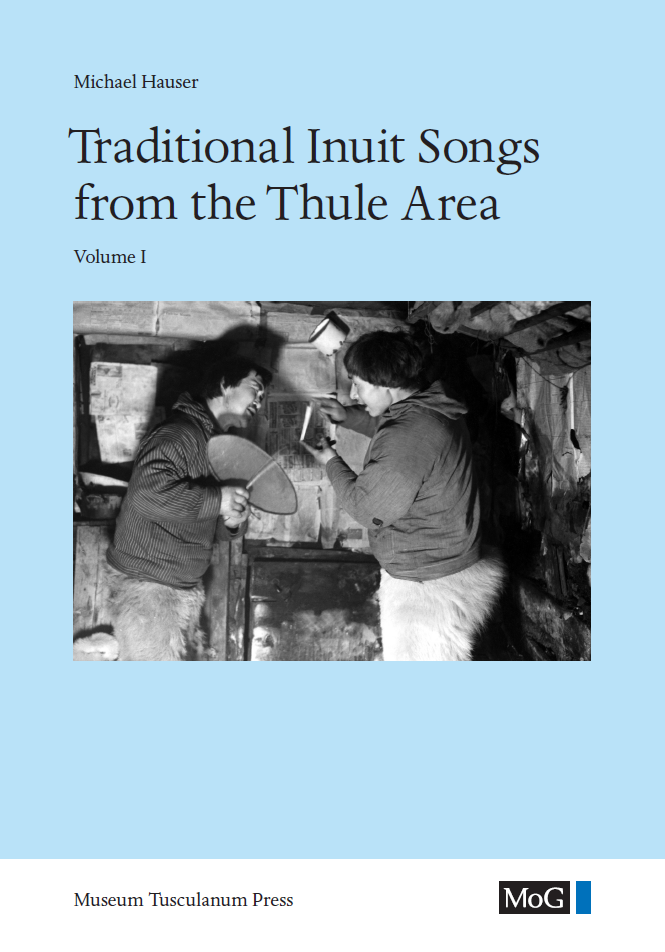
Traditional Inuit songs from the Thule area. Volume 1
DOI:
https://doi.org/10.7146/mog-ms.v36.150183Abstract
This publication deals with the traditional song of the Inuit, primarily Inughuit from the Thule area, but also from Baffin Island and the Copper Inuit and Uummannaq and Upernavik areas, based on sound recordings from 1909, 1912, 1915, 1937, 1962 and 1984.
In 1937 Professor Erik Holtved (1899-1981) recorded 134 traditional songs: no drum-songs and 24 other songs. Transcriptions and scientific processing of this collection is the nucleus of this work. The songs are presented/notated in their full length - with drum accompaniment and the texts/ singing syllables used - but also with analyses of a representative stanza from each song. The vast majority of Holtved's informants sang long songs in a dominating form type, where certain motifs had to be used in specific positions in the course of the stanza.
The present author recorded approximately 350 songs in 1962 in collaboration with the eskimologist Bent Jensen and approximately 240 in 1984 in collaboration with the artist Pauline Motzfeldt Lumholt, also in the Thule area. Both collections were recorded for the Danish Folklore Archives. The 1962 collection has been transcribed and analysed in the same way as the 1937 collection, and other form types were found. One of the "new" form types was particularly easy to recognise, as the first motif in each stanza was repeated at a lower level. The informants of this form type were to a large extent descendants of people who had emigrated from Baffin Island in the 1860s. A frequent occurrence of the same characteristic was found in a collection of 45 songs from southern Baffin Island, indicating that the nucleus of the immigrant group of the 1860s had its roots in southern Baffin Island. This is confirmed by language studies and by genealogy.
The most complicated and dominating form type found in the music of the Inughuit was also found in sound recordings made in 1914-16 with the Qitiqmiut, Copper Inuit. Both partial and close similarities indicated that the type was introduced by families coming from the Copper Inuit area(s). This is confirmed by archaeological finds and language studies.
Old collections from the Uummannaq and Upernavik areas were also transcribed and analysed. These songs have only basic motifs in common with those of the Thule area. The song tradition, the performance of the songs as they were sung in 1962 and 1984, and the predominant soloist performance are described, as well as the song texts, the drum with its construction and use, movement patterns during the drum-dance and the difficult interplay between singing and drumming.
A CD with a selection of the songs is enclosed with the publication.
Downloads
Published
Issue
Section
License
Coypyright by the authors and the Commision for Scientific Research in Greenland / Danish Polar Center/Museum Tusculanum Press as indicated in the individual volumes. No parts of the publications may be reproduced in any form without the written permission by the copyright owners.
