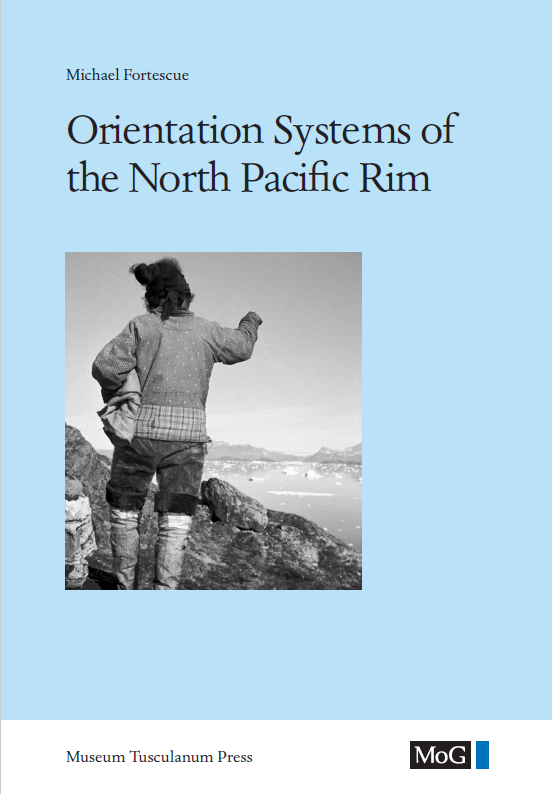
Orientation systems of the North Pacific Rim
DOI:
https://doi.org/10.7146/mog-ms.v42.150097Abstract
Orientation Systems of the North Pacific Rim is an extension of the author’s earlier volume Eskimo Orientation Systems (also published in the series Monographs on Greenland | Meddelelser om Grønland, Man & Society, 1988). This time it covers all the contiguous languages – and cultures – across the northern Pacific rim from Vancouver Island in Canada to Hokkaido in northern Japan, plus the adjacent Arctic coasts of Alaska and Chukotka. These form a testing ground for recent theories concerning the nature and classification of orientation systems and their shared ‘frames of reference’, in particular the many varieties of ‘landmark’ systems typifying the Arctic and sub-Arctic.
Despite the wide variety of languages spoken here (all of them endangered), there is much in common as regards their overlapping geographical settings and the ways in which terms for orientation within the microcosm (the house) and within the macrocosm (the surrounding environment) mesh throughout the region. This is illustrated with numerous maps and diagrams, from both coastal and inland sites.
Attention is paid to ambiguities and anomalies within the systems revealed by the data, as these may be clues to pre-historic movements of the populations concerned – from a riverine setting to the coast, from the coast to inland, or more complex successive displacements. Cultural factors over and beyond environmental determinism are discussed within this broad context.
Downloads
Published
Issue
Section
License
Coypyright by the authors and the Commision for Scientific Research in Greenland / Danish Polar Center/Museum Tusculanum Press as indicated in the individual volumes. No parts of the publications may be reproduced in any form without the written permission by the copyright owners.
