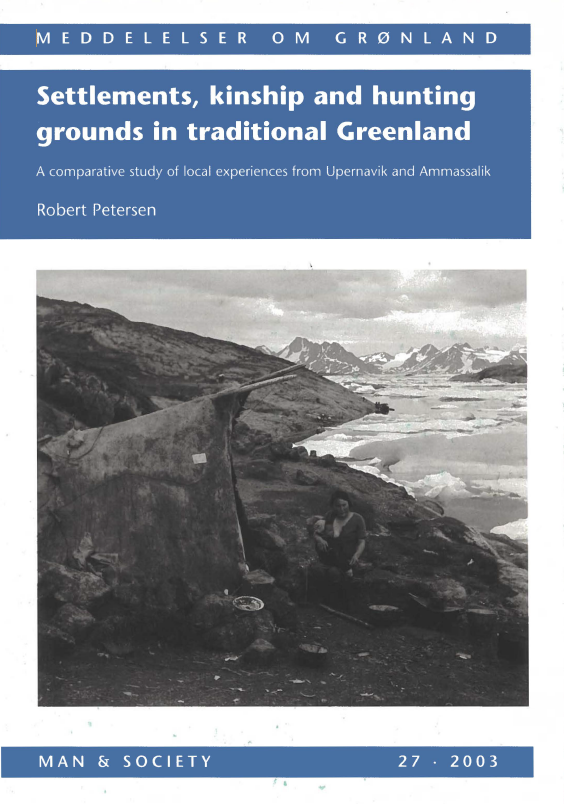
Settlements, kinship and hunting grounds in traditional Greenland. A comparative study of local experiences from Upernavik and Ammassalik
DOI:
https://doi.org/10.7146/mog-ms.v27.147013Abstract
Settlements, kinship and hunting grounds in traditional Greenland is a comparative study of the geographical mobility of hunters in the Upernavik and Ammassalik districts.
The periods dealt with are c. 1860 to 1970 for the Upernavik district and 1894 to 1970 for the Ammassalik district.
On the basis of the experiences of local hunters themselves, the study shows how kinship and social organization are important factors for the description of settlement patterns. When one compares the two districts, one finds that the strategies chosen and the results of expansion differ.
Social organization, economic solidarity and traditional rights of use are evaluated against the background of the incest prohibition and exchanges of knowledge.
The size of the hunting area of one local community is estimated, allowing for increases in population and the effect of bad hunting years, two factors crucial to the expansion of the hunting areas. The role of pioneers in the expansion process is described.
In the final chapters, the economy of hunting communities as part of modern Greenlandic society is studied. The economic status of the hunting communities as supplemented by wage income seems to be equivalent to that of the true hunting society,
but is controversial as compared with similar present-day communities. The economic situation in the 1990s is discussed for both areas.
Downloads
Published
Issue
Section
License
Coypyright by the authors and the Commision for Scientific Research in Greenland / Danish Polar Center/Museum Tusculanum Press as indicated in the individual volumes. No parts of the publications may be reproduced in any form without the written permission by the copyright owners.
