Hunting, fishing and animal husbandry at The Farm Beneath The Sand, western Greenland
An archaeozoological analysis of a Norse farm in the Western Settlement
DOI:
https://doi.org/10.7146/mog-ms.v28.146800Abstract
A large and generally well preserved sample of animal bones was excavated at "The Farm Beneath The Sand" (Gården under Sandet, GUS) in the Norse Western Settlement in Greenland. The sample represents the entire period of occupation, from ea. AD 1000-1400 and could be divided into three time phases, allowing analysis of changes in the economy of the farm. A total of 8,250 bone fragments, from at least 36 species of fish, birds and mammals, were identified.
The 166 fish bones from GUS constitute the hitherto largest sample from a Norse site in Greenland. The generally poor state of preservation of the fish bones, in combination with the fact that fish bones were only found in sieved
samples, indicate that fishing may have played a larger role than the sheer number of fish bones indicates. The majority of the fish bones are from Arctic char (Salvelinus alpinus), followed by cod (Gadus morhua) and capelin (Ma/lotus villosus).
The material of bird bones is strongly dominated by ptarmigan (Lagopus mutus), but there are also bones of, e.g., geese, auks, whooper swan (Cygnus cygnus), mallard (Anas platyrhynchos) and eider (Somateria mollissima).
Remains of wings of White-tailed eagle (Haliaeetus albicilla) and a goose were found.
The GUS people exploited the wild mammal fauna but also kept domestic animals. Bones of seals numerically dominate the mammal bone material. Reindeer (Rangifer tarandus) was also important, and Arctic hare (Lepus
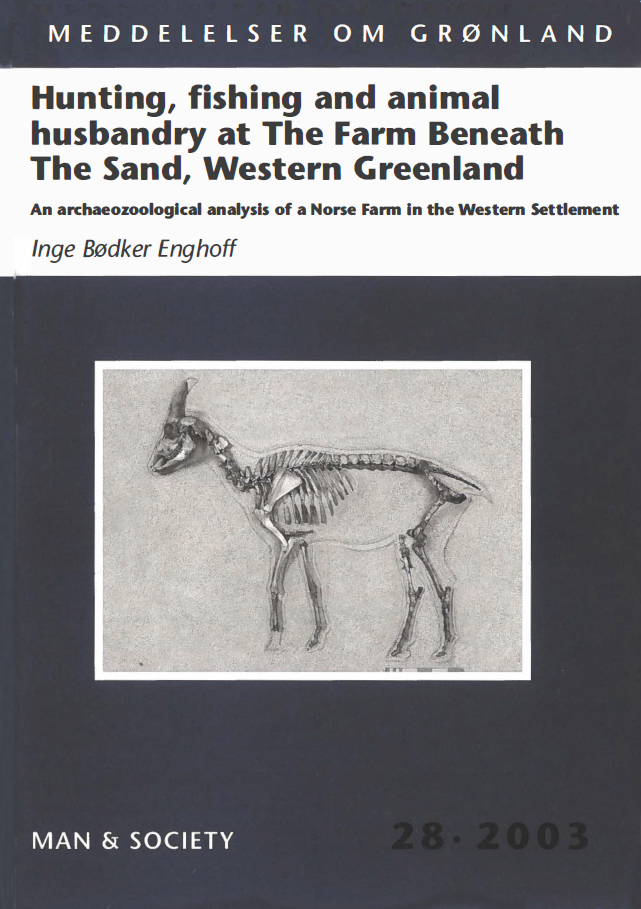
arcticus) was a smaller but constant element. Second in numerical importance among the mammals is sheep+goat which strongly dominate among the domestic animals. Right from the first time phase, the number of goats (Capra hircus) almost equals that of sheep (Ovis aries). The find of a complete goat skeleton is of particular interest. Cattle (Bos taurus) was also kept at GUS, whereas the find of only a single bone of swine (Sus domesticus) does not prove pig husbandry. Measurements of metacarpal and metatarsal bones indicate that sheep, goats and cattle were small and stout. Age estimates based on, i.a., tooth eruption and wear patterns indicate that cattle were kept mainly to provide milk. For sheep and goats, a more mixed exploitation is indicated, however, with the main emphasis on meat production.
There are several indications of temporal changes in the economy of GUS: The exploitation of seals increases, and while common seal (Phoca vitulina) dominates the first phases, there is a change towards dominance of harp seal
(Phom groenlandirn) in the later phase. The exploitation of reindeer decreases, sheep and goat become slightly more numerous, and cattle becomes scarcer.
GUS was an inland farm, and its overall economy seems to have been strongly based on exploitation of the inland fauna: hunting of ptarmigan, geese, reindeer and hare; seals brought in from nearby breeding grounds; fishing for char, maybe at the mouth of the river in the nearby fjord. Hunting and fishing was combined with animal husbandry dominated by sheep and goats, and with a little cattle. Excursions must have been made to the seacoast
to obtain harp seals and walruses (Odoben11s rosmarus). Throughout the period of occupation the relation between bone fragments of wild and domestic mammals was ea. 1:1, whereas the animal food gradually became more dominated by marine species: in phase 1, 29% of the fragments are from marine species, versus 44% in phase 3.
A fair number of bones from horses and a skull and mandibles from greyhound-type dogs indicate that the farm had a certain level of status.
Downloads
Published
Issue
Section
License
Coypyright by the authors and the Commision for Scientific Research in Greenland / Danish Polar Center/Museum Tusculanum Press as indicated in the individual volumes. No parts of the publications may be reproduced in any form without the written permission by the copyright owners.
