
Publiceret 15.12.1990
Citation/Eksport
Copyright (c) 2025 Tidsskriftet Kirkehistoriske Samlinger

Dette værk er under følgende licens Creative Commons Navngivelse – Ingen bearbejdelser (by-nd).
Resumé
At the end of the south transept of Ribe Cathedral we find the so-called »Kathovedd0r« (Cat’s head doorway«), but the »cat’s head« - part of an exquisite door knocker -is, in fact, a bronze lion’s head. The carved tympanum shows a Descent from the Cross (dat.app. 1125-50). The relief is one of Denmark’s oldest and finest examples of granite sculpture and has, together with the triangular top relief (dat. app. 1200-50)
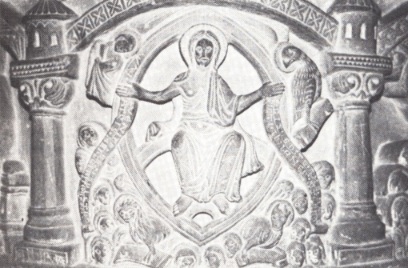
Fig. 4. Døbefont 1129, Freckenhorst. Dommedag. Foto: Bodil Franck.
completing the door case, claimed the attention of scholars throughout the ages. Dating problems and difficulties in placing it stylistically, but particularly motif and inscription interpretation, have been constant sources of debate and dispute. Thus the tympanum inscription has so far been regarded as »enigmatic«. Its text has been interpreted as reading: »rex obit, hie plorat, carus dolet, impius orat« - meaning the King (Christ) dies, she (Mary) weeps, the dear one (John) suffers, the infidel (?) prays. The problem is that nobody knows for certain who »the infidel« is, the word having been associated with Nicodemus, Adam, Longinus and others. In the top relief we see a multitude of heads, men and women, crowned and uncrowned, raising their faces and imploring hands towards Mary and Christ enthroned in the centre. The elegantly draped stoles of two large angels flank the centre piece above Christ and Mary, bearing the carved inscription »Civitas Hierusalem« (Heavenly Jerusalem). Other angels wear long stoles inscribed with passages from the Old and New Testaments. The left-hand side reads: »Beati pauperes ...« a quotation from the Sermon on the Mount (Matthew 5,3) and the right-hand side: »Venite ascendam ad Montem Dei ...«, a quotation from either Isaiah (2,3) or Micah (4,2), both versions being more or less identical. One widely accepted interpretation (1972) suggests that there is no connection between the top relief and the Descent from the Cross, but that very likely it is an epitaph commemorating named members of royalty who meet other departed souls in »Civitas Hierusalem«. Other scholars have submitted that the placing (although 100 years later) of the triangular relief signified further confirmation of the salvation found in the sacrificial death of Christ.
Personally, I do not subscribe to the idea of seeing it as an epitaph, since in those times it was not customary to place epitaphs over a church portal, the religious message being the all-important thing. I am also convinced that the triangular relief with its »Civitas Hierusalem« inscription commemorating Christ’s sacrifice was placed there quite deliberately - not illustrated by a Crucifixion, but again quite deliberately by a Descent from the Cross. So far scholars have not focussed too much attention on this motif, the general view being that it was of no liturgical importance. That, however, is not the case. On the contrary, the Descent from the Cross was by certain 12th-century theologians regarded as the most important Eucharistic symbol, an assumption based on the Mass liturgy of the Carolingian theologian Amalarius of Metz, in which the Consecration is linked to the Descent from the Cross. The meaning of the motif is essential, too, in connection with the liturgical Depositio drama performed within the framework of the Good Friday liturgy. The drama springs from the East, but in its Western form it is thought to be rooted in the Mass interpretation of Amalarius. Along with the Easter Depositio drama other ceremonies - christening and penance - occurred, too. I therefore interpret the Latin »impius« in this context as meaning »sinful«, - thus associating it with the penitents. Good Friday was one of the most strictly observed days of the time of fasting, when those fasting wholly identified themselves with the suffering Christ and vigorously asked forgiveness for their sins. In this week of sorrow (the period from Palm Sunday to Easter Sunday) believers were thought to be excluded from Heavenly Jerusalem and admonished to live in such a way that sorrow might turn to joy through the Resurrection of Christ and they might all return to »Civitas Hierusalem«. Thus we have established a clear connection between the tympanum (Good Friday) and the triangular relief (Easter Morning). The top relief inscriptions also corroborate such a theory. In the Sermon on the Mount Christ teaches us to behave properly and obey God’s will if we are ever to enter His kingdom, and Isaiah tells us of sinful Jerusalem which is to be punished by divine judgment and later to rise again as a righteous city to which the heathens will flock to share the blessing of the Lord.